
Viral in the US: group empties entire Halloween candy bucket
A viral video shows a group emptying an entire Halloween candy bucket in the US. The stunt reopens the debate over trust and civility in the tradition of leaving candy out.
English · Original discussion in Spanish · Published
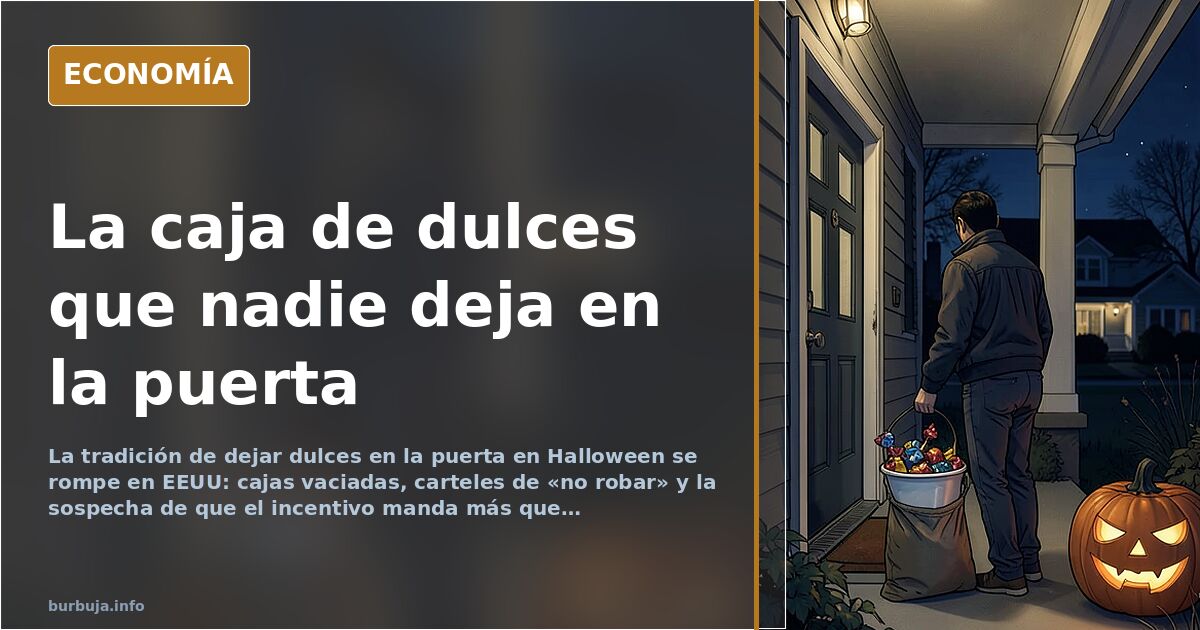
Why the Halloween candy bucket is no longer left on the porch in the US
The tradition of leaving a bag of candy on the porch for kids to help themselves is fading in the US. A viral Halloween video shows a group emptying an entire bucket of candy in one go while the camera rolls, and the stunt has peine the old debate over trust, civility and the cost of the holiday. The scene is simple: someone puts out treats, someone wipes them out. What's being discussed is what breaks when something breaks.
The tipped bucket and the camera recording it
The footage circulating shows a group of kids pouring the contents of one bag into another and running off with the loot. The scene, filmed and shared, is what has ignited the conversation: an entire bucket disappears in seconds. Some read it as a neighborhood anecdote, others turn it into a symptom. The discussion splits in two: those who claim the holiday has gone downhill, and those who point out that the video smells staged.
"If it were real, they would have taken the cauldrons and the skeleton too", sums up one of the skeptical arguments. Suspicion of staging runs through much of the conversation: too perfect, too well filmed. But the anecdote still works as a trigger.
From door-to-door "trick or treat" to the abandoned bucket
The classic model was different. A childhood memory from Michigan describes it precisely: you knocked on the door, shouted the phrase, and the owner handed over the candy in person, with the basket kept inside the house. Handing it over in person was the system. Leaving the bag on the porch is a recent mutation, convenient for the person giving out candy and risky for anyone who trusts.
The diagnosis repeated most often in the conversation is trust: it works as long as the neighborhood shares the same codes, and it cracks when someone exploits that trust to take everything. The person who puts out candy is seen as a fool, one jokes; the one who grabs it shamelessly, as clever. That's the crux.
The solutions circulating: laxatives, bad candy and surveillance
The conversation fills up with home remedies. One: put out the cheap candy first and the good stuff later, once the swarm has passed. Another: wait at the door and hand it over in person. And the most repeated one, half in jest and half not: mix a laxative into the treats and let the clever ones learn their lesson in the bathroom.
"That's done with castor oil", another chimes in. These are dinner-table quips, not serious proposals, but they capture the mood: a desire to strike back without leaving the couch.
What the joke costs
In economic terms, the holiday rests on a small expense per household that becomes unsustainable if the whole thing disappears every year. The person handing out candy pays twice: the bag, and the feeling of having been played for a fool. That's where the cost-benefit calculation comes in that explains why many neighbors are switching back to door-to-door handing or simply turning off the lights.
The social consequence is the usual one: where oversight relaxes, petty thievery rises. And where petty thievery rises, those who played by the rules withdraw. The tradition doesn't die from lack of willingness; it dies from lack of trust.
The backdrop nobody wants in the headline
Much of the material drifts into identity territory, with generalizations about groups that this outlet does not reproduce. What's relevant to the matter is more prosaic: the holiday depends on a civility that cannot be imposed. When it breaks, those who trusted change their behavior. And the change in behavior is what kills the custom.
The video will keep circulating. The bag on the porch, probably, less and less. Given all this, one can expect handing out in person to return as the norm in neighborhoods where trust has broken down — though, judging by how things go, I wouldn't bet much on it lasting everywhere.
Summary of a discussion on Burbuja.info - Foro de economía, actualidad y política., translated from Spanish and reviewed before publication. Read the full discussion (117 replies).
More summaries
-
Halloween in Spain: fewer kids in costume, fewer sweets
Residents report fewer costumed children and doorbells that never rang; some blame the mourning after the train crash and the cost-of-living crisis.
-
Ayuso parade video sparks debate over misinformation and footwear
A video of Madrid President Ayuso walking during the Hispanidad parade has triggered intense online debate involving claims of manipulation and misinformation.
-
Sánchez denies link to Koldo case arrests
Spanish PM Pedro Sánchez states new arrests in the Koldo corruption probe have no connection to him, though investigations reach his inner circle.
-
Body Positivity Influencer Celebrates Texas Democratic Win From Sofa
A viral tweet shows a body positivity influencer celebrating the Democratic victory in Texas without leaving her couch, sparking debate on political discourse.
-
Spain Health Campaign Links Care to Residency
Spain's Ministry of Health launches a campaign asserting healthcare access based on residency, sparking debate over its scope and message.
-
Vasectomy, Inheritance, and a Son: The Unexpected Twist
A vasectomy case involving a much younger partner raises questions about inheritance security, medical reversibility, and financial motives.