
Viral Child Drawing Sparks Debate in Spain
A drawing attributed to a 7-year-old boy generated 120 forum responses. The author's age remains unverified, fueling suspicions of political manipulation.
English · Original discussion in Spanish · Published
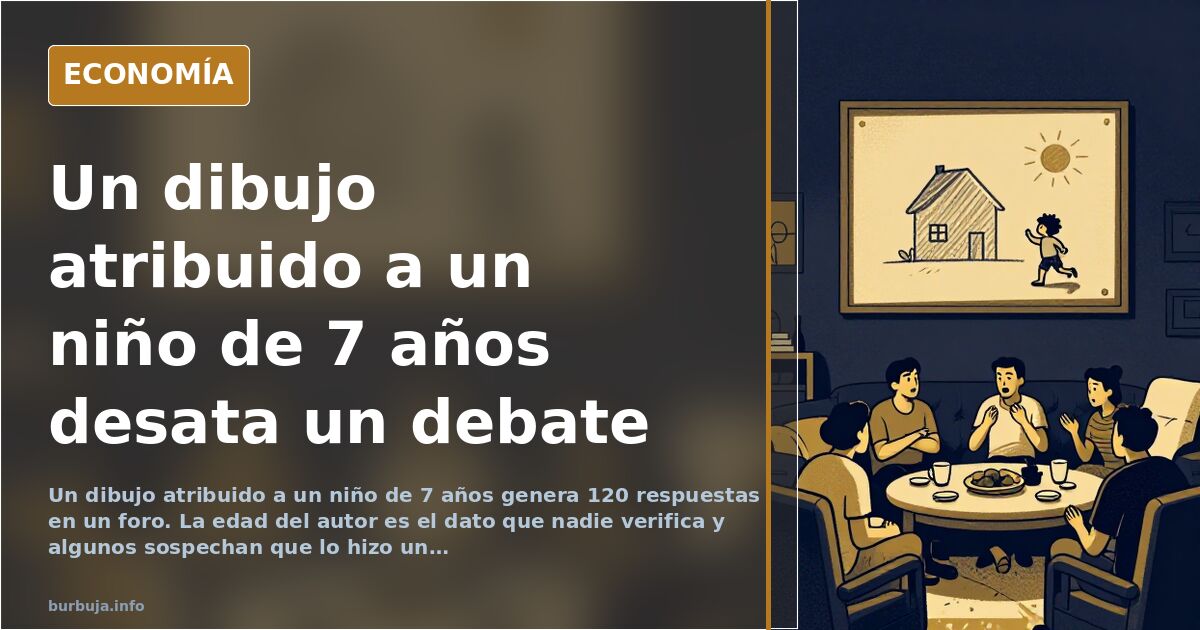
Viral Child Drawing Sparks Debate in Spain
A sheet of paper antiestéticaturing a crudely drawn figure, the Venezuelan flag, and exaggerated anatomy has fueled a 120-response discussion spanning 783 days in an Economics subforum. The alleged creator: a 7-year-old child. The first reply already casts doubt: "At 7, I couldn't have drawn that penis on that feminist Nancy." From there, the issue evolves into something more interesting than the drawing itself: the impossibility of verifying authorship, suspicions of a false flag operation, and the political use of childhood as an argumentative shield.
Why is it doubted that a 7-year-old drew it?
The technical objection is the most repeated. One participant notes that a "first-grade student" lacks the manual dexterity to trace such anatomy with that confidence. Another adds that "children never lie," in an ironic twist that summarizes the trap: if the kid says he did it, which adult will call him a liar? The problem is that the drawing doesn't stand up as proof of anything. The author's age is the only accepted fact, yet even that cannot be verified.
Some go further, arguing an adult made it. "You drew that with the marker box El Perro lent you, and 'seven years old' is your mental age," they snap at the poster. The accusation is unverifiable but circulates with the same naturalness as the defense.
False flag theory and political use of the drawing
The drawing isn't neutral. It includes the Venezuelan flag with all its stars and a character whose antiestéticatures the thread associates with a specific leader. This led several participants to read it as a montage. "Podemos-style false flag," one concludes. "Chepas appears, along with the transvestite's huge cock: those scum's favorite fetishes." The theory lacks proof but fits the general tone: the drawing isn't discussed as childish expression, but as a political artifact.
The discussion then shifts to children's role in political discourse. One participant argues "children absorb what they see at home very well." Another replies that "seven-year-olds have no concern for society or its political troubles," but that "70-80% of kids aged 12-17" he knows "openly show a clear right-wing tendency." Childhood thus becomes a battlefield where each side projects its own antiestéticars.
From anecdote to clash of narratives about childhood
The drawing is just the excuse. What's debated is whether a 7-year-old can have political awareness, if they do, in which direction, and what that says about the country. One participant summarizes mockingly: "At 7, I was toca. You surely didn't start until 16." The provocation doesn't seek to convince, but to deactivate the opposing argument by ridiculing it.
Others bring the issue to generational grounds. "You guys are turning out fascist without remedy," one asserts, attributing the phenomenon to teenage rebellion against "the leftist society they grew up in." The thesis lacks data but connects with real concern: the political gap between generations and the feeling that the official narrative fails among the young.
The drawing as symptom of broader debate
The drawing case intersects with other topics in the discussion: immigration, security, public spending. One participant warns that "when thugs stab his child three times and his mother beats her father while Abaas Khal talks about expanding welfare, he'll understand his savior is among the bad guys." The phrase mixes threat, violence, and politics in one paragraph. It's not an argument; it's a slogan.
On the opposite side, another responds with political calculation: "Your Pharisee Jew's party wants to cram this country with more North African immigrants than all pesetas combined in history." Insults replace data. The discussion degrades but reveals the core: the drawing activated a repertoire of grievances unrelated to the artwork.
What can be concluded from the case?
Little and much at once. Little, because there's no way to verify who drew what or with what intent. Much, because the episode shows how a trivial object can become a battlefield projecting current political tensions. The drawing doesn't matter. What matters is what each side believes it signifies.
The unanswered question is the most obvious: if a 7-year-old made it, why hasn't anyone shown a photo of the child holding the paper? If an adult did, why hasn't anyone claimed authorship? Silence, in this case, is the only verifiable data.
Also available in: Deutsch
Summary of a discussion on Burbuja.info - Foro de economía, actualidad y política., translated from Spanish and reviewed before publication. Read the full discussion (120 replies).
More summaries
-
Puente and the racial slur: Spain's PSOE faces its own banners
Spanish Socialist minister Óscar Puente sparks controversy with a racial slur aimed at Alvise and Abascal. The PSOE and its anti-hate rhetoric face an uncomfortable mirror.
-
LaSexta deletes tweet concerning masked individuals in Ceuta
LaSexta removes the tweet regarding masked figures in Ceuta amid growing, unsubstantiated 'false flag' claims. The original content remains on their website.
-
Spain's Aznar-Bush Pact Theory Links US Units to 11-M Attacks
A conspiracy theory attributes the 2004 Madrid bombings to a US unit protected by a 2001 pact, citing a coincidental victim count.
-
Bukele challenges France: 'I could save it in a week'
Nayib Bukele claims El Salvador overcame 'a problem a hundred times worse' than France's and could save it in a week. The debate over his model and its cost is reigniting.
-
Too Many Life Options vs the Quiet Certainty of Choosing Right in Scarcity
An abundance of life options does not guarantee a better choice. In scarcity, a Sabina record was enough to feel sure you had chosen right. Come in and compare.
-
Galicia sells off its industry: from Avícola Tratante to Aludec
Avícola Tratante, Aludec, Ochoa, Martínez Otero: foreign capital is buying up Galician companies; forum users point to the lack of generational succession