
Viral Bus Video Shows Passenger Restraining Man with Chokehold
A viral video shows a passenger restraining a disruptive man on a bus using a chokehold, reigniting debate about citizen justice.
English · Original discussion in Spanish · Published
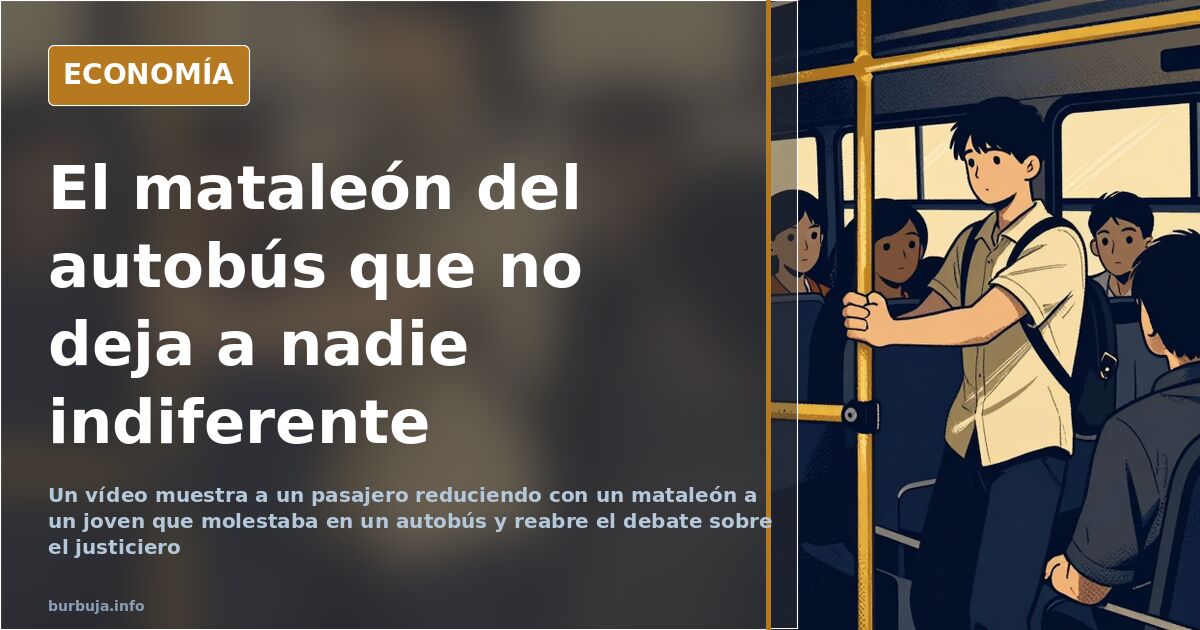
Chokehold on the Bus: Viral Video and Citizen Justice Debate
What happens when one traveler becomes a problem and another decides to handle it personally? A video circulating on social media shows a young man disturbing other bus passengers and a man subduing him with a rear naked choke—known as a mataleón—until he is immobilized. The clip lasts only seconds and lacks clear audio, yet it has reached thousands of screens, leaving behind a trail of uncomfortable questions.
Two things should be established from the start. First: the video does not reveal what peine beforehand. Second: in that gap, people project their own narratives.
Where Did the Bus Chokehold Incident Occur?
The first dispute is geographical. Some claim the scene is not in Spain and that the language heard is not Spanish; others point to French and place the episode outside national borders. Even the protagonist's nationality is debated: he is attributed Romanian origins without speaking that language, turning this detail into a rushed label.
This detail matters because it changes the legal framework. A struggle on a Spanish transport network differs from one in another country with different rules on use of force. Could it simply be an out-of-context fragment?
The Mataleón: Equally Effective and Risky
The rear chokehold commands great respect. It cuts off air within seconds but can also end badly: one second too long turns a scare into serious injury. The person applying it assumes responsibility if they maintain it after the subject is contained.
The video itself invited criticism. Some argue the passenger released him too soon, while others believe releasing him just in time proves competence. The line between containment and excess is finer than it appears from afar.
Can Private Citizens Detain Disruptive Passengers?
Here consensus collapses. One group defends anyone's right to repel those disrupting order and detain them until police arrive, envisioning scenarios where defenders face charges while instigators walk free. Another reminds us this isn't vigilante territory: private force has strict limits, and excesses can lead to court.
A recurring antiestéticar lingers: that any intervention results in lawsuits, turning interveners into suspects. This anxiety resurfaces whenever shared space safety is discussed. Underlying it is suspicion that the law treats disruptors gently while scrutinizing those who stand up.
The Bus as a Mirror of Coexistence
Beyond this specific case, the incident serves as a social thermometer. Buses are among few places where strangers share tight spaces, where friction explodes instantly. That most reactions involve filming rather than mediating says as much about the event as about observers.
Some see proof we've lost ability to calm tensions peacefully. Others believe the video reveals nothing new: just another altercation amplified by social media. Between these views lies an uncomfortable certainty: almost no one disputes facts because almost no one knows them.
Three certainties remain alongside one doubt. A young man ended up restrained, a passenger demonstrated restraint technique, and nearly everyone disagrees on which country this occurred. The persistent question remains: how would opinions shift if the restrained person were family? Surely then analysis would have been far more nuanced.
Also available in: Deutsch
Summary of a discussion on Burbuja.info - Foro de economía, actualidad y política., translated from Spanish and reviewed before publication. Read the full discussion (131 replies).
More summaries
-
Cultural clash on public transport: civilization or barbarism?
Debate on Burbuja about the degradation of public spaces and the cultural clash between Japanese order and the Hispanic American reality.
-
Citizen Autotutela and the Perceived Collapse of Public Order in Spain
Analysis of citizen autotutela in Spain amid state inaction and the perceived collapse of public order.
-
DGT: City Centers Accessible Only by Public Transport
The DGT believes city centers should be reached by public transport, taxi, or ride-sharing platforms, as electric cars do not solve congestion.
-
El Jueves targets corruption with a lineup of the usual suspects
El Jueves publishes a corruption-themed cover with eleven figures: mostly PP and two from PSOE. Criticism over imbalance and omissions.
-
Spanish employment lawyer warns: never flatly refuse your boss's orders
Spanish employment lawyer Ignacio de la Calzada warns that refusing a work order outright can cost you your job. He explains how to document health problems instead.
-
The Great Replacement theory is a nationalist conspiracy, London analysis shows
The portrayal of London as "hell" is tied to the "Great Replacement" conspiracy theory. What lies behind it?