
DGT: City Centers Accessible Only by Public Transport
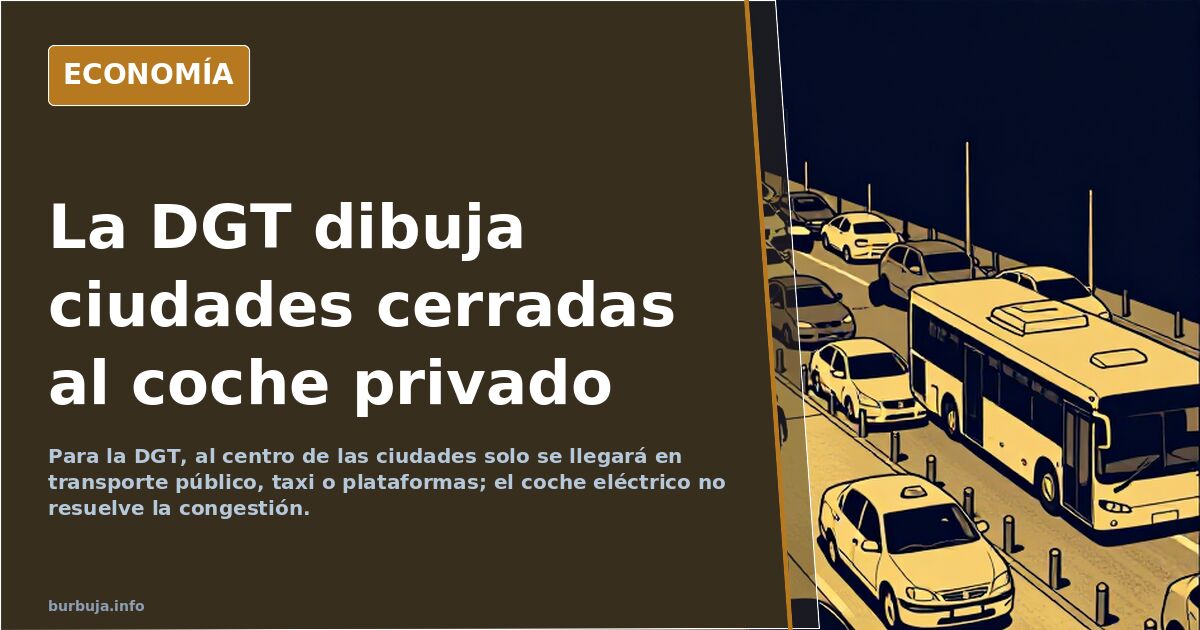
The DGT believes city centers should be reached by public transport, taxi, or ride-sharing platforms, as electric cars do not solve congestion.
English · Original discussion in Spanish · Published
DGT: City Centers Accessible Only by Public Transport
Can city centers be car-free without dismantling half the economy? The Directorate-General for Traffic (DGT) has already outlined its vision, leaving little room for interpretation: urban centers are to be reached by public transport. If you're in a hurry, take a taxi or a ride-sharing service. Private cars, whether electric or combustion, are surplus.
These statements come from the head of the agency, Pere Navarro, and were disseminated with material from the department itself: 'The model we all aspire to is, "go to the city center by public transport."' He added that, if in a hurry, one should take a taxi or a ride-sharing service, 'but not their own car.' The underlying idea is not new, but the bluntness is: the private vehicle is no longer the default mode of transport but a tolerated exception.
Electric Cars Don't Solve Congestion
'The problem is space,' Navarro insisted. 'What we don't want are cars in the city center. We don't want to fill it with electric cars and have the congestion problem again, but this time with electric cars.' This statement challenges the narrative of the last decade, when electrification was promoted as the way to maintain road access. If the limit is square meters, not emissions, the engine technology is irrelevant.
Some see this as a mid-game rule change: first, those who bought electric cars were rewarded with labels and advantages, and now they are warned that even these cars won't have free rein. The argument is that the measure devalues the asset, as a vehicle designed for city driving loses much of its utility if it cannot enter the city. Prohibiting before providing alternatives is not planning; it's faith.
Public Transport That Can't Handle More
Madrid boasts nearly all-electric buses and a metro system renowned for its exemplary service. The problem is capacity. Some argue that the same schedules and frequencies as fifteen years ago are maintained for a significantly larger population, with demand that didn't exist before, and no material margin to fit more passengers per vehicle. When the system is full, restricting cars doesn't move passengers; it crowds them.
Part of the analysis suggests the model broke when the network stopped being a local service—stops every 500 meters, a five-minute walk—and expanded towards a commuter rail scheme, with long journeys, transfers, and stations designed to capture the metropolitan area. From the furthest stops, thirty minutes was reasonable; now it's a gamble. And investment is going elsewhere: 'Paris has a huge plan underway to expand its metro and RER, here it's zero.'
Entry Tolls, Industrial Estates, and Freight: The Fine Print
The detail no one showed is where the restrictions begin. A participant recounts that in an industrial estate twelve kilometers in a straight line from the center of Madrid, with vacant lots around and six-axle trucks entering to load, there is already signage limiting circulation. The question is obvious: if the truck can't pass, does the merchandise arrive by taxi?
The other aspect is access from outside. Some anticipate a toll for those entering the municipal area with their cars, and others recall that a closed city also requires resolving what happens with peripheral municipalities, where people who later work inside live. The 15-minute city is already appearing in the debate, pointed out by a participant as the approaching horizon, for better or worse.
While decisions are being made, the official solution for the hurried citizen is a taxi, an Uber, or a Cabify. That is, the same car, with a different license plate and a different bill. More expensive, though.
Can city centers be car-free without dismantling half the economy? The Directorate-General for Traffic (DGT) has already outlined its vision, leaving little room for interpretation: urban centers are to be reached by public transport. If you're in a hurry, take a taxi or a ride-sharing service. Private cars, whether electric or combustion, are surplus.
These statements come from the head of the agency, Pere Navarro, and were disseminated with material from the department itself: 'The model we all aspire to is, "go to the city center by public transport."' He added that, if in a hurry, one should take a taxi or a ride-sharing service, 'but not their own car.' The underlying idea is not new, but the bluntness is: the private vehicle is no longer the default mode of transport but a tolerated exception.
Electric Cars Don't Solve Congestion
'The problem is space,' Navarro insisted. 'What we don't want are cars in the city center. We don't want to fill it with electric cars and have the congestion problem again, but this time with electric cars.' This statement challenges the narrative of the last decade, when electrification was promoted as the way to maintain road access. If the limit is square meters, not emissions, the engine technology is irrelevant.
Some see this as a mid-game rule change: first, those who bought electric cars were rewarded with labels and advantages, and now they are warned that even these cars won't have free rein. The argument is that the measure devalues the asset, as a vehicle designed for city driving loses much of its utility if it cannot enter the city. Prohibiting before providing alternatives is not planning; it's faith.
Public Transport That Can't Handle More
Madrid boasts nearly all-electric buses and a metro system renowned for its exemplary service. The problem is capacity. Some argue that the same schedules and frequencies as fifteen years ago are maintained for a significantly larger population, with demand that didn't exist before, and no material margin to fit more passengers per vehicle. When the system is full, restricting cars doesn't move passengers; it crowds them.
Part of the analysis suggests the model broke when the network stopped being a local service—stops every 500 meters, a five-minute walk—and expanded towards a commuter rail scheme, with long journeys, transfers, and stations designed to capture the metropolitan area. From the furthest stops, thirty minutes was reasonable; now it's a gamble. And investment is going elsewhere: 'Paris has a huge plan underway to expand its metro and RER, here it's zero.'
Entry Tolls, Industrial Estates, and Freight: The Fine Print
The detail no one showed is where the restrictions begin. A participant recounts that in an industrial estate twelve kilometers in a straight line from the center of Madrid, with vacant lots around and six-axle trucks entering to load, there is already signage limiting circulation. The question is obvious: if the truck can't pass, does the merchandise arrive by taxi?
The other aspect is access from outside. Some anticipate a toll for those entering the municipal area with their cars, and others recall that a closed city also requires resolving what happens with peripheral municipalities, where people who later work inside live. The 15-minute city is already appearing in the debate, pointed out by a participant as the approaching horizon, for better or worse.
While decisions are being made, the official solution for the hurried citizen is a taxi, an Uber, or a Cabify. That is, the same car, with a different license plate and a different bill. More expensive, though.
Summary of a discussion on Burbuja.info - Foro de economía, actualidad y política., translated from Spanish and reviewed before publication. Read the full discussion (294 replies).
More summaries
-
Madrid Metro's Green Seats: Reserved, Not Decorative
Users believe Madrid Metro's green seats are reserved spaces, but signage lacks clarity, leading to confusion about their purpose.
-
Córdoba Father Self-Immolates: Mental Illness or Societal Despair?
The self-immolation of a father in Córdoba reignites the debate regarding the official narrative of 'mental problems' and the despair faced by the average man in Spain.
-
Euthanasia in Old Age: Autonomy vs. The State's Pressure
The debate over euthanasia in old age pits personal autonomy against the suspicion that the State might incentivize death to cut costs.
-
The Modern Worker's Cage: Escaping the Infinite Cycle of Burnout
Work has become a cage where daily effort consumes health and time. Discover why we push ourselves so hard and how to break the cycle.
-
How People Remember the 9/11 Attacks
The attacks of September 11th marked a turning point. Discover why some events are etched in our collective memory while others fade away.
-
Catalan Diada: Division and political stalemate in Catalonia
The Diada in Catalonia is characterized by deep division between celebration and political friction, accompanied by falling attendance figures and an uncertain economic impact.