
Video shows Russian agent paying journalist €1,000
A video allegedly showing a Russian agent handing cash to a journalist reignites claims that Moscow buys media influence.
English · Original discussion in Spanish · Published
Video revives claims of Moscow buying journalists
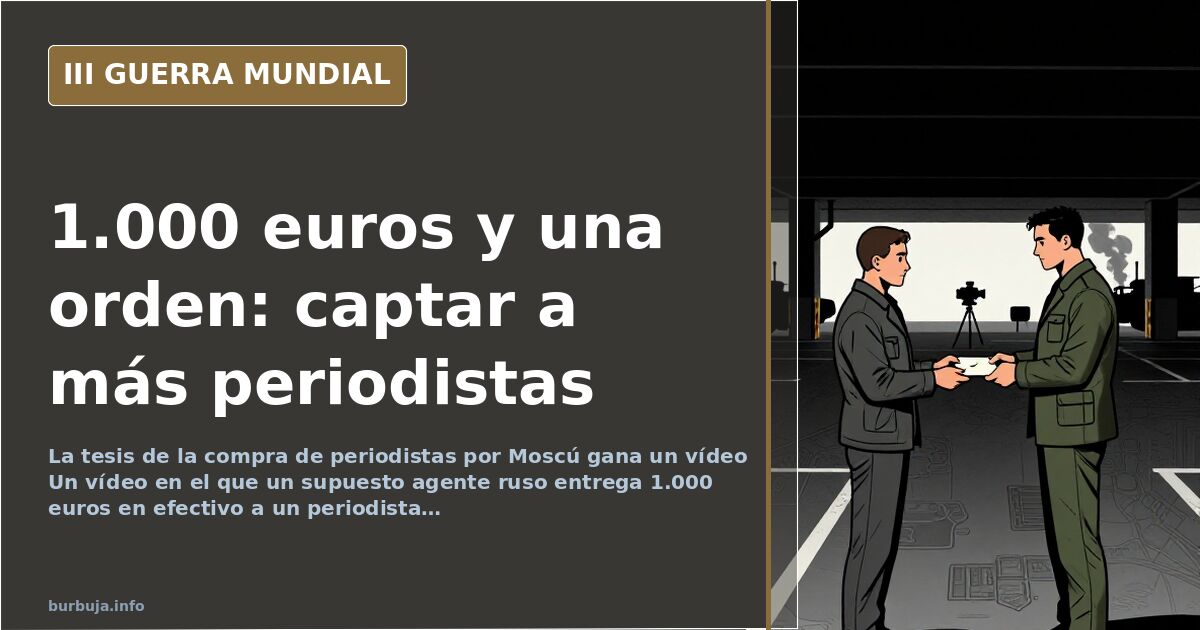
A video in which an alleged Russian agent hands €1,000 in cash to a journalist to start working and, in turn, recruit other collaborators has revived the theory that Moscow buys off journalists. The script accompanying the payment is repetitive: first, bribery ensures the reporter delivers what is desired; then, they are recruited as direct collaborators. A thousand euros do not buy a conscience. They buy the seed of a network.
What the video shows and what is asked in return for the money
In the footage, the intermediary hands over the cash and sets the conditions: one thousand euros to get started. The instruction does not end with the recipient. The journalist must use that amount to buy off other journalists, so the network grows on its own, without each new hire depending on external orders. This has been described as chain subversion: money flows down, and the message flows up.
This scheme explains why the case is read as more than a one-off bribe. No specific news story is paid for: infrastructure is financed. And this infrastructure has a virtue for those who build it. It is cheap, replicable, and leaves no documentary trace beyond physical cash.
How can you detect a journalist on a foreign government's payroll?
There is no public registry of payments from foreign services to reporters, so detection relies on indicators. For one participant, the criterion is textbook: anyone covering a war without mentioning trapped civilians and without calling for an end to the conflict is, at minimum, aligned with someone. He adds that the first thing a reasonable analyst should do is demand the halt of a war initiated by a nuclear power, whether in Iraq or Ukraine, and that those who skip this step and only discuss maps and casualties of the opposing side raise suspicions.
There are biographical indicators. Attention has focused on profiles claiming stable employment in Spain but spending extended periods abroad without their jobs suffering. The most discussed case is that of a content creator who spent virtually all summer in Donbas, with her first video on June 29 and the last on August 25, and who never details how she makes a living. The question is elementary: which Spanish job grants two consecutive months of vacation in summer?
It is worth noting: none of these criteria constitute proof. They are filters of suspicion, and as such, they work better to order the conversation than to close it.
From cash to sponsored content: other payment channels
The envelope of money is the crude form. The subtle one is advertising and favors. Examples cited include image campaigns commissioned by large corporations and agreements with regulated sectors: advertorials for banks, contracts with utility companies, and the entire range of sponsorships and collaborations that do not appear in any public accounting.
Underneath this lies the system's foundation: ownership. Much of the media is controlled by two or three investment funds —the names most frequently mentioned are BlackRock and Vanguard— turning editorial independence into a working hypothesis rather than a starting point. Added to this, according to another line of argument running through the discussion, is the existence of private verification structures operating as an Ministry of Truth validator.
The counterattack: "Americans do it too"
Against the framework of "Russia buys journalists," the symmetric argument is raised. The United States has intervened in wars and toppled governments consistently since the end of World War II, and that list is recited from memory: Korea, Vietnam, Bay of Pigs, Grenada, Panama, Persian Gulf, Bosnia, Afghanistan, Libya, Syria, Yemen, Somalia, Pakistan. To this are added regime changes in Iran, Guatemala, Congo, Dominican Republic, Brazil, or Chile. Since 2001, this current argues, the security war imposed in Europe was not defense: it was business and control. In the enumeration, the March 11 attacks (11M) also appear, with a thesis formulated without evidentiary support: that the attack benefited Washington, not Moscow.
There is also a theory about message coordination. When the same topic appears the same week in the mouths of presenters, comedians, and even a TV chef, the theme ends up imposing itself as if it had sprung from nowhere. Repetition across different channels is, in itself, the message.
A video in which an alleged Russian agent hands €1,000 in cash to a journalist to start working and, in turn, recruit other collaborators has revived the theory that Moscow buys off journalists. The script accompanying the payment is repetitive: first, bribery ensures the reporter delivers what is desired; then, they are recruited as direct collaborators. A thousand euros do not buy a conscience. They buy the seed of a network.
What the video shows and what is asked in return for the money
In the footage, the intermediary hands over the cash and sets the conditions: one thousand euros to get started. The instruction does not end with the recipient. The journalist must use that amount to buy off other journalists, so the network grows on its own, without each new hire depending on external orders. This has been described as chain subversion: money flows down, and the message flows up.
This scheme explains why the case is read as more than a one-off bribe. No specific news story is paid for: infrastructure is financed. And this infrastructure has a virtue for those who build it. It is cheap, replicable, and leaves no documentary trace beyond physical cash.
How can you detect a journalist on a foreign government's payroll?
There is no public registry of payments from foreign services to reporters, so detection relies on indicators. For one participant, the criterion is textbook: anyone covering a war without mentioning trapped civilians and without calling for an end to the conflict is, at minimum, aligned with someone. He adds that the first thing a reasonable analyst should do is demand the halt of a war initiated by a nuclear power, whether in Iraq or Ukraine, and that those who skip this step and only discuss maps and casualties of the opposing side raise suspicions.
There are biographical indicators. Attention has focused on profiles claiming stable employment in Spain but spending extended periods abroad without their jobs suffering. The most discussed case is that of a content creator who spent virtually all summer in Donbas, with her first video on June 29 and the last on August 25, and who never details how she makes a living. The question is elementary: which Spanish job grants two consecutive months of vacation in summer?
It is worth noting: none of these criteria constitute proof. They are filters of suspicion, and as such, they work better to order the conversation than to close it.
From cash to sponsored content: other payment channels
The envelope of money is the crude form. The subtle one is advertising and favors. Examples cited include image campaigns commissioned by large corporations and agreements with regulated sectors: advertorials for banks, contracts with utility companies, and the entire range of sponsorships and collaborations that do not appear in any public accounting.
Underneath this lies the system's foundation: ownership. Much of the media is controlled by two or three investment funds —the names most frequently mentioned are BlackRock and Vanguard— turning editorial independence into a working hypothesis rather than a starting point. Added to this, according to another line of argument running through the discussion, is the existence of private verification structures operating as an Ministry of Truth validator.
The counterattack: "Americans do it too"
Against the framework of "Russia buys journalists," the symmetric argument is raised. The United States has intervened in wars and toppled governments consistently since the end of World War II, and that list is recited from memory: Korea, Vietnam, Bay of Pigs, Grenada, Panama, Persian Gulf, Bosnia, Afghanistan, Libya, Syria, Yemen, Somalia, Pakistan. To this are added regime changes in Iran, Guatemala, Congo, Dominican Republic, Brazil, or Chile. Since 2001, this current argues, the security war imposed in Europe was not defense: it was business and control. In the enumeration, the March 11 attacks (11M) also appear, with a thesis formulated without evidentiary support: that the attack benefited Washington, not Moscow.
There is also a theory about message coordination. When the same topic appears the same week in the mouths of presenters, comedians, and even a TV chef, the theme ends up imposing itself as if it had sprung from nowhere. Repetition across different channels is, in itself, the message.
Also available in: Deutsch
Summary of a discussion on Burbuja.info - Foro de economía, actualidad y política., translated from Spanish and reviewed before publication. Read the full discussion (156 replies).
More summaries
-
Russia bets on attrition and winter in Ukraine
Analysis suggests Russia can outlast sanctions despite 15% inflation and a 10% GDP drop.
-
Russia’s 400,000 casualties: what the obituaries reveal
An independent count of Russian obituaries records 43,460 deaths and 6,400 tanks lost, while the unverified 400,000 casualty figure circulates widely.
-
Russia demands gas payments in rubles; Europe continues paying in euros
Russian decree requires opening ruble accounts for gas purchases from April 1. Euro payments are converted via Gazprombank.
-
Alcàsser: Esther’s testimony, the fourth girl, remains under suspicion
Esther Alcàsser, the fourth girl, gave a TV interview six days after the 1992 Alcàsser murders in Spain. Her account and timeline discrepancies fuel ongoing controversy.
-
Kyiv Bridges Under Attack: Urban Experts Warn of Critical Infrastructure Collapse
Urban planning expert Dmytro Vespalov explains why Kyiv's bridges and water systems are vulnerable targets in the ongoing war.
-
Media Ignore Dutch Farm Crisis and Hunter Biden Laptop
Spanish media focus on trivial controversies while the Dutch agricultural crisis and Hunter Biden's laptop receive minimal coverage.