
Russia’s 400,000 casualties: what the obituaries reveal
An independent count of Russian obituaries records 43,460 deaths and 6,400 tanks lost, while the unverified 400,000 casualty figure circulates widely.
English · Original discussion in Spanish · Published
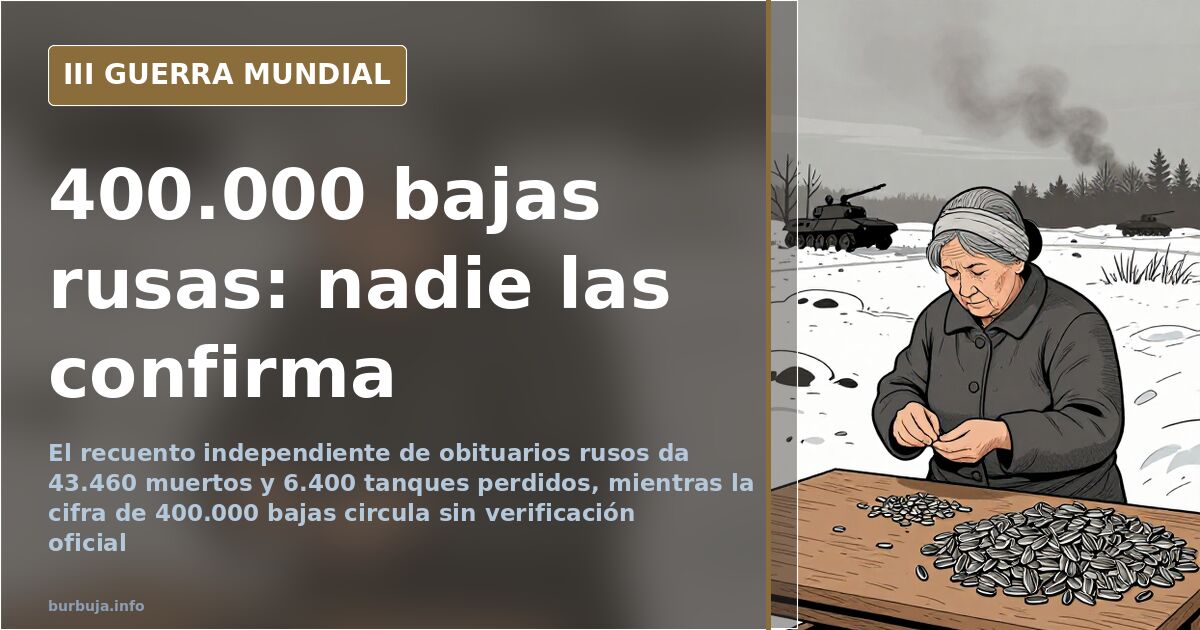
Russia’s 400,000 casualties: the unconfirmed figure everyone cites
No one has counted 400,000 Russian corpses. The number originates from a brief social media message, repeats without a source, and ends up functioning as an official report. The problem is not that it is false: it coexists with a methodical count yielding a figure several times smaller, and hardly anyone bothers to place them side by side. The message that peine this conversation included a violent wish toward the Russian president, which this text does not reproduce.
How many confirmed Russian casualties are there in Ukraine?
The auditable data comes from Russian local newspaper obituaries counted by Mediazona, an independent outlet working with death notices and bereavement announcements. Its figure, as of February 2024, was 43,460 Russians killed. Applying the same criteria to Ukrainian casualties, the result jumps to 422,000.
This contrast is the core of the entire disagreement. For some, 43,000 dead out of an army of hundreds of thousands deployed is incompatible with the narrative of the bloodletting. For others, the obituaries only capture the fraction published in provinces with active press, and underreporting is huge. In between lies the obvious: neither side has access to the Russian army morgues. Neither their own nor the enemy’s.
The arithmetic of attrition: 1,000 daily casualties and 800 days
With an average of 1,000 daily casualties and between 500,000 and 600,000 deployed personnel, the circulating calculation is simple: about 600 days of war at this pace, and up to 800 if partial replenishment of 200 men per day is added. From this comes the range of two to three years before a hypothetical Russian surrender.
The exercise has a merit and a trap. The merit is that it converts an abstract headline into a date on the calendar. The trap is that it assumes a linearity that no war respects: rates depend on whether Moscow sustains recruitment, whether the West maintains aid packages, and whether the front remains positional or starts moving again.
There is also the precedent used in both directions. In Afghanistan, about 15,000 Russians died over ten years, and that was read as a catastrophe. The comparison with a figure tens of times larger is inevitable, although the two wars have little in common: facing them is a state with artillery, drones, and a regular army, not an insurgency.
6,400 tanks lost and ten T-90s per month
In armored material, attrition is easier to photograph than human loss. Circulating estimates speak of 6,400 tanks lost, nearly 1,000 per year, with an estimated deficit of 800 units annually compared to what enters combat. The inherited Soviet Union stocks are enormous, but satellite images of the warehouses also show how much of that heritage has been outdoors for decades.
Production is estimated at a dozen T-90s per month. It is a notable pace for a sanctioned economy and remains insufficient: replacing losses at this rate would take years, and meanwhile, the front consumes more than factories deliver.
Avdiivka and 20% of the territory: the front that barely moves
On the ground, the tangible fact is that Russia controls around 20% of Ukrainian territory and 75% of the coast, and that Ukraine lacks offensive capacity to recover it in the short term, according to those trinc the front daily. The capture of Avdiivka, a settlement of barely 30,000 inhabitants, lasted months amidst rubble and was presented as the major advance of the season.
The distribution of human costs in such sieges is the most debated point. It is argued that the attacker suffers between four and ten casualties for each of the defender in urban combat, and at the same time that the defender, subjected to continuous shelling, ends up losing more men. Two incompatible readings of the same mud. And a fact that disconcerts both sides: Kharkiv is visible from the Russian border and remains uncaptured.
How much is the war costing Russian demographics?
The answer lies in its own statistics. Russia went from two million annual births a decade ago to 1.2 million in 2023, a drop close to half that leaves the indicator below the Spanish level. The Russian president has even asked women in his country to have a minimum of five or six children.
Translated into the long term, this means less replacement of the working-age population just when the economy needs labor and the army, soldiers. The other side of the argument is that no Western society is much better in birth rates and that Russia can compensate with migrant workers, as others already do. Demographics, in any case, are not fixed by decree.
With this landscape, it is reasonable to expect a long conflict and a post-war worse than the war for whoever wins. Russia will likely retain the occupied territory and lose the status of power it believed it had. Ukraine will retain sovereignty over a ruined country without short-term NATO entry. And the prediction in which even those disputing each figure agree is that the country emerging strongest from all this is not on the front.
No one has counted 400,000 Russian corpses. The number originates from a brief social media message, repeats without a source, and ends up functioning as an official report. The problem is not that it is false: it coexists with a methodical count yielding a figure several times smaller, and hardly anyone bothers to place them side by side. The message that peine this conversation included a violent wish toward the Russian president, which this text does not reproduce.
How many confirmed Russian casualties are there in Ukraine?
The auditable data comes from Russian local newspaper obituaries counted by Mediazona, an independent outlet working with death notices and bereavement announcements. Its figure, as of February 2024, was 43,460 Russians killed. Applying the same criteria to Ukrainian casualties, the result jumps to 422,000.
This contrast is the core of the entire disagreement. For some, 43,000 dead out of an army of hundreds of thousands deployed is incompatible with the narrative of the bloodletting. For others, the obituaries only capture the fraction published in provinces with active press, and underreporting is huge. In between lies the obvious: neither side has access to the Russian army morgues. Neither their own nor the enemy’s.
The arithmetic of attrition: 1,000 daily casualties and 800 days
With an average of 1,000 daily casualties and between 500,000 and 600,000 deployed personnel, the circulating calculation is simple: about 600 days of war at this pace, and up to 800 if partial replenishment of 200 men per day is added. From this comes the range of two to three years before a hypothetical Russian surrender.
The exercise has a merit and a trap. The merit is that it converts an abstract headline into a date on the calendar. The trap is that it assumes a linearity that no war respects: rates depend on whether Moscow sustains recruitment, whether the West maintains aid packages, and whether the front remains positional or starts moving again.
There is also the precedent used in both directions. In Afghanistan, about 15,000 Russians died over ten years, and that was read as a catastrophe. The comparison with a figure tens of times larger is inevitable, although the two wars have little in common: facing them is a state with artillery, drones, and a regular army, not an insurgency.
6,400 tanks lost and ten T-90s per month
In armored material, attrition is easier to photograph than human loss. Circulating estimates speak of 6,400 tanks lost, nearly 1,000 per year, with an estimated deficit of 800 units annually compared to what enters combat. The inherited Soviet Union stocks are enormous, but satellite images of the warehouses also show how much of that heritage has been outdoors for decades.
Production is estimated at a dozen T-90s per month. It is a notable pace for a sanctioned economy and remains insufficient: replacing losses at this rate would take years, and meanwhile, the front consumes more than factories deliver.
Avdiivka and 20% of the territory: the front that barely moves
On the ground, the tangible fact is that Russia controls around 20% of Ukrainian territory and 75% of the coast, and that Ukraine lacks offensive capacity to recover it in the short term, according to those trinc the front daily. The capture of Avdiivka, a settlement of barely 30,000 inhabitants, lasted months amidst rubble and was presented as the major advance of the season.
The distribution of human costs in such sieges is the most debated point. It is argued that the attacker suffers between four and ten casualties for each of the defender in urban combat, and at the same time that the defender, subjected to continuous shelling, ends up losing more men. Two incompatible readings of the same mud. And a fact that disconcerts both sides: Kharkiv is visible from the Russian border and remains uncaptured.
How much is the war costing Russian demographics?
The answer lies in its own statistics. Russia went from two million annual births a decade ago to 1.2 million in 2023, a drop close to half that leaves the indicator below the Spanish level. The Russian president has even asked women in his country to have a minimum of five or six children.
Translated into the long term, this means less replacement of the working-age population just when the economy needs labor and the army, soldiers. The other side of the argument is that no Western society is much better in birth rates and that Russia can compensate with migrant workers, as others already do. Demographics, in any case, are not fixed by decree.
With this landscape, it is reasonable to expect a long conflict and a post-war worse than the war for whoever wins. Russia will likely retain the occupied territory and lose the status of power it believed it had. Ukraine will retain sovereignty over a ruined country without short-term NATO entry. And the prediction in which even those disputing each figure agree is that the country emerging strongest from all this is not on the front.
Summary of a discussion on Burbuja.info - Foro de economía, actualidad y política., translated from Spanish and reviewed before publication. Read the full discussion (241 replies).
More summaries
-
Russia loses 483 vehicles as Ukraine strikes six refineries
Russia lost 483 vehicles in a week while Ukraine hit six refineries. The war of attrition shifts to fuel supplies and Moscow's skies.
-
Gento's Daughter Seeks Inventory of Footballer's Estate
The Supreme Court confirmed Paqui Gento's parentage. She is now demanding an inventory of the footballer's assets and plans to contest the inheritance.
-
Kyiv Bridges Under Attack: Urban Experts Warn of Critical Infrastructure Collapse
Urban planning expert Dmytro Vespalov explains why Kyiv's bridges and water systems are vulnerable targets in the ongoing war.
-
Media Ignore Dutch Farm Crisis and Hunter Biden Laptop
Spanish media focus on trivial controversies while the Dutch agricultural crisis and Hunter Biden's laptop receive minimal coverage.
-
Is the Russian military truly obsolete?
Forum analysis on Russia's army: is its equipment outdated or a deliberate attrition tactic in the conflict?
-
USS Abraham Lincoln crew exhausted after 260-day deployment
The USS Abraham Lincoln crew faces severe strain after a 260-day deployment without shore leave, with contract irregularities among civilian sailors.