
Video of ham dispute at a Donostia kebab shop goes viral
A video shows a dispute over ham at a kebab shop in Amara, Donostia, Spain. The clip spreads without context while the neighbourhood faces rental pressure.
English · Original discussion in Spanish · Published
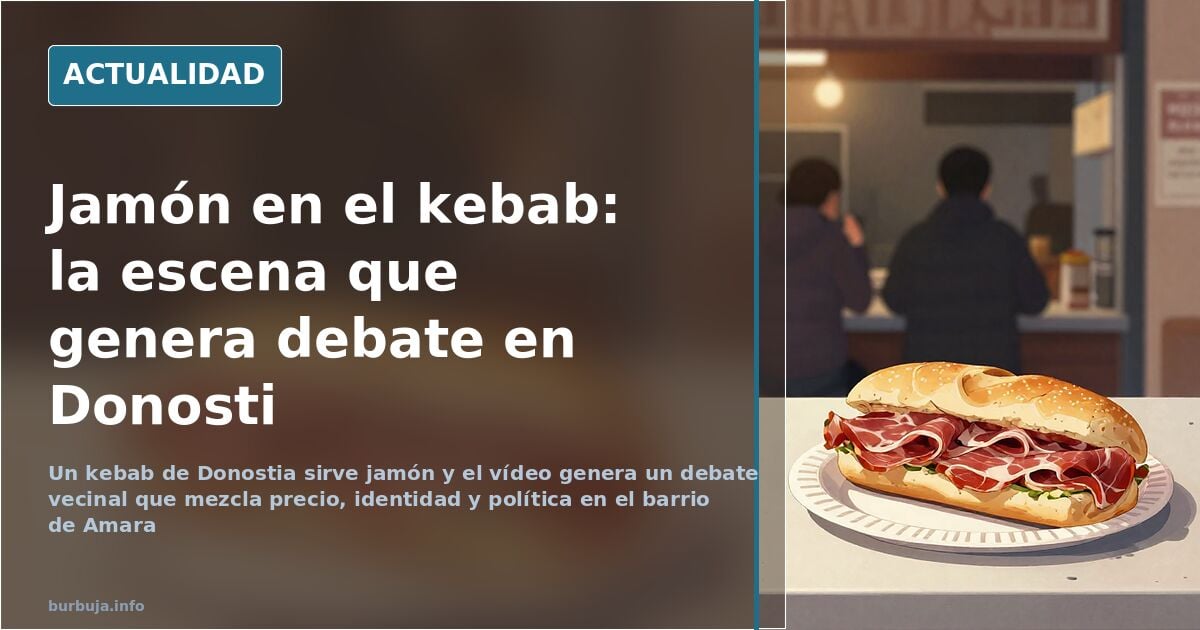
Video of a ham dispute at a Donostia kebab shop reopens neighbourhood tensions
What happens when someone orders ham at a kebab shop in Donostia, Spain, and the place doesn't have any? The video circulating on social media these days shows an argument at an establishment in the Amara neighbourhood, next to the Larramendi sign, and it has been enough for the matter to turn into an exchange of recriminations about coexistence, prices and how people voted. The scene, recorded and shared without context, has become the latest episode in a tension that has been simmering for months in the city's hospitality sector.
What the video shows and what is known about the dispute
The footage shows an argument at the counter of a kebab shop in the Amara area, near where the fire station and municipal police used to be, on the stretch leading up to old Amara. According to the accounts accompanying the video, the trigger was a request for more food for the same price. There are no images of physical aggression or damage, but there is an raised tone that has led to the clip being shared as an example of a cultural clash that is, in reality, more economic than identity-based.
The location is no coincidence: old Amara is today one of the areas most strained by rental prices in Donostia, with a mix of long-time residents and newcomers pushed there by the rise in the property market. The kebab shop, as a neighbourhood business, becomes a thermometer for that coexistence.
Ham as a symbol: what is really being debated
In this context, ham functions more as a symbol than as food. Some argue the request is an unnecessary provocation; others contend that a customer has the right to order whatever they want in a place that is not exclusively halal. The argument, at its core, is not about cold cuts: it is about who sets the rules in public space and what is considered normal.
What is striking is that the video went viral without anyone verifying the full sequence. There is no complaint filed, no identification of the people involved and no confirmation that the dispute went beyond a verbal exchange. That has not stopped the clip from being used to illustrate very different theories about integration, prices and municipal politics.
The economic backdrop nobody mentions
Donostia is one of the cities with the highest housing prices in Spain, and old Amara concentrates part of that pressure. Hospitality venues compete for customers with less disposable income, and kebab shops have filled the cheap-food niche that other formats used to cover. The dispute over "more food for the same price" is not a whim: it is the everyday expression of an inflation that is squeezing everyone.
In that context, the video acts as a catalyst for a frustration that finds no outlet. Some argue that coexistence is deteriorating, but coexistence data show no serious incidents in the area. What they do show is growing tension over the use of public space and the perception that the rules are not the same for everyone.
What the video does not say
There are no official figures on incidents at kebab shops in Donostia. There are no complaints filed over this specific episode. There are no institutional statements. The video is, for now, a loose document that everyone interprets according to their own prior framework. Those who want to see a clash of civilisations, see one. Those who want to see an argument over the price of dinner, see that too.
The only certainty is that the clip has served as a screen onto which many people project their own battles. And that, in a city that lives off tourism and prides itself on integration, is more uncomfortable than any argument at a counter.
Also available in: Deutsch
Summary of a discussion on Burbuja.info - Foro de economía, actualidad y política., translated from Spanish and reviewed before publication. Read the full discussion (16 replies).
More summaries
-
Mpox death in Spain: Patient infected by roommate at Donostia Hospital
A 61-year-old patient died of mpox after catching it from a roommate at Donostia Hospital. Osakidetza vaccinated 25 contacts.
-
Bilbao man hospitalized after intervening in couple's argument
An 18-year-old with boxing training was arrested in Bilbao for severely injuring a 46-year-old who tried to mediate his domestic dispute.
-
Anna's Archive Blocked in Spain Without VPN
Court-ordered Cloudflare block makes Anna's Archive inaccessible in Spain without a VPN, causing severe download delays.
-
16-year-old Mexican's sonic fire extinguisher: pure physics, already patented
A 16-year-old Mexican student has created a liquid-free acoustic extinguisher, but sound-based fire suppression was already used in 2012. So why is this news?
-
Spain's distrust of police, judges and psychiatrists
A fine based on invented facts and suspicion of mass surveillance of 47 million: Spain's authorities under citizen scrutiny.
-
Spain's right cheers a king drifting toward Sánchez
Spain's right cheers the king and the police, yet Felipe VI is aligning with Sánchez. How long will this loyalty last? An analysis of the contradiction.