
Venezuela's Bow-and-Arrow Militia Sparks Global Ridicule
A viral tweet showing Bolivarian militia with bows and arrows mocks anti-imperialist rhetoric, sparking debate on colonial history.
English · Original discussion in Spanish · Published
Venezuela Arms Indigenous Groups with Bows Against US
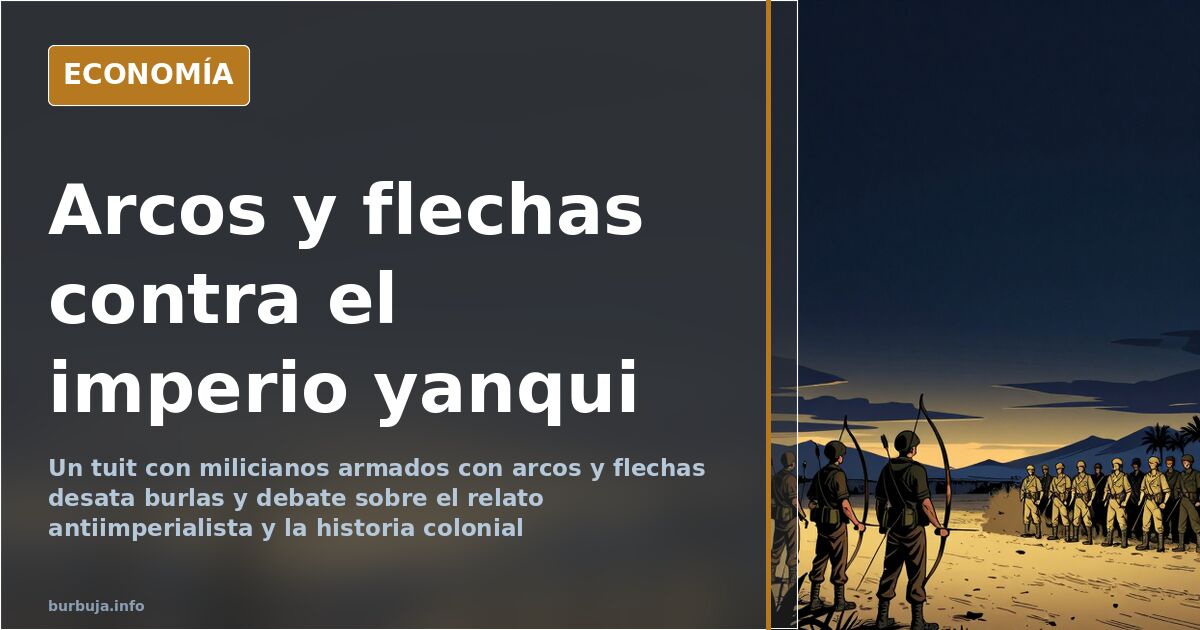
One tweet lit the fuse: "US pressure on Maduro is over; after this, no one would dare invade Venezuela." The accompanying image showed Bolivarian militiamen—armed with wooden bows and metal-free arrows—presented as the final line of defense against a hypothetical US intervention. The scene spread as resistance propaganda. Within hours, the conversation shifted to something more uncomfortable than the news itself: historical comparisons between empires, the actual quality of weaponry, and the role of indigenous peoples in independence wars.
What the Images Actually Show
The circulating photos and videos depict groups of indigenous people—speculated to be Llaneros or southern communities—carrying wooden bows and arrows with carved, non-metal tips. The Bolivarian militia integrates them as a symbolic force of anti-imperialist resistance. The staging resembles a Western movie set more than an operational military unit.
Some argue it is a propaganda operation with no real military value. The counter-argument is that asymmetric warfare is measured not by steel, but by attrition capacity and terrain knowledge. A militiaman with a bow in the jungle won't shoot down a fighter jet, but complicates an occupation. However, the discussion remained stuck on aesthetics: wooden arrows against aircraft carriers.
Ridicule as Political Weapon
The dominant reaction was mockery. The weaponry was compared to 16th-century colonial armies, recalling how a handful of Spaniards hardened by war against the Moors devastated indigenous empires with horses, swords, and arquebuses. The key argument was organizational, not technological. This reasoning now turns against the Bolivarian narrative: if the enemy is mentally backward, as some analysis suggests, victory requires coordination, not arrows.
Another line of criticism points to Freemasonry and propaganda as drivers of a decadent Hispanic identity. Four centuries of decline, they say, and rising. The irony targets both Caracas and Madrid: the former for arming militias with bows, the latter for believing themselves heirs to an empire that no longer exists.
Indigenous People Who Fought for Spain
The historical fact that disorients many: during the independence wars, a significant portion of indigenous peoples and Llaneros fought for the Spanish Crown, not Bolívar's armies. The Llaneros were the main shock force loyal to the monarchy against the Bolivarian guasons. This breaks the national liberation narrative currently sold by Caracas.
The paradox is evident: indigenous peoples are claimed as anti-imperialist symbols when many were allies of the Spanish Empire. History doesn't fit the ideological mold. And those who point this out are accused of being traitors or colonialists.
The Precedent No One Wants to Repeat
Comparisons with Vietnam and the Gulf War appear frequently. It is recalled that Iraqi soldiers surrendered upon seeing Marines, but also that Afghanistan proved a technologically superior army can get bogged down for twenty years. Venezuela is not Grenada, it is warned. An invasion of a country with nearly thirty million inhabitants, antiestéticaturing jungles, mountains, and dispersed militias, cannot be resolved in a week.
The warning is directed at Washington: be careful what you wish for. And at Caracas: invasions are executed, not advertised. If the goal was deterrence, the effect was the opposite. If it was mobilization, ridicule deactivated it.
The Shadow of Experiments and Double Standards
In parallel, the history of US medical experiments in Guatemala surfaced, where syphilis was injected into military personnel and orphan children, and among the Yanomami population of Venezuela and Brazil, exposed to radiation to study its effects. These documented episodes do not generate the same scandal as the Spanish Black Legend. The selectivity of historical memory is the most uncomfortable point.
The question remains floating: why is Spanish genocide remembered while US experiments are forgotten? The answer is not historiographical, but political. And in that battle, bows and arrows are just scenery.
With these elements, the Bolivarian militia has more stagecraft than deterrent capability. Pressure on Maduro is not measured in arrows, but in oil, sanctions, and alliances. Does anyone truly believe a wooden bow changes the balance of power in the Caribbean?
One tweet lit the fuse: "US pressure on Maduro is over; after this, no one would dare invade Venezuela." The accompanying image showed Bolivarian militiamen—armed with wooden bows and metal-free arrows—presented as the final line of defense against a hypothetical US intervention. The scene spread as resistance propaganda. Within hours, the conversation shifted to something more uncomfortable than the news itself: historical comparisons between empires, the actual quality of weaponry, and the role of indigenous peoples in independence wars.
What the Images Actually Show
The circulating photos and videos depict groups of indigenous people—speculated to be Llaneros or southern communities—carrying wooden bows and arrows with carved, non-metal tips. The Bolivarian militia integrates them as a symbolic force of anti-imperialist resistance. The staging resembles a Western movie set more than an operational military unit.
Some argue it is a propaganda operation with no real military value. The counter-argument is that asymmetric warfare is measured not by steel, but by attrition capacity and terrain knowledge. A militiaman with a bow in the jungle won't shoot down a fighter jet, but complicates an occupation. However, the discussion remained stuck on aesthetics: wooden arrows against aircraft carriers.
Ridicule as Political Weapon
The dominant reaction was mockery. The weaponry was compared to 16th-century colonial armies, recalling how a handful of Spaniards hardened by war against the Moors devastated indigenous empires with horses, swords, and arquebuses. The key argument was organizational, not technological. This reasoning now turns against the Bolivarian narrative: if the enemy is mentally backward, as some analysis suggests, victory requires coordination, not arrows.
Another line of criticism points to Freemasonry and propaganda as drivers of a decadent Hispanic identity. Four centuries of decline, they say, and rising. The irony targets both Caracas and Madrid: the former for arming militias with bows, the latter for believing themselves heirs to an empire that no longer exists.
Indigenous People Who Fought for Spain
The historical fact that disorients many: during the independence wars, a significant portion of indigenous peoples and Llaneros fought for the Spanish Crown, not Bolívar's armies. The Llaneros were the main shock force loyal to the monarchy against the Bolivarian guasons. This breaks the national liberation narrative currently sold by Caracas.
The paradox is evident: indigenous peoples are claimed as anti-imperialist symbols when many were allies of the Spanish Empire. History doesn't fit the ideological mold. And those who point this out are accused of being traitors or colonialists.
The Precedent No One Wants to Repeat
Comparisons with Vietnam and the Gulf War appear frequently. It is recalled that Iraqi soldiers surrendered upon seeing Marines, but also that Afghanistan proved a technologically superior army can get bogged down for twenty years. Venezuela is not Grenada, it is warned. An invasion of a country with nearly thirty million inhabitants, antiestéticaturing jungles, mountains, and dispersed militias, cannot be resolved in a week.
The warning is directed at Washington: be careful what you wish for. And at Caracas: invasions are executed, not advertised. If the goal was deterrence, the effect was the opposite. If it was mobilization, ridicule deactivated it.
The Shadow of Experiments and Double Standards
In parallel, the history of US medical experiments in Guatemala surfaced, where syphilis was injected into military personnel and orphan children, and among the Yanomami population of Venezuela and Brazil, exposed to radiation to study its effects. These documented episodes do not generate the same scandal as the Spanish Black Legend. The selectivity of historical memory is the most uncomfortable point.
The question remains floating: why is Spanish genocide remembered while US experiments are forgotten? The answer is not historiographical, but political. And in that battle, bows and arrows are just scenery.
With these elements, the Bolivarian militia has more stagecraft than deterrent capability. Pressure on Maduro is not measured in arrows, but in oil, sanctions, and alliances. Does anyone truly believe a wooden bow changes the balance of power in the Caribbean?
Summary of a discussion on Burbuja.info - Foro de economía, actualidad y política., translated from Spanish and reviewed before publication. Read the full discussion (152 replies).
More summaries
-
Joan Donovan warns US militias preparing for civil war
Disinformation expert Joan Donovan argues US militias are gearing up for civil conflict, citing social media as key infrastructure.
-
Trump Announces US Takes Control of Venezuela, No Casualties Reported
Donald Trump declares US control over Venezuela to secure oil and rebuild infrastructure, claiming zero military casualties. Analysis covers costs, reserves, and geopolitical parallels with Ukraine.
-
Abstention vs. Strategic Voting: A Divided Spanish Electorate
Debate intensifies in Spain over whether abstaining delegitimizes the system, analyzing arguments for strategic voting and low turnout.
-
Why an Argentine Resident in Spain Decided to Return Home
A 37-year-old woman describes her return to Argentina, citing hiring barriers for non-nationals and a tax burden consuming nearly half of her income.
-
Bordeaux attack video reignites security debate in France
A viral video of an assault on a woman and her granddaughter in Bordeaux, France, has reopened debates on media coverage and the political use of security issues.
-
Spain's Yolanda Díaz pushes larger firms, hitting the 50-employee wall
Yolanda Díaz proposes scaling up Spanish companies to 'democratize' them. Critics point to the 50-worker threshold and corporate tax hurdles.