
Silver spot price jumps from €15 to €52 since 2019
Silver spot exceeds €52 while retail coins near €105. Warnings about buying at $50 clash with persistent physical premiums.
English · Original discussion in Spanish · Published
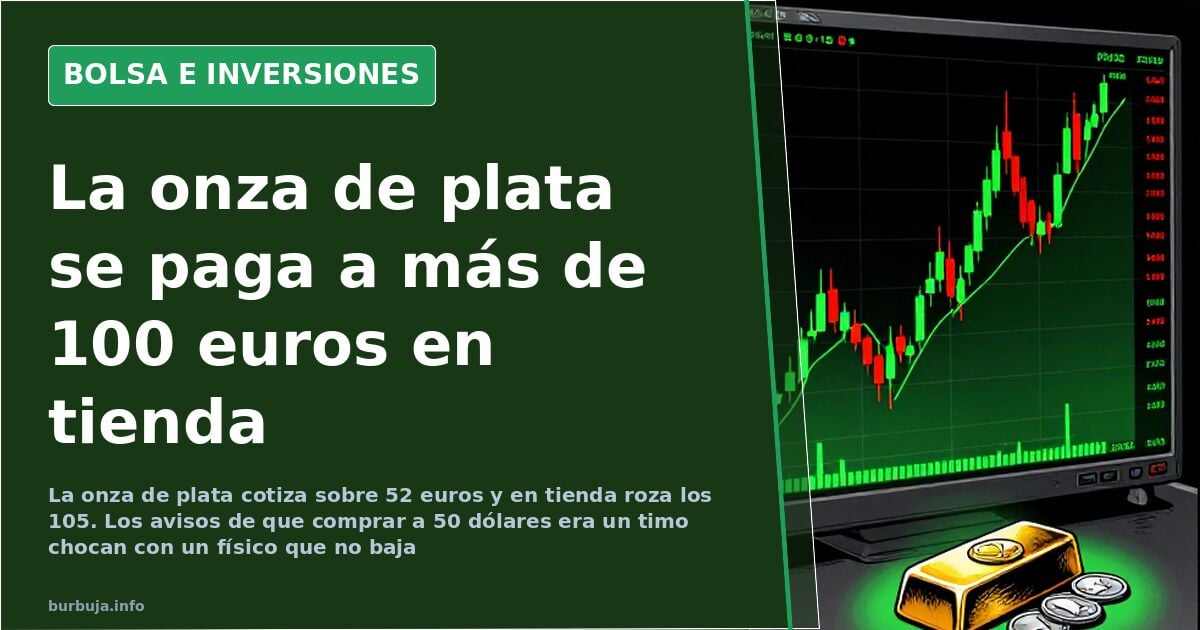
Silver: From €15 per ounce in 2019 to over €100 in stores
The silver ounce trades above €52, but classic coins—Libertad, Philharmonic, Eagle, Panda—sell for between €95 and €100 in shops, with the 2026 Kookaburra already hitting €105. Spot prices briefly reached $53.50. In recent weeks, the metal rose 30% before correcting by 10%. This volatility fueled warnings that those who bought at $50 were "taken for a ride," contrasting with views that $100 is imminent and the opportunity won't last.
Nearly a year later, neither certainty has materialized. What has changed is the retail price of physical silver: if anything, recent months prove you no longer buy the ounce at chart prices, but significantly higher.
What does it cost to buy a silver ounce today?
Between €95 and €105, depending on the piece and issuer. Standard mintage coins set the lower end, while limited editions like the 2026 Kookaburra reach €105. The premium over spot, distribution channels, and taxes explain almost all the difference from the €52 spot price—a gap that isn't new but now spans tens of euros.
There's an underlying curiosity in this market. Those buying annual ounces of popular issues—Pandas, Kookaburras—to maintain collections are calculating how many monthly salaries these recurring purchases equal. Others do different math: if the rally continues, they may switch to half-ounce pieces, and premium issues could hit €350 or €500. That figure is speculation, not current pricing.
The $30 forecast and the cheap buy nobody finds
Bearish arguments haven't disappeared. Some claim the metal should drop below $30 within two months, that buyers at $50 hide their coins to avoid scrutiny, and that everything boils down to waiting for the next cycle to sell them off. The opposing thesis doesn't dispute the timeline; it disputes the direction.
Long-term holders aren't selling. Positions peine at €15 per ounce in 2019 remain untouched until prices multiply tenfold, and some worry only if costs exceed €16. The problem for latecomers is that the rumored cheap prices—€18, €20—don't appear in any store. Those waiting for that window have waited months while the metal rises.
VAT and the extra cost of buying physical silver
Buying metal outside private channels requires paying applicable taxes. In Spain, VAT on silver has cooled retail demand: some buyers admit they haven't purchased an ounce since the tax change, describing it as paying a feudal tribute. The effect is double, raising both entry and exit costs.
This drives interest in physical silver ETFs. They solve fiscal costs and home storage issues—which become real concerns for moderate amounts—but shift exposure to paper assets. Another unresolved doubt remains: whether to invest in circulated pieces or sealed ones, which command higher numismatic premiums but recover value less effectively.
Industry holds stock amid financial collapse narratives
Shops supplying hobbyists in casting and jewelry report two things inconsistent with a calm market. Gold and silver alloy manufacturers aren't shipping orders, expecting higher prices, and outgoing orders go to oil-rich nations. When suppliers prefer inventory over sales, the bottleneck isn't at the mine.
Behind this circulates a broader narrative: debt crises, AI-linked stock corrections, depreciating fiat money, and Western governments lacking margin. Hoarding metal isn't seen as short-term investment but preparation for major upheaval. Some add that money will be digital in ten years, making coins folklore. Others warn nanomaterials could devalue gold, though no one specifies its development stage.
Unsubstantiated predictions also emerge: claims China closed the silver market or that an imminent attack on Iran is planned. No evidence supports these, occurring alongside reminders of tips that never materialized.
A side effect: the contrarian predictor
The phenomenon has a curious derivative. Some confess reading categorical forecasts to do the opposite, attributing an eight-property, four-car, two-dog portfolio to this inverse strategy. It's an exaggeration, but reflects sentiment: when the metal rises despite warnings, the most trinc signal is no longer the chart.
With standard-issue silver nearing €100 and spot in the fifties, the open question isn't whether there was a scam. It's how much of that differential is industrial premium, tax, and antiestéticar of missing out. And so far, no answer holds up another year.
The silver ounce trades above €52, but classic coins—Libertad, Philharmonic, Eagle, Panda—sell for between €95 and €100 in shops, with the 2026 Kookaburra already hitting €105. Spot prices briefly reached $53.50. In recent weeks, the metal rose 30% before correcting by 10%. This volatility fueled warnings that those who bought at $50 were "taken for a ride," contrasting with views that $100 is imminent and the opportunity won't last.
Nearly a year later, neither certainty has materialized. What has changed is the retail price of physical silver: if anything, recent months prove you no longer buy the ounce at chart prices, but significantly higher.
What does it cost to buy a silver ounce today?
Between €95 and €105, depending on the piece and issuer. Standard mintage coins set the lower end, while limited editions like the 2026 Kookaburra reach €105. The premium over spot, distribution channels, and taxes explain almost all the difference from the €52 spot price—a gap that isn't new but now spans tens of euros.
There's an underlying curiosity in this market. Those buying annual ounces of popular issues—Pandas, Kookaburras—to maintain collections are calculating how many monthly salaries these recurring purchases equal. Others do different math: if the rally continues, they may switch to half-ounce pieces, and premium issues could hit €350 or €500. That figure is speculation, not current pricing.
The $30 forecast and the cheap buy nobody finds
Bearish arguments haven't disappeared. Some claim the metal should drop below $30 within two months, that buyers at $50 hide their coins to avoid scrutiny, and that everything boils down to waiting for the next cycle to sell them off. The opposing thesis doesn't dispute the timeline; it disputes the direction.
Long-term holders aren't selling. Positions peine at €15 per ounce in 2019 remain untouched until prices multiply tenfold, and some worry only if costs exceed €16. The problem for latecomers is that the rumored cheap prices—€18, €20—don't appear in any store. Those waiting for that window have waited months while the metal rises.
VAT and the extra cost of buying physical silver
Buying metal outside private channels requires paying applicable taxes. In Spain, VAT on silver has cooled retail demand: some buyers admit they haven't purchased an ounce since the tax change, describing it as paying a feudal tribute. The effect is double, raising both entry and exit costs.
This drives interest in physical silver ETFs. They solve fiscal costs and home storage issues—which become real concerns for moderate amounts—but shift exposure to paper assets. Another unresolved doubt remains: whether to invest in circulated pieces or sealed ones, which command higher numismatic premiums but recover value less effectively.
Industry holds stock amid financial collapse narratives
Shops supplying hobbyists in casting and jewelry report two things inconsistent with a calm market. Gold and silver alloy manufacturers aren't shipping orders, expecting higher prices, and outgoing orders go to oil-rich nations. When suppliers prefer inventory over sales, the bottleneck isn't at the mine.
Behind this circulates a broader narrative: debt crises, AI-linked stock corrections, depreciating fiat money, and Western governments lacking margin. Hoarding metal isn't seen as short-term investment but preparation for major upheaval. Some add that money will be digital in ten years, making coins folklore. Others warn nanomaterials could devalue gold, though no one specifies its development stage.
Unsubstantiated predictions also emerge: claims China closed the silver market or that an imminent attack on Iran is planned. No evidence supports these, occurring alongside reminders of tips that never materialized.
A side effect: the contrarian predictor
The phenomenon has a curious derivative. Some confess reading categorical forecasts to do the opposite, attributing an eight-property, four-car, two-dog portfolio to this inverse strategy. It's an exaggeration, but reflects sentiment: when the metal rises despite warnings, the most trinc signal is no longer the chart.
With standard-issue silver nearing €100 and spot in the fifties, the open question isn't whether there was a scam. It's how much of that differential is industrial premium, tax, and antiestéticar of missing out. And so far, no answer holds up another year.
Summary of a discussion on Burbuja.info - Foro de economía, actualidad y política., translated from Spanish and reviewed before publication. Read the full discussion (180 replies).
More summaries
-
Gold Hits $4,000 After Doubling, Texas Accepts It as Currency
Gold jumps from $1,450 to $4,106 per ounce, correcting to $4,000, as Texas, Florida, and Missouri recognize it as legal tender.
-
Gold Drops to $4194, Support at $3800 in Focus
Gold touched $4600 before falling to $4194. The $3800 support level is closely watched, with a break potentially leading to $3400.
-
ING clients seek alternatives after Iker Jiménez ad controversy
ING pulled ads from Iker Jiménez's show, prompting some customers to switch banks for better rates at BBVA or Sabadell.
-
Selling gold: urgency dictates the price
Forum example shows selling 20 ounces in a hurry can drop offers from €1,000 to €800 per ounce.
-
Bitcoin inflows drop, market sees buy signal
Bitcoin trading volume cools as declining inflows are interpreted by some investors as a contrarian buying opportunity.
-
Superman's $3.25M Debut: Comic Market Reality
Action Comics #1 sold for $3.25 million, but CGC grades and buyer demographics drive the rest of the market.