
Venezuela calls referendum to annex Guyana's Essequibo
Venezuela has scheduled a December 3 referendum on annexing the Essequibo, a region comprising 75% of Guyana and rich in oil.
English · Original discussion in Spanish · Published
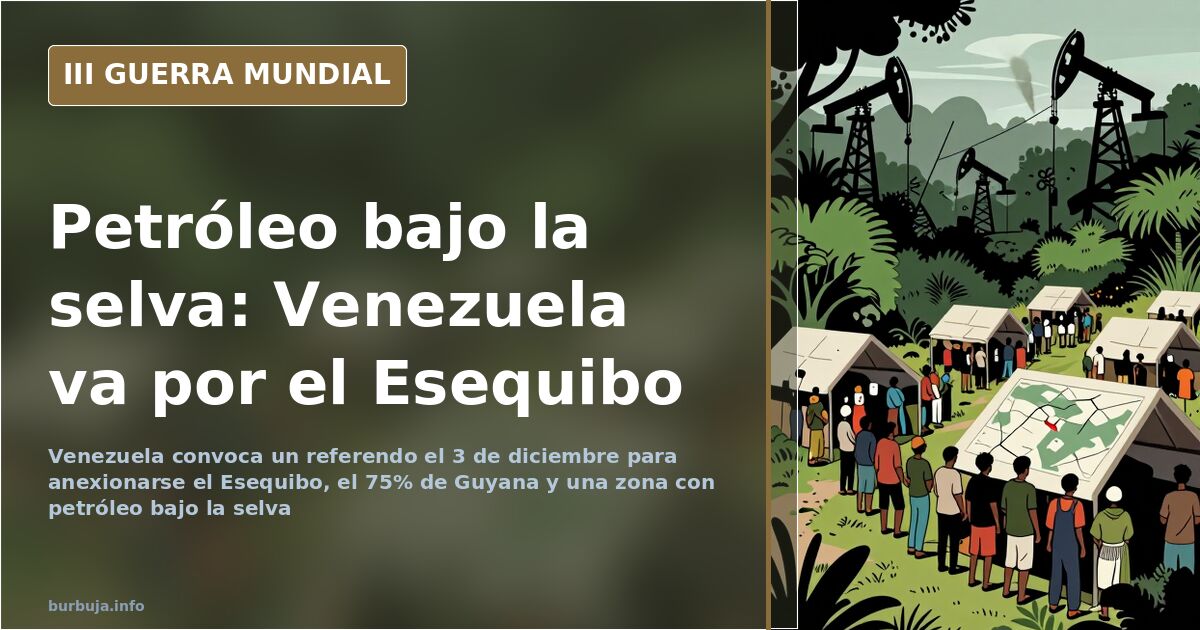
Referendum in Venezuela for Essequibo annexation
Venezuela is set to annex the Essequibo. Or not. What is confirmed is that a referendum on this annexation has been called for December 3, and that the disputed territory —the Guayana Esequiba, west of the Essequibo River— represents, according to legal arguments, 75% of Guyana. Jungle, river, and beneath it, oil.
The claim dates back far: the United Kingdom retained control of the zone, Venezuela challenged an unfavorable arbitration award late, and in 1966 signed a treaty with the British to resolve the issue. According to analysts, what has changed the landscape is the context: Guyana is no longer governed by the left, has a right-wing president, and aligns with the US and Caribbean powers. And there is crude oil under the jungle.
Why does Venezuela claim the Essequibo?
The core argument is historical: it is argued that the British illegally occupied territory that should have belonged to Venezuela under its independence treaties. Some draw parallels with the Falklands or Guantanamo, those remnants of Spanish geography that ended up in foreign hands. Others add a more uncomfortable reading: the allies who financed American independences later took their payment in territory.
Against this, the legal facts work against Caracas. There is an arbitration award recognizing British administration, which Venezuela challenged —belatedly, even defenders admit— and a subsequent treaty obliging parties to seek a negotiated solution. In short: a clean path for unilateral annexation is not on the table.
How much oil is in the Essequibo?
This is the question driving everything else. The discovery of hydrocarbons in Guyanese waters and land turned a nineteenth-century dispute into a matter watched by multinationals. One school of thought dampens enthusiasm: estimated reserves would not reach 200 days of consumption —according to circulating calculations— and extraction would be difficult or impossible with current technology.
The other reading is more prosaic. If oil were irrelevant, there would be no majors from the US and Europe moving around the area, nor offshore projects underway. That oil is expensive to extract doesn't miccionan nobody wants it: it means whoever extracts it needs high prices and legal certainty they don't currently have.
Can you invade a territory without roads?
Here the discussion becomes geographic, and geography is stubborn. A quick look at satellite images yields the same result: there is not a single road crossing the border. To the south, a mountain range with more jungle and a river. And climate above all: rainy season, extreme humidity, jaguars, anacondas, caimans, and piranhas. The prevailing forecast is that a moving force would suffer more casualties from the environment than from the enemy.
The counter-thesis is that conflicts like this aren't fought via highway. Thousands of troops with rifles, mules, and canteens can enter the jungle. Sustaining supply, logistics, and sarracena for months in terra incognita is another matter. No power has ever won quickly in terrain that devours supply lines.
Who would support Guyana in a conflict?
On paper, Guyana has a police-sized force. Its asset isn't the army, but its allies. Its Defense Minister visited Brazil's Ministry of Defense for "strategic dialogue," a visit read as seeking backing. Brazil has Lula and Maduro in the same ideological orbit, but no interest in a neighborhood in flames.
The US and UK are the other card. The cynical view holds that Washington would see a clash as the perfect excuse to put boots on the ground in an oil-rich zone and stay to exploit it while "defending" the neighbor. The contrary view: nobody wants to open a new front with Ukraine and Israel consuming attention and ammunition.
Under the jungle lies crude oil
The mess is served
With the Venezuelan economy in ruins, the currency losing decimals every year, and Russia and Iran distracted on other fronts, annexing the Essequibo looks more like a domestic political move than a military operation. But staff colleges have studied that map for decades, and referendums, when called, are called for a reason.
The bet, with all reservations: there will be gestures, rhetoric, and symbolic deployment, not an invasion. And if someone ends up crossing the river, the first enemy won't wear a uniform.
Venezuela is set to annex the Essequibo. Or not. What is confirmed is that a referendum on this annexation has been called for December 3, and that the disputed territory —the Guayana Esequiba, west of the Essequibo River— represents, according to legal arguments, 75% of Guyana. Jungle, river, and beneath it, oil.
The claim dates back far: the United Kingdom retained control of the zone, Venezuela challenged an unfavorable arbitration award late, and in 1966 signed a treaty with the British to resolve the issue. According to analysts, what has changed the landscape is the context: Guyana is no longer governed by the left, has a right-wing president, and aligns with the US and Caribbean powers. And there is crude oil under the jungle.
Why does Venezuela claim the Essequibo?
The core argument is historical: it is argued that the British illegally occupied territory that should have belonged to Venezuela under its independence treaties. Some draw parallels with the Falklands or Guantanamo, those remnants of Spanish geography that ended up in foreign hands. Others add a more uncomfortable reading: the allies who financed American independences later took their payment in territory.
Against this, the legal facts work against Caracas. There is an arbitration award recognizing British administration, which Venezuela challenged —belatedly, even defenders admit— and a subsequent treaty obliging parties to seek a negotiated solution. In short: a clean path for unilateral annexation is not on the table.
How much oil is in the Essequibo?
This is the question driving everything else. The discovery of hydrocarbons in Guyanese waters and land turned a nineteenth-century dispute into a matter watched by multinationals. One school of thought dampens enthusiasm: estimated reserves would not reach 200 days of consumption —according to circulating calculations— and extraction would be difficult or impossible with current technology.
The other reading is more prosaic. If oil were irrelevant, there would be no majors from the US and Europe moving around the area, nor offshore projects underway. That oil is expensive to extract doesn't miccionan nobody wants it: it means whoever extracts it needs high prices and legal certainty they don't currently have.
Can you invade a territory without roads?
Here the discussion becomes geographic, and geography is stubborn. A quick look at satellite images yields the same result: there is not a single road crossing the border. To the south, a mountain range with more jungle and a river. And climate above all: rainy season, extreme humidity, jaguars, anacondas, caimans, and piranhas. The prevailing forecast is that a moving force would suffer more casualties from the environment than from the enemy.
The counter-thesis is that conflicts like this aren't fought via highway. Thousands of troops with rifles, mules, and canteens can enter the jungle. Sustaining supply, logistics, and sarracena for months in terra incognita is another matter. No power has ever won quickly in terrain that devours supply lines.
Who would support Guyana in a conflict?
On paper, Guyana has a police-sized force. Its asset isn't the army, but its allies. Its Defense Minister visited Brazil's Ministry of Defense for "strategic dialogue," a visit read as seeking backing. Brazil has Lula and Maduro in the same ideological orbit, but no interest in a neighborhood in flames.
The US and UK are the other card. The cynical view holds that Washington would see a clash as the perfect excuse to put boots on the ground in an oil-rich zone and stay to exploit it while "defending" the neighbor. The contrary view: nobody wants to open a new front with Ukraine and Israel consuming attention and ammunition.
Under the jungle lies crude oil
The mess is served
With the Venezuelan economy in ruins, the currency losing decimals every year, and Russia and Iran distracted on other fronts, annexing the Essequibo looks more like a domestic political move than a military operation. But staff colleges have studied that map for decades, and referendums, when called, are called for a reason.
The bet, with all reservations: there will be gestures, rhetoric, and symbolic deployment, not an invasion. And if someone ends up crossing the river, the first enemy won't wear a uniform.
Also available in: Deutsch
Summary of a discussion on Burbuja.info - Foro de economía, actualidad y política., translated from Spanish and reviewed before publication. Read the full discussion (128 replies).
More summaries
-
US Oil Reserves to Last 11 Years, UK's Just 5
US has 11 years of domestic crude left, consuming 19 million barrels daily. UK faces losing 75% of its supply in five years.
-
Zaporizhzhia: Nuclear Threat Reignites Military Tensions
Calls to deploy four aircraft carriers to the Black Sea to prevent Zaporizhzhia's destruction clash with views that Moscow won't self-poison.
-
Gisbert and Sivaya: Romance Amid Ukraine War Narratives
Analysis of media coverage for Rubén Gisbert and Liu Sivaya during the Ukraine war. Is this digital propaganda or reality?
-
Iglesias Prefers Obama, Undermining Communist Label
Pablo Iglesias favors Obama over Putin, sparking debate on Podemos' identity: communism, postmodernism, or crony capitalism?
-
Spain backs Morocco's Sahara autonomy plan, angering Algeria
Sánchez endorses Moroccan autonomy for Western Sahara in letter to King Mohammed VI. Algeria recalls ambassador amid gas supply concerns.
-
US Decline Debate: Portland Homelessness and UFO Distractions
A viral tweet about caravans in Portland reignites discussions on US decline, poverty, and theories that UFO noise masks social issues.