
Venezuela Bets on Surviving Military Standoff with the US
Venezuela, lacking domestic arms production, strategizes survival against the US through jungle warfare, oil, and a government-in-exile in Norway.
English · Original discussion in Spanish · Published
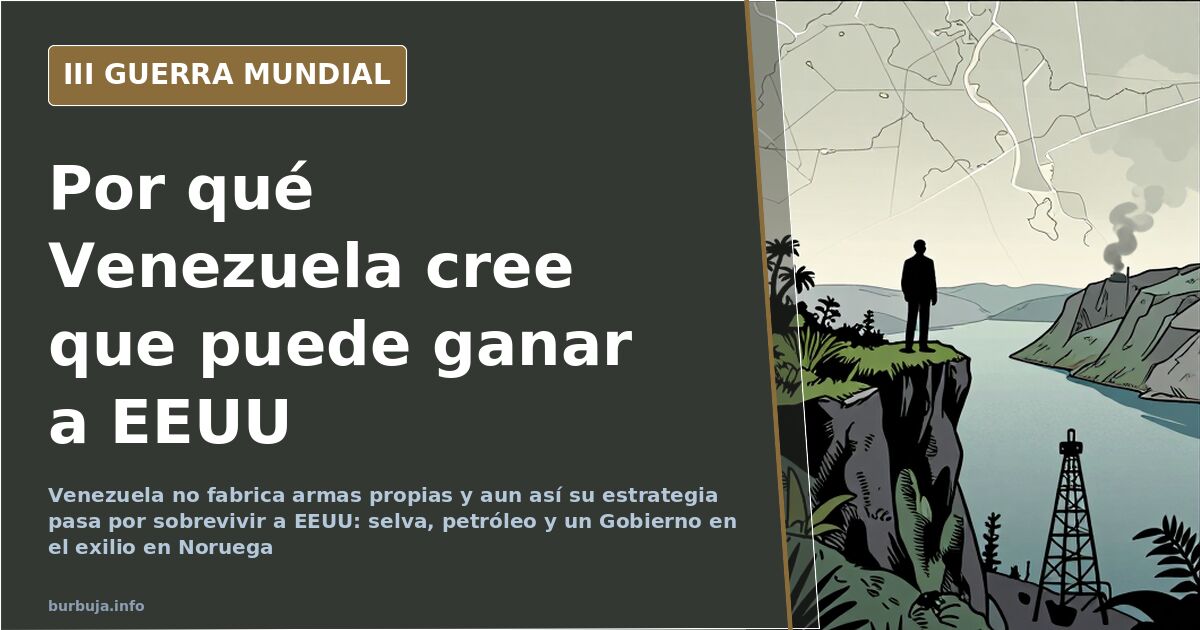
Venezuela Resists US Through Jungle and War of Attrition
F-18s flew low over waters Caracas deems territorial. In this maneuver, supported by US special forces, María Corina Machado reportedly left the country. Her daughter accepted the Nobel Peace Prize on her behalf, and hours later, the Venezuelan opposition was reportedly en route to Norway to meet with an "in-exile" Assembly and Supreme Court. The sequence described involves seven steps: the award, the extraction, the two parallel institutions, the recognizing presidents, the appointment of Edmundo González as president-elect and Machado as vice president, the request for Washington's aid, and finally, selective airstrikes until Maduro leaves power.
The underlying question is not whether this framework has solid legal backing—its proponents admit it's weak. It's another: Can Venezuela defeat the US? The coldest analysis answers yes, but not by fighting. By surviving.
Why a Long War Hurts Venezuela
Caracas's weak point is industrial, not military. Venezuela does not manufacture its own weapons or ammunition. Everything entering the country comes through one border: Colombian or Brazilian, neither described as easy. If the conflict drags on, replenishing material becomes the main problem.
The premise of the discussion itself is explicit: Venezuela only needs to survive the threat to win. It doesn't need a military victory, just not to be overthrown. This is the classic asymmetry of the weaker party, and it explains why the calendar is the main battlefield.
Against this stands the geographic argument. Dense jungle bordering your suppliers is an advantage, not an obstacle: those who want to cut off logistics have to venture into it. The repeated reference is to the Vietnamese guerrillas, who turned the undergrowth into their best defense system. Add to this that neighboring governments don't seem willing to act as transmission belts, leaving smuggling as a residual route.
The Government in Exile No One Voted For
On paper, the operation is complete. Four South American presidents and several former presidents would lend validity and recognition to the "in-exile" Executive. With that backing, the US would have authorization to support it with military actions. Some argue the setup is impeccable on paper, while others counter with the argument that dismantles its effectiveness: the theater is set, but the audience hasn't bought tickets.
The timeline doesn't help either. The names supporting this alternative Executive have been out of the country for years, and their ability to mobilize internally is, to say the least, debatable. A designation based in Oslo and backed by former presidents holds up in offices, not in the streets.
Guaidó as a Precedent
The precedent weighs heavily. The previous operation—recognizing an alternative president and treating him as head of state—ended up fizzling out without results. A lesson was learned from that, which is now being repeated: legal backing without territorial control is not enough. International recognition doesn't topple governments; at most, it inconveniences them.
The Missing Minutes
The legitimacy of the process is the crux. The Carter Center was invited by Venezuela to supervise the elections, according to the version recorded, and its assessment was not well-received. The opposition insists that Chavismo did not make the electoral records public, preventing verification of the results, and claims that withholding them is equivalent to admitting defeat.
The officialist defense reverses the burden: no country publishes records, the opposition had the chance to submit its own and didn't, and each state has its legal channels. The matter also spilled into Spanish politics, with mutual accusations—denied by those receiving them—about alleged financing of parties through a production company that worked for Iranian public television.
Oil, the Undisguised Motive
Crude oil is the elephant in the room. Those defending intervention argue that the US needs Venezuelan oil "yesterday". Those rejecting it say it plainly: democracy is the alibi, and resources are the objective. The capture of a Venezuelan oil tanker off its coast, documented with drone footage, points to a standoff being fought more in economic than military terms. The reasoning is completed with a question that neither side answers well: why do some undemocratic regimes deserve Washington's attention and others don't.
The Military Scenario Under Consideration: Maracaibo
In the speculation about what an intervention would look like, one hypothesis is repeated: enter from the west, through Maracaibo, with the lake on one flank and the Colombian border on the other. The pincer movement would leave the government with little room to maneuver, according to this reading. The previous day's flights, they insist, were in that direction. No one provides proof that such a plan exists.
The other interpretation prefers inaction: letting sanctions and internal desgaste do the work, without assuming the military or political cost of an occupation. For Caracas, this version is almost good news.
The Disconcerting Fact
If the popular support were as described in the declarations, the streets should be full. Those defending the government use this as proof: there is no general strike, no mass protests. Those fighting it respond with another figure: those who have left. There's talk of between 4 and 5 million Venezuelans emigrated, with some versions putting the count as high as 8 million exiles.
Between these two figures—the people protesting and the people leaving—the real standoff is decided. Neither figure fully aligns with the other. And neither side is in a hurry to prove which is the true one.
F-18s flew low over waters Caracas deems territorial. In this maneuver, supported by US special forces, María Corina Machado reportedly left the country. Her daughter accepted the Nobel Peace Prize on her behalf, and hours later, the Venezuelan opposition was reportedly en route to Norway to meet with an "in-exile" Assembly and Supreme Court. The sequence described involves seven steps: the award, the extraction, the two parallel institutions, the recognizing presidents, the appointment of Edmundo González as president-elect and Machado as vice president, the request for Washington's aid, and finally, selective airstrikes until Maduro leaves power.
The underlying question is not whether this framework has solid legal backing—its proponents admit it's weak. It's another: Can Venezuela defeat the US? The coldest analysis answers yes, but not by fighting. By surviving.
Why a Long War Hurts Venezuela
Caracas's weak point is industrial, not military. Venezuela does not manufacture its own weapons or ammunition. Everything entering the country comes through one border: Colombian or Brazilian, neither described as easy. If the conflict drags on, replenishing material becomes the main problem.
The premise of the discussion itself is explicit: Venezuela only needs to survive the threat to win. It doesn't need a military victory, just not to be overthrown. This is the classic asymmetry of the weaker party, and it explains why the calendar is the main battlefield.
Against this stands the geographic argument. Dense jungle bordering your suppliers is an advantage, not an obstacle: those who want to cut off logistics have to venture into it. The repeated reference is to the Vietnamese guerrillas, who turned the undergrowth into their best defense system. Add to this that neighboring governments don't seem willing to act as transmission belts, leaving smuggling as a residual route.
The Government in Exile No One Voted For
On paper, the operation is complete. Four South American presidents and several former presidents would lend validity and recognition to the "in-exile" Executive. With that backing, the US would have authorization to support it with military actions. Some argue the setup is impeccable on paper, while others counter with the argument that dismantles its effectiveness: the theater is set, but the audience hasn't bought tickets.
The timeline doesn't help either. The names supporting this alternative Executive have been out of the country for years, and their ability to mobilize internally is, to say the least, debatable. A designation based in Oslo and backed by former presidents holds up in offices, not in the streets.
Guaidó as a Precedent
The precedent weighs heavily. The previous operation—recognizing an alternative president and treating him as head of state—ended up fizzling out without results. A lesson was learned from that, which is now being repeated: legal backing without territorial control is not enough. International recognition doesn't topple governments; at most, it inconveniences them.
The Missing Minutes
The legitimacy of the process is the crux. The Carter Center was invited by Venezuela to supervise the elections, according to the version recorded, and its assessment was not well-received. The opposition insists that Chavismo did not make the electoral records public, preventing verification of the results, and claims that withholding them is equivalent to admitting defeat.
The officialist defense reverses the burden: no country publishes records, the opposition had the chance to submit its own and didn't, and each state has its legal channels. The matter also spilled into Spanish politics, with mutual accusations—denied by those receiving them—about alleged financing of parties through a production company that worked for Iranian public television.
Oil, the Undisguised Motive
Crude oil is the elephant in the room. Those defending intervention argue that the US needs Venezuelan oil "yesterday". Those rejecting it say it plainly: democracy is the alibi, and resources are the objective. The capture of a Venezuelan oil tanker off its coast, documented with drone footage, points to a standoff being fought more in economic than military terms. The reasoning is completed with a question that neither side answers well: why do some undemocratic regimes deserve Washington's attention and others don't.
The Military Scenario Under Consideration: Maracaibo
In the speculation about what an intervention would look like, one hypothesis is repeated: enter from the west, through Maracaibo, with the lake on one flank and the Colombian border on the other. The pincer movement would leave the government with little room to maneuver, according to this reading. The previous day's flights, they insist, were in that direction. No one provides proof that such a plan exists.
The other interpretation prefers inaction: letting sanctions and internal desgaste do the work, without assuming the military or political cost of an occupation. For Caracas, this version is almost good news.
The Disconcerting Fact
If the popular support were as described in the declarations, the streets should be full. Those defending the government use this as proof: there is no general strike, no mass protests. Those fighting it respond with another figure: those who have left. There's talk of between 4 and 5 million Venezuelans emigrated, with some versions putting the count as high as 8 million exiles.
Between these two figures—the people protesting and the people leaving—the real standoff is decided. Neither figure fully aligns with the other. And neither side is in a hurry to prove which is the true one.
Summary of a discussion on Burbuja.info - Foro de economía, actualidad y política., translated from Spanish and reviewed before publication. Read the full discussion (211 replies).
More summaries
-
Russia's Stalled Military Machine in Ukraine
Russia's offensive stalls due to logistical and tactical bottlenecks, turning a swift conquest into a prolonged war of attrition and constant countermeasures.
-
Ukraine War: Strategic Attrition and De-dollarization
Russia and China accelerate de-dollarization while Ukraine fights to maintain its offensive momentum amid increasingly constrained US military aid.
-
Ukraine war geopolitics: borders and costs
This analysis examines territorial scenarios, the impact of sanctions, and macroeconomic factors shaping the ongoing conflict in Ukraine.
-
Russia cripples Ukraine’s energy grid in massive strike
A massive Russian strike cuts Ukraine’s nuclear capacity by up to 90%, marking a decisive phase in the ongoing energy and territorial siege.
-
Ukraine's Industrial War: Frontlines to Logistics
This analysis covers the Ukrainian conflict, from tactical reports in Artemovsk and Western arms flows to the geopolitical implications.
-
Ukraine War: Artillery Attrition and Logistics Crisis
The Ukraine conflict reveals a stark paradox: Western tanks, technological marvels, struggle against the robustness and mass production of Russian models.