
Vending Machine Business Struggles Under Verifactu Regulation
Verifactu mandates electronic ticketing from January 2026. Vandalism and tight margins complicate the business...
English · Original discussion in Spanish · Published
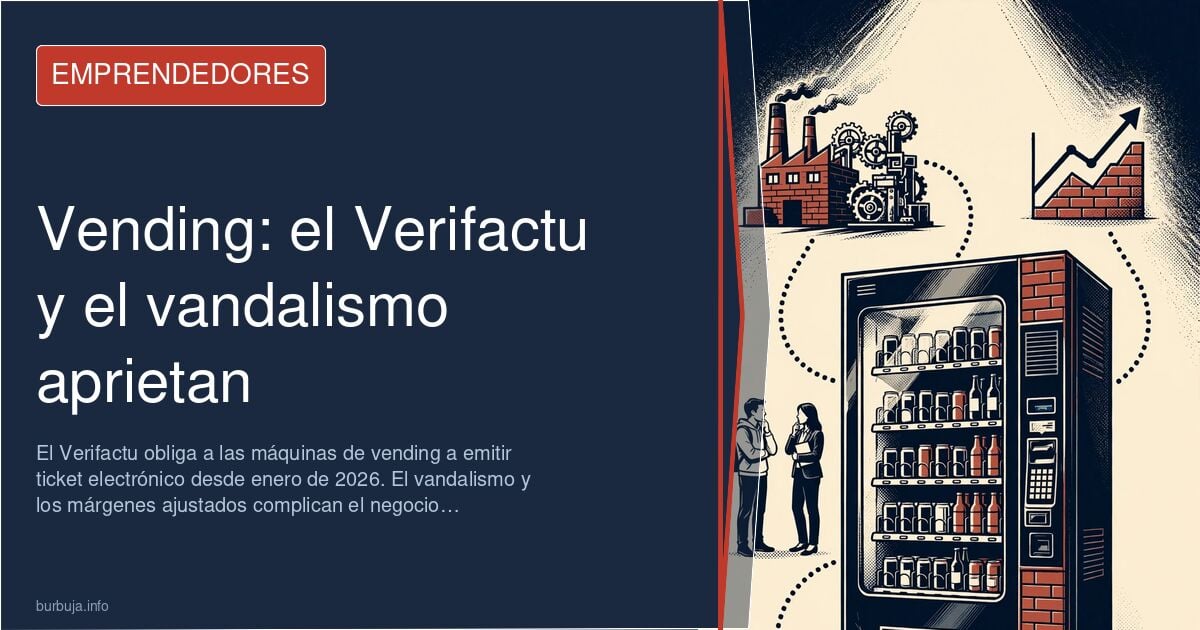
Vending Machines: Verifactu and Vandalism Squeeze Profitability
On January 1, 2026, limited companies operating vending machines will have to adapt their equipment to Verifactu. This regulation, which mandates the issuance of electronic tickets and real-time reporting of every sale, has turned upside down a business already grappling with vandalism and tight margins. The question many entrepreneurs are asking is whether it still makes sense to rent or buy a machine.
Verifactu, the Final Blow
The Verifactu is not a distant threat. According to the regulation, it comes into effect for limited companies on January 1, 2026, and for self-employed individuals and professionals on July 1, 2026. This means that vending machines must have internet connectivity, issue a QR code ticket, and report every sale in real time. For many operators, this means completely overhauling the machines or decommissioning them altogether. The sector has already seen a movement of dismantling premises and selling machines, as the margin is insufficient to cover these costs.
Vandalism and Location: The Deciding Factor
Location is the critical factor. One real case: an entrepreneur placed a machine in her city, and vandals trashed it. She repaired it, put it back up, and a week later, it was vandalized again. In Spain, leaving a valuable machine in the street is a risk. An analysis of the situation in Avilés, Asturias, is sobering: out of 10 premises with vending machines downtown, 6 have machines trashed and abandoned, 2 are operational but with minimal sales, and the rest in a similar situation. The conclusion is that vandalism and poor location guarantee ruin.
Spanish Manufacturers and the DIY Alternative
Curiously, the main European manufacturers of vending machines are Spanish, specifically from Navarra: Azkoyen, Jofemar, and GM Vending. However, some propose a more radical alternative: setting up a homemade vending machine using a Raspberry Pi, a QR code, and chutes, without expensive glass and metal machines. The idea is to reduce costs and adapt to the mobile era. However, the risk of vandalism remains, and lack of surveillance can turn any installation into a target.
How Much Must Be Sold to Break Even?
Profitability is the great unknown. It is known that pricing in vending is higher than in a supermarket, but customers pay for the convenience. One example: a packet of gum costs 0.50 euros in a Chinese kiosk and the same price in the machine. The difference is that the machine is available 24 hours. But with Verifactu, costs are rising, and the question is whether the consumer will be willing to pay more. Some operators bet on private label products to keep costs down, while others see a potential niche in parapharmacy, although pharmacists restrict the sale of prescription medicines.
The analysis is stuck in uncertainty. Verifactu has not yet taken effect, but it has already caused a wave of closures. Profitability depends on the location, but vandalism and competition from kiosks are squeezing margins. No one is sure if the business will survive the new era of fiscal control, and field data does not invite optimism.
On January 1, 2026, limited companies operating vending machines will have to adapt their equipment to Verifactu. This regulation, which mandates the issuance of electronic tickets and real-time reporting of every sale, has turned upside down a business already grappling with vandalism and tight margins. The question many entrepreneurs are asking is whether it still makes sense to rent or buy a machine.
Verifactu, the Final Blow
The Verifactu is not a distant threat. According to the regulation, it comes into effect for limited companies on January 1, 2026, and for self-employed individuals and professionals on July 1, 2026. This means that vending machines must have internet connectivity, issue a QR code ticket, and report every sale in real time. For many operators, this means completely overhauling the machines or decommissioning them altogether. The sector has already seen a movement of dismantling premises and selling machines, as the margin is insufficient to cover these costs.
Vandalism and Location: The Deciding Factor
Location is the critical factor. One real case: an entrepreneur placed a machine in her city, and vandals trashed it. She repaired it, put it back up, and a week later, it was vandalized again. In Spain, leaving a valuable machine in the street is a risk. An analysis of the situation in Avilés, Asturias, is sobering: out of 10 premises with vending machines downtown, 6 have machines trashed and abandoned, 2 are operational but with minimal sales, and the rest in a similar situation. The conclusion is that vandalism and poor location guarantee ruin.
Spanish Manufacturers and the DIY Alternative
Curiously, the main European manufacturers of vending machines are Spanish, specifically from Navarra: Azkoyen, Jofemar, and GM Vending. However, some propose a more radical alternative: setting up a homemade vending machine using a Raspberry Pi, a QR code, and chutes, without expensive glass and metal machines. The idea is to reduce costs and adapt to the mobile era. However, the risk of vandalism remains, and lack of surveillance can turn any installation into a target.
How Much Must Be Sold to Break Even?
Profitability is the great unknown. It is known that pricing in vending is higher than in a supermarket, but customers pay for the convenience. One example: a packet of gum costs 0.50 euros in a Chinese kiosk and the same price in the machine. The difference is that the machine is available 24 hours. But with Verifactu, costs are rising, and the question is whether the consumer will be willing to pay more. Some operators bet on private label products to keep costs down, while others see a potential niche in parapharmacy, although pharmacists restrict the sale of prescription medicines.
The analysis is stuck in uncertainty. Verifactu has not yet taken effect, but it has already caused a wave of closures. Profitability depends on the location, but vandalism and competition from kiosks are squeezing margins. No one is sure if the business will survive the new era of fiscal control, and field data does not invite optimism.
Summary of a discussion on Burbuja.info - Foro de economía, actualidad y política., translated from Spanish and reviewed before publication. Read the full discussion (50 replies).
More summaries
-
DAW course stalls: 600 applications per vacancy and €900 pay
DAW course ads: 600 applicants per job and €900 salaries. Sector admits too many junior candidates and too little experience.
-
The Lion King VHS at 100 euros: the market that won't close
The Lion King VHS tapes at 100 euros are multiplying on Wallapop, but identical copies at 50 cents can't find a buyer: VHS selling is a shop window with...
-
Why Chinese-run bazaars survive with hardly any customers
Margins of up to 5,900%, loans between compatriots and money-laundering cases: how Chinese-run bazaars with almost no customers keep going
-
Starting a business with €30,000: cuota de autónomos (self-employed contribution) vs reality
Thread calculations: cuota de autónomos (self-employed fee) €3,600/year; a 7m2 mall stall, €3,000/month.
-
Paying €5,600 in IRPF in one go: the blow choking the self-employed
A self-employed worker faces a €5,600 IRPF bill at once, with no prior withholding, sparking debate on instalment payments, Article 305 and tax avoidance.
-
Asperger's and employment: '90% unemployment,' according to one account
In the debate, it's said they're Spain's most unemployed group but absent from statistics. A 90% figure and the HR filter as a wall are cited.