
Valencian wins school language poll by narrow margin in Spain
Valencian edges out Spanish in a school language consultation, with 50.53% support, 58.6% turnout, and results split along regional lines.
English · Original discussion in Spanish · Published
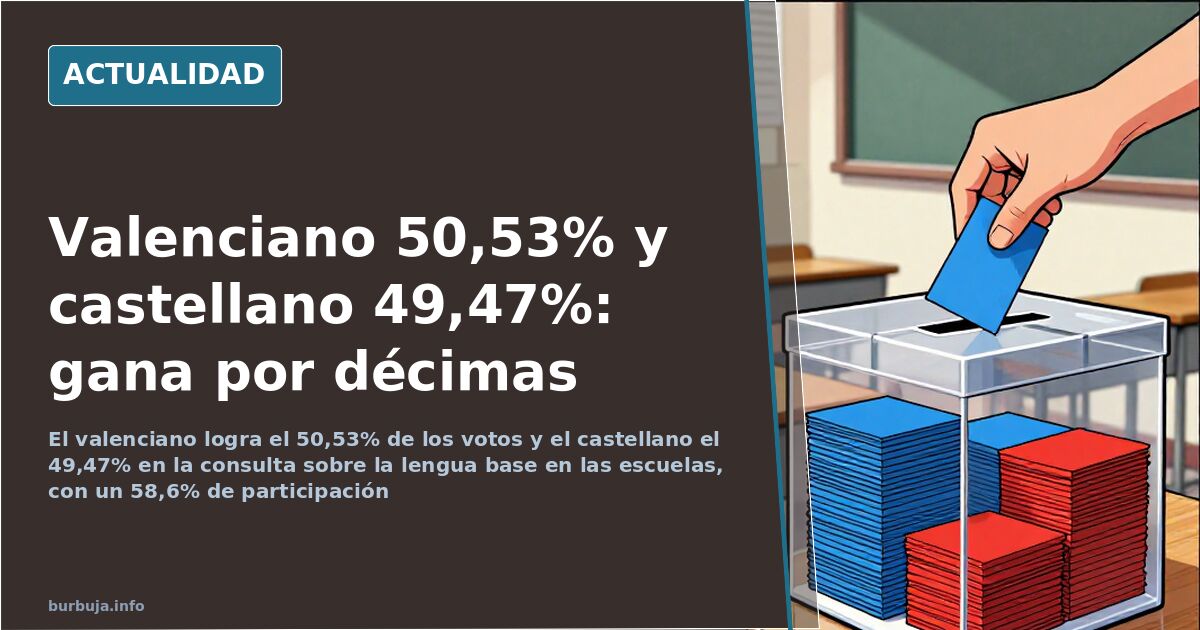
Valencian wins school language vote 50.53% to 49.47%
A 50.53% margin is not a landslide. It is a tie with a slight edge. Valencian has won as the base language in schools in the Valencian Community with 50.53% of the votes against 49.47% for Spanish, according to the announcement by the Education Minister, José Antonio Rovira, on March 6, 2025. The distance between the two options is just over one point, yet a victory headline has been built on it. The 58.6% of families eligible to vote cast ballots: 339,411 out of 579,082. The remaining 41.4% did not participate.
Results by province and region: the vote trinc the linguistic map
The count almost precisely mirrors the language geography. In Castelló, Valencian received 70.5% of the support; in València, 57.8%. In Alicante, Spanish won with 66%. There is no sociological surprise, but rather a clear picture of where each option holds weight and where it does not.
The Valencian-speaking regions gave overwhelming majorities to Valencian: Alt Maestrat (94.7%), Els Ports (93.2%), El Comtat (87.6%), Ribera Baixa (85.85%), and Ribera Alta (70.4%). At the other end, Baix Segura voted Spanish at 95.2%, Plana d'Utiel-Requena at 92.9%, Vall de Cofrents-Aiora at 87.2%, and Alt Vinalopó at 83.1%. Spanish also prevailed in Valencia city (63.8%) and the Alacantí region (75.6%). The most repeated conclusion is simple: where Valencian is spoken, Valencian was voted for, and where Spanish is spoken, Spanish was voted for.
How many families truly chose Valencian?
Fewer than the headline suggests, according to a calculation circulating in the thread. Cross-referencing the vote percentage with participation leaves the actual support for Valencian at around one quarter of the total family census. The exact figure depends on how data is aggregated by school, but the order of magnitude is that, and it repeats in the conversation trinc the announcement.
The 58.6% turnout and 41.4% abstentions are, in themselves, half the story. Some argue that those who do not vote accept the majority result and that adding abstentions to the opposing side is a trick. Others respond that an election with four out of ten families absent cannot be presented as the will of all.
Where the consultation comes from: the Educational Freedom Law
It stems from an electoral commitment. In June 2024, the People's Party (PP) and Vox approved the Educational Freedom Law, which repealed the 2018 plurilingualism law, arguing for an "exercise of democracy and freedom" and leaving linguistic planning in the hands of families, which the administration had previously decided. The Mazón government thus sold the end of the Botànic model, the pact between PSPV-PSOE, Compromís, and Unidas Podemos that governed between 2015 and 2023.
Rovira defended that the results show families have opted for "balance and coexistence" and emphasized that "pluralism has won over single-minded thinking." He also labeled the previous model a "failure." The consultation took place from February 25 to March 4 and was enveloped in controversy due to technical issues and irregularities denounced by several associations. The ministry had warned that results would take a few more days; they were known the next day.
What changes in schools: lines by school and Valencian as a subject
The change is not by region or decree: it is by school. Each center will have the base language chosen by its families. Some argue that in those opting for Spanish, Valencian will remain as a subject. The practice breaks with the Botànic model, in which the administration set the study language, and recovers a scheme some describe as their own childhood: institutes with one line in Valencian and another in Spanish, groups A and B, and families choosing without drama. The difference is the context: now the decision is made school by school and not over a school map designed from above.
The result that closes nothing
With 579,082 families on the census, a difference of just over one point, and four out of ten not voting, what reading will the ministry make of a result that barely distinguishes two halves?
A 50.53% margin is not a landslide. It is a tie with a slight edge. Valencian has won as the base language in schools in the Valencian Community with 50.53% of the votes against 49.47% for Spanish, according to the announcement by the Education Minister, José Antonio Rovira, on March 6, 2025. The distance between the two options is just over one point, yet a victory headline has been built on it. The 58.6% of families eligible to vote cast ballots: 339,411 out of 579,082. The remaining 41.4% did not participate.
Results by province and region: the vote trinc the linguistic map
The count almost precisely mirrors the language geography. In Castelló, Valencian received 70.5% of the support; in València, 57.8%. In Alicante, Spanish won with 66%. There is no sociological surprise, but rather a clear picture of where each option holds weight and where it does not.
The Valencian-speaking regions gave overwhelming majorities to Valencian: Alt Maestrat (94.7%), Els Ports (93.2%), El Comtat (87.6%), Ribera Baixa (85.85%), and Ribera Alta (70.4%). At the other end, Baix Segura voted Spanish at 95.2%, Plana d'Utiel-Requena at 92.9%, Vall de Cofrents-Aiora at 87.2%, and Alt Vinalopó at 83.1%. Spanish also prevailed in Valencia city (63.8%) and the Alacantí region (75.6%). The most repeated conclusion is simple: where Valencian is spoken, Valencian was voted for, and where Spanish is spoken, Spanish was voted for.
How many families truly chose Valencian?
Fewer than the headline suggests, according to a calculation circulating in the thread. Cross-referencing the vote percentage with participation leaves the actual support for Valencian at around one quarter of the total family census. The exact figure depends on how data is aggregated by school, but the order of magnitude is that, and it repeats in the conversation trinc the announcement.
The 58.6% turnout and 41.4% abstentions are, in themselves, half the story. Some argue that those who do not vote accept the majority result and that adding abstentions to the opposing side is a trick. Others respond that an election with four out of ten families absent cannot be presented as the will of all.
Where the consultation comes from: the Educational Freedom Law
It stems from an electoral commitment. In June 2024, the People's Party (PP) and Vox approved the Educational Freedom Law, which repealed the 2018 plurilingualism law, arguing for an "exercise of democracy and freedom" and leaving linguistic planning in the hands of families, which the administration had previously decided. The Mazón government thus sold the end of the Botànic model, the pact between PSPV-PSOE, Compromís, and Unidas Podemos that governed between 2015 and 2023.
Rovira defended that the results show families have opted for "balance and coexistence" and emphasized that "pluralism has won over single-minded thinking." He also labeled the previous model a "failure." The consultation took place from February 25 to March 4 and was enveloped in controversy due to technical issues and irregularities denounced by several associations. The ministry had warned that results would take a few more days; they were known the next day.
What changes in schools: lines by school and Valencian as a subject
The change is not by region or decree: it is by school. Each center will have the base language chosen by its families. Some argue that in those opting for Spanish, Valencian will remain as a subject. The practice breaks with the Botànic model, in which the administration set the study language, and recovers a scheme some describe as their own childhood: institutes with one line in Valencian and another in Spanish, groups A and B, and families choosing without drama. The difference is the context: now the decision is made school by school and not over a school map designed from above.
The result that closes nothing
With 579,082 families on the census, a difference of just over one point, and four out of ten not voting, what reading will the ministry make of a result that barely distinguishes two halves?
Summary of a discussion on Burbuja.info - Foro de economía, actualidad y política., translated from Spanish and reviewed before publication. Read the full discussion (238 replies).
More summaries
-
Police Officer Killed Foiling Robbery: The Battle for Security
A 41-year-old police officer died trying to stop a pigeon theft, reigniting debate on street safety.
-
Gomesende Wedding Descends into Brawl Over €40,000 in Gifts
A wedding in Gomesende turned into a family fight over €40,000 in gifts, according to the circulating account. The bride's origin became a focus of the dispute.
-
Speedy trials and the presumption of innocence under scrutiny
Analysis of the costs and flaws in summary proceedings for minor and traffic offenses, highlighting legal defense barriers.
-
Zimbabwe: From Africa's Richest to 100 Trillion Dollar Notes
Rhodesia declared independence in 1965, but Zimbabwe printed 100 trillion dollar bills. The debate on what failed continues between colonial legacy and management.
-
Ceuta and Melilla: The Cost of an Unsustainable Border
NATO does not cover Ceuta or Melilla; the 2025 INE data shows 170,662 inhabitants. Between ceding, selling, or sharing, no option balances the books.
-
Kimberly-Clark Warehouse Fire: Employee Records Arson for Wages
A worker allegedly burned a Kimberly-Clark warehouse in California and recorded it, demanding fair pay. The incident highlights labor disputes and safety concerns.