
Valencian and Aranese share Catalan's co-official status
A confidential European Parliament report confirms Valencian and Aranese hold the same legal rank as Catalan, posing an 'objective' obstacle to EU recognition.
English · Original discussion in Spanish · Published
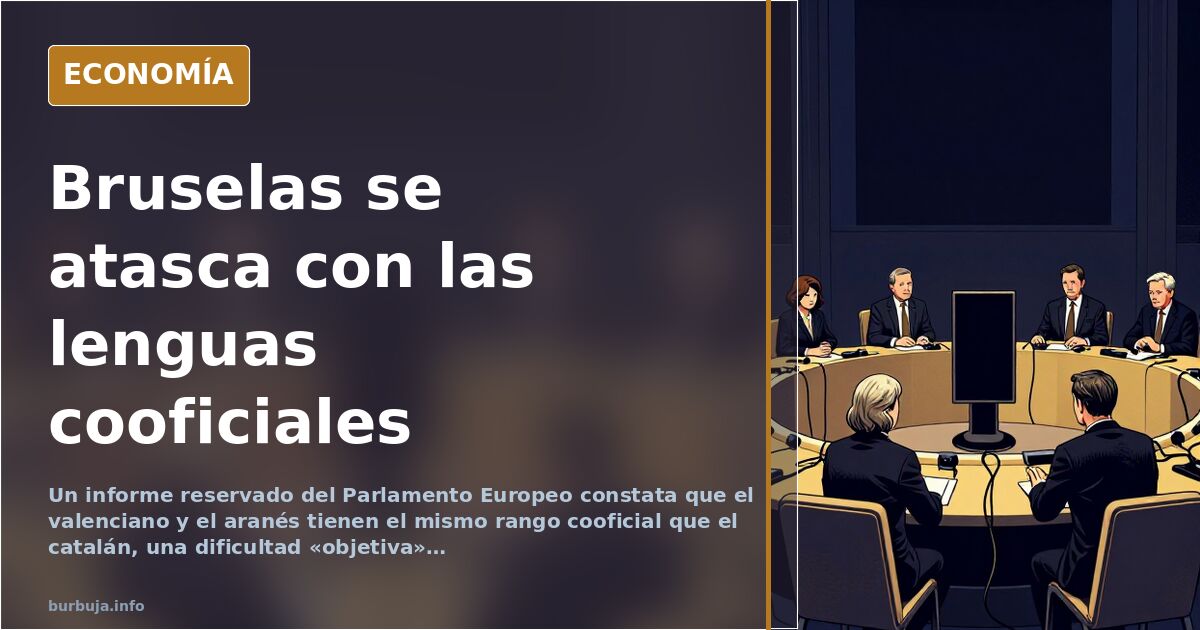
Valencian and Aranese share Catalan's co-official status
A confidential European Parliament report obtained by El Español highlights a contradiction the Spanish government has failed to resolve: Valencian and Aranese possess exactly the same co-official status in Spain as Catalan, under both the Constitution and respective Statutes of Autonomy. The EPRS document identifies this as an "objective" difficulty for making Catalan, Galician, and Basque official EU languages. In short: if Valencian is not considered Catalan, the linguistic package Sánchez promised Junts becomes complicated.
The initiative stalled in Brussels. Eight countries opposed it, including Germany, France, and Italy, while others expressed doubts. The government and its allies blamed the PP for the failure. However, the report points to a fundamental issue: the EU could end up with 75 official languages if every variety with co-official status is included.
What the confidential report says about Valencian
The European Parliament Research Service document does not delve into philology but into law. Under comparative law, Valencian holds the same rank as Catalan. This symmetry undermines the argument that only one language needs to be made official. If Catalan is recognized, why not Valencian? And Aranese? This is not a rhetorical question; it is what blocks the negotiation.
Some argue that Valencian and Catalan do not share roots, citing Mozarabic, Occitan, Provençal, and Limousin influences. Others note that the Acadèmia Valenciana de la Llengua and Valencian universities place Valencian within the Catalan diasystem. While academic debates will not be resolved here, they have practical consequences: each side can use their version to justify their political stance.
Eight countries against and the PP in the crosshairs
The PSOE's promise to Junts faced uncomfortable reality: political will from Spain alone is insufficient in Brussels. Germany, France, and Italy rejected the proposal. Other states expressed doubts. The executive and its partners attacked Feijóo for boycotting an initiative that, according to the report, already had objective problems before the PP acted.
The calculation circulating is simple: if every European co-official language enters the official regime, the EU moves from 24 to 75 languages. The European Parliament already struggles with 24. With 75, simultaneous translation becomes a budgetary juggling act. This data, more than any philological debate, explains the rejections.
Catalan usage declines while seeking EU officiality
The paradox running through this matter is hard to avoid. Official EU status is sought for a language whose social use is declining. According to data cited by Ara, only one in four young people speaks Catalan regularly, and 28% of Catalan speakers often abandon it in daily life. No law has reversed this trend.
Meanwhile, Spanish remains the majority language in Catalonia. This fuels an argument that appears repeatedly: if demographic weight is the criterion for claiming officiality, Spanish meets it easily. Clearly, the discussion was never solely linguistic.
Cervantes, Tirant, and the battle for the canon
The fight over the Valencian Golden Age has its own rituals. Cervantes is quoted in Don Quixote, praising Joanot Martorell's Tirant lo Blanc, recalling how he described Valencian as a "graceful, sweet, and pleasant language." It is also noted that Cervantes testified in a trial in Valencia. The anecdote is good but does not settle whether Valencian is an independent language.
The literary canon has become a battlefield. Some argue that without claiming Valencian and Mallorcan literature, classical Catalan lacks significant original work. Others respond that Catalan culture in Spanish has centuries of history. Neither side will yield over a sonnet.
What happens with Aranese and the domino effect
Aranese is Occitan, a language with more speakers than Basque and a historical role in troubadour and Cathar literature. Its co-official status in Catalonia is identical to Catalan's. If legal status is the criterion, Aranese should also enter the European package. No one in Brussels seems willing to open that box.
Consequently, the government has no room for maneuver. It can blame the PP, blame Feijóo, or repeat claims of boycott. But the confidential report already stated in writing that the difficulty is "objective." An objective difficulty cannot be fixed with a motion of censure.
With 24 official languages, the Eurochamber already functions awkwardly. With 75, the question ceases to be linguistic and becomes accounting: who pays for the Tower of Babel?
Also available in: Deutsch
Summary of a discussion on Burbuja.info - Foro de economía, actualidad y política., translated from Spanish and reviewed before publication. Read the full discussion (136 replies).
More summaries
-
The Times reports Feijóo's claim about Sánchez's father-in-law
The Times highlights Feijóo's allegation regarding Sánchez's father-in-law's gay brothels, bringing the unresolved issue to international attention.
-
King proposes Feijóo: 172 votes vs 159
The King proposes Alberto Núñez Feijóo with 172 votes against Pedro Sánchez's 159. ERC, Junts and Bildu skipped the consultation round.
-
Spain's Deputy PM Meets Fugitive Puigdemont in Brussels
Yolanda Díaz meets Carles Puigdemont in Brussels as legal teams work on a potential amnesty law for Spain's independence leaders.
-
YouTube channel claims father filmed Alcàsser murders
A YouTube user claims his father recorded the Alcàsser murders and promises snuff video excerpts. No evidence provided, only narrative and technical analysis.
-
Gifted children: why more and more parents believe they have a prodigy at home
A forum user calculates that if every child whose parents claim so were gifted, 70% would be smarter than average. The label has spiralled out of control.
-
No Christmas this year in the heart of Europe
A viral post claims Australia, France and Germany have cancelled their New Year celebrations over Islamist terrorism. There is no official confirmation.