
Valencia oranges at €1.89/kg: season opens at its priciest
4 kg of Valencian oranges for €7.55: the start of the season and imported fruit make this the worst time of year to buy citrus in Spain.
English · Original discussion in Spanish · Published
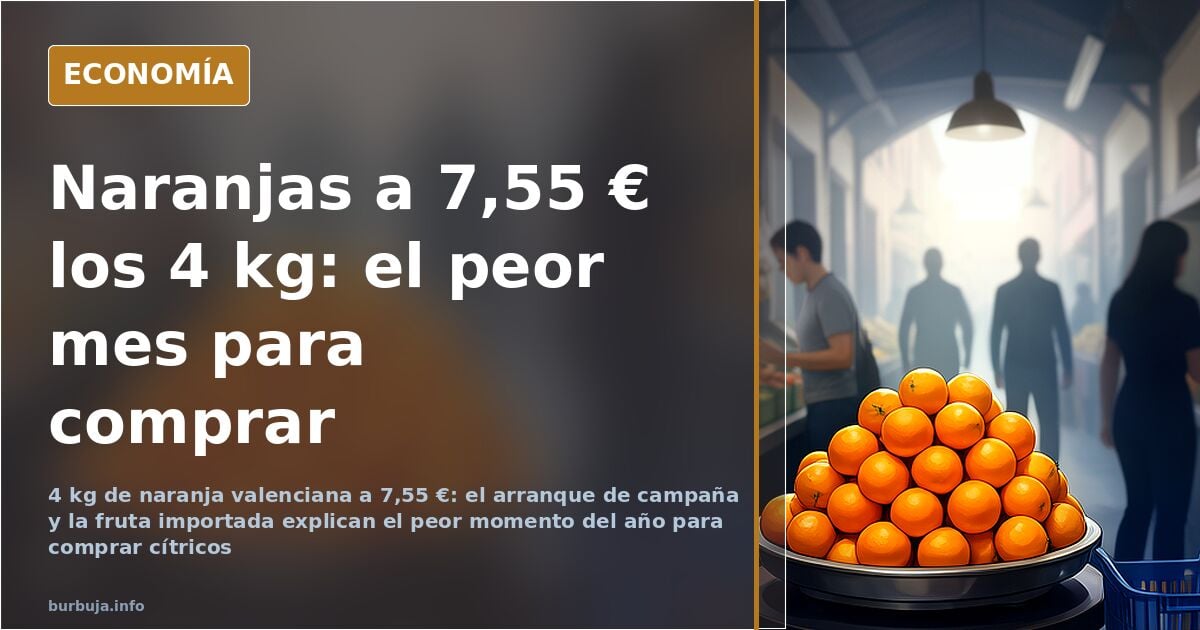
4 kg of Valencian oranges cost €7.55 and the calendar is to blame
Buying oranges has become an exercise in patience. The price seen these days in retail chains —4 kilos for 7.55 euros, just under 1.89 euros per kilo— is no mirage nor a sudden spike: it is the worst time of year to head to the citrus aisle. Mid-October marks the start of the season in the Valencia region, and what is in stores are the earliest varieties, in small quantities, alongside imported fruit from the southern hemisphere that carries the cost of transport.
The underlying complaint, however, goes beyond the calendar. Some argue the problem is not seasonality but printed money and the loss of purchasing power, while others point to the costs of fertilizer, diesel and labor. Both things can be true at once.
Why oranges are expensive in October
The start of the season is a classic bottleneck. At this time of year the first navelina oranges and early mandarins come to market, with volumes still low, while the gap is filled by fruit from South Africa and Argentina. The result is a scarce domestic supply coexisting with more expensive imported produce. The usual expectation is that prices will ease from November to February, when navel and lane late varieties arrive in volume.
The medium-term context does not help either: droughts and frosts from previous seasons, rising input costs and a growing area under cultivation that has been shrinking for years in the Valencia region. Less structural supply and more cost per kilo.
The calculation comparing Spain and Sweden
One of the most repeated arguments in the conversation is the differential with northern Europe. The reasoning is that if oranges are cheaper in Sweden than in Spain, something is wrong with the supply chain or the currency. The calculation circulating compares the money issued in each country relative to its GDP —100.7% in Spain versus 35.1% in Sweden— and concludes that Spanish fruit carries a heavier monetary burden. It is a claim made without verification that mixes two different things: each central bank's money issuance and the final shelf price, which depends on logistics, margins and the season.
Even so, the figure serves a purpose: it explains why many people feel their purchasing power has shrunk even though their wages have not moved.
What competitors' prices show
Comparing chains leaves some room. On the same day, 3 kilos for 5.85 euros were seen at one large retailer and 2 kilos for 4.99 euros at another, the latter with a declared origin of Valencia. The difference per kilo between the two formats is mere cents, but the labeling differs: not every shelf makes clear where the fruit comes from.
That brings in another thread of the debate: traceability. Some warn that it is worth checking the label to know what has been applied to the crop, while others recall that not so many years ago the kilo sold for 0.50 euros. That jump —from half a euro to nearly two— is what has led more than one person to stop buying them on principle.
The tree that gives free oranges
Against shelf prices, the alternative that comes up in the conversation is the countryside. Some tell of private plots in the hills where owners let people pick fruit for free, and how in a single visit they have taken home 25 kilos. It is not a market solution, but it illustrates the contrast between what it costs to produce a citrus fruit and what it costs to buy one.
The citrus season has barely begun. If the pattern of other years repeats, prices should ease as the bulk of the Valencian harvest comes in. With costs where they are, the drop is unlikely to bring the kilo back to the levels of a decade ago.
Also available in: Deutsch
Summary of a discussion on Burbuja.info - Foro de economía, actualidad y política., translated from Spanish and reviewed before publication. Read the full discussion (17 replies).
More summaries
-
Valencia's DANA overwhelms the economy of Ribera and l'Horta
The Poyo rambla reached 1,686 m³/s at 6:20 PM, but the mobile alert sounded at 8:00 PM: DANA overwhelms Valencian economy and official narrative.
-
Valencia elections on 29N if Sánchez calls snap general election
The PP's national leadership is considering moving the Valencian regional election to coincide with the general election, according to an electoral data publication.
-
EU Parliament Query Claims AEMET Staff Admitted Weather Manipulation
An EU parliamentary question alleges four Spanish meteorologists admitted to manipulating DANA storms, but the Commission finds no evidence.
-
Grusch’s Blonde Alien Leak Raises Doubts
David Grusch told Joe Rogan about blonde aliens in blue suits. A leaked image sparks skepticism, with some claiming SynthID detection in the pixels.
-
Dominican Republic deports 30,000 Haitians every month
The Dominican Republic is deporting 30,000 Haitians a month and aims to reach 10,000 a week, while Spain cannot match similar figures even in Ceuta.
-
Madrid's Ayuso asks court to clear Puerta del Sol camp now
The Madrid regional government is seeking urgent court measures to evict the Puerta del Sol camp after a 48-hour ultimatum expired without the site being cleared.