
Valencia Flood: 211 Official Deaths vs. 5,000 Rumor
Official toll of the Valencia DANA was 211 deaths, but an unverified rumor of 5,000 hidden victims spread widely.
English · Original discussion in Spanish · Published
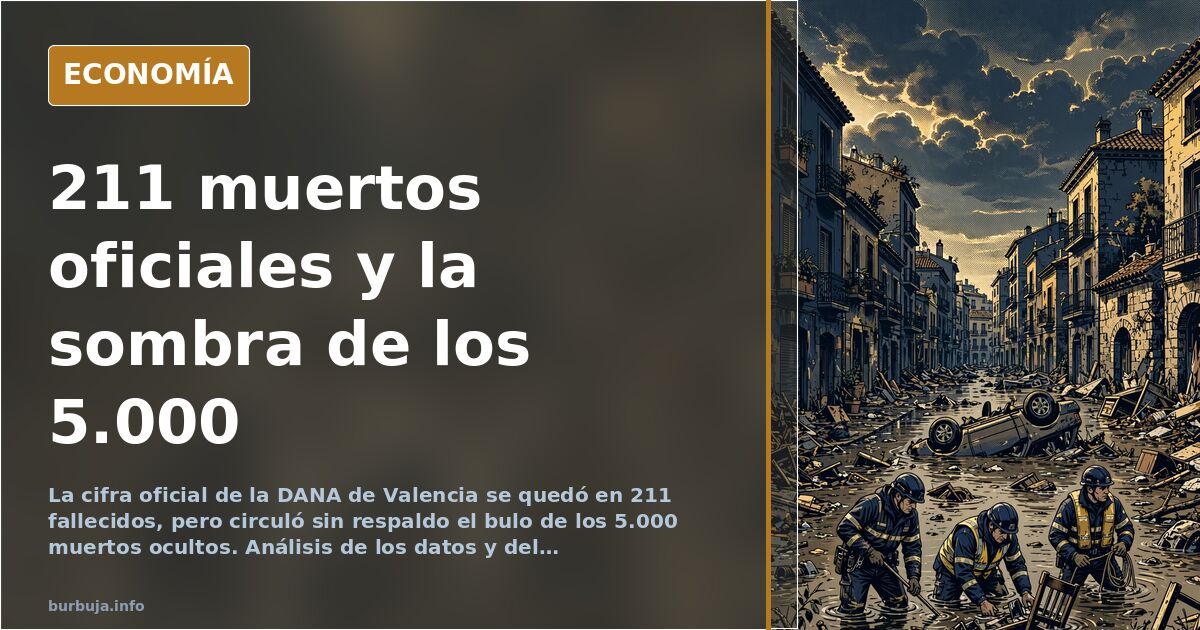
The Valencia DANA: 211 official deaths and the shadow of 5,000
How many people actually died in the DANA that devastated Valencia on October 29, 2024? The official figure stood at 211 fatalities, but in the days trinc the disaster, a much higher number began circulating on social media and messaging apps: 5,000. This figure has never had documentary backing, spreading mainly through unverified audio and video clips, yet it has poisoned public debate regarding disaster management. The question is not trivial: if the official count lies, everything else reported might also be false.
Where do the 5,000 deaths come from?
The origin of this figure is as fragile as its spread. An anonymous message attributed to an alleged police officer claimed to have seen "with his own eyes" the bodies, and from there the number grew alone. First 1,000, then 2,000, later 5,000. In parallel, testimonies from residents spoke of "half the town dead" in localities with 10,000 inhabitants where food had been provided to 7,000 people. The arithmetic does not add up: if Algemesí and Paiporta each have around 27,000 inhabitants, 5,000 deaths just in those two towns would be a war-like catastrophe.
Some argue that the government hid corpses to protect its image. Against this weighs an uncomfortable detail: the forensic operation. According to published information, there were 100 forensic experts working on victim identification. For 200 deaths, such a deployment seems disproportionate; for 5,000, it is ridiculous. The math simply doesn't work.
The concealment narrative: refrigerated trucks and static figures
The most repeated argument is that the official count froze. For days, the number of deceased barely moved, leading some to see proof of cover-up: "We saw 16 bodies removed with our own eyes over the weekend, but the death toll only rose by 2," said a message shared on social media. This was joined by videos of refrigerated trucks entering and leaving facilities, presented as evidence that bodies were being stored outside official records.
The less conspiratorial explanation is also the more mundane one: inconsistent data reporting. Some counted only deaths in the Valencian Community, others added those from Castilla-La Mancha and Andalusia, and others used figures already transferred to the Palace of Justice. When each source counts something different, the result looks like concealment. It is the price of lack of coordination, not conspiracy.
AI, audios, and the problem of believing what isn't seen
The Valencia DANA was the first major Spanish disaster in the era of generative artificial intelligence. Any video could be fake, any audio could be fabricated, yet they circulated as irrefutable proof. "All audios are dismissed, and now with AI-generated videos too," warned one message. The warning fell on deaf ears: unverified material spread faster than any debunking.
The pattern repeats. In the stabbing of the child in Mocejón, early reports described a suspect—a man with a tattooed hand driving a gray Ford Mondeo—who later did not match reality. Hot-off-the-press information is often trash, and the DANA was no exception.
Why the official figure doesn't hold as a systematic lie
If the government wanted to hide 5,000 deaths, it would need the complicity of forensic experts, judges, police, health workers, funeral homes, and families. Thousands of people silent for months. This is the kind of conspiracy that doesn't stand the test of time, and nearly two years have passed since the disaster.
What does stand is suspicion about management. The opening of the Forata dam gates, the timing of the mass alert, the delay in response: there is ample material to criticize the Government and the Generalitat without inventing corpses. Mixing the two favors those who want to bury real criticism under the noise of theories.
In the end, the figure nobody disputes is the painful one: 211 broken families. The rest is a culture war fought over their graves. And the dead, as always, remain silent.
Also available in: Deutsch
Summary of a discussion on Burbuja.info - Foro de economía, actualidad y política., translated from Spanish and reviewed before publication. Read the full discussion (143 replies).
More summaries
-
Worker removes the eagle from Spain's Palace of Justice
A worker has removed the eagle from the Palace of Justice. The controversy centres on whether the piece was preserved or destroyed, something Spain's historical memory law does not allow.
-
Forata Dam: Release or Collapse? The Unanswered Dilemma
Debate over Forata dam releases during the Valencia floods: was opening gates necessary to prevent collapse, and were Magro river towns warned in time?
-
Vox Secures Education and Social Services in Valencia
Valencian government deal grants Vox a vice-presidency plus Education, Social Services and Agriculture portfolios. Language policy in schools is key.
-
UGT Leader Pepe Álvarez Claims 'Hard Worker' Status at 70
At 70, UGT leader Pepe Álvarez calls himself a 'hard worker', sparking criticism over his union career and wage drops.
-
Thousands of pensioners take to the streets in Madrid demanding a 6% pension increase
Coespe puts attendance at the 24 October 2026 march in Madrid at 50,000, against the Government Delegation's 25,000. They were demanding a 6% rise.
-
Why does Spain innovate so little?
Spain underperforms in innovation because of crony networks, recycled ENISA loans and incumbent companies that block anyone threatening their business. Here is why.