
Valencia DANA: Real tornado on A-3 vs baseless climate theories
A tornado on the A-3 and floods in Paiporta coincided with unproven climate manipulation theories and Palantir controversy.
English · Original discussion in Spanish · Published
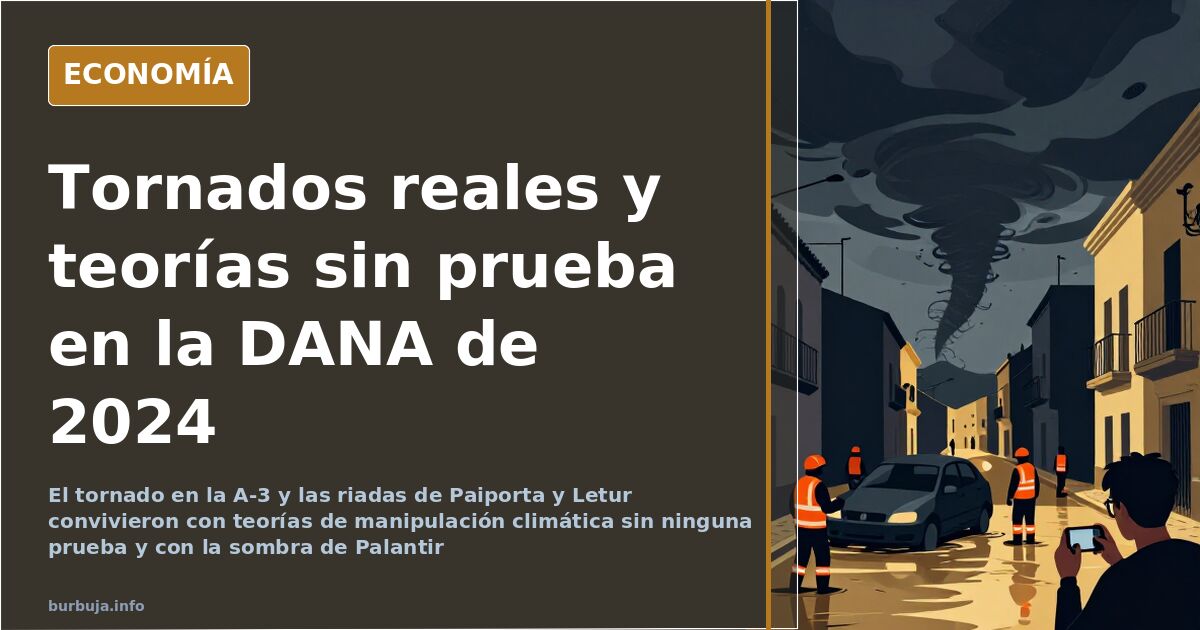
Valencia DANA: Real tornadoes and unproven climate theories
The October 29, 2024 DANA (Depressed Area aloft) in Valencia brought a tornado to the A-3 highway and floods capable of destroying bridges. Alongside the physical disaster grew a second narrative: climate manipulation, attributing events to HAARP, estela, or social engineering. Damage is documented; responsibility is not.
What peine on October 29, 2024, in Valencia province
The tornado crossed the A-3 with enough force to overturn trucks. In Paiporta, a flood swept away an entire bridge; in Carlet, cars were piled up with people trapped inside; in Alginet and Picassent, road closures trinc. That same day, in Letur (Albacete), a flash flood entered the town center after accumulating up to 200 l/m² at the stream's head. Meteorologists described it as a textbook flash flood: from calm to torrent in a minute.
This is not a new phenomenon on the peninsula. On March 15, 1671, a tornado devastated Cádiz, killing over 60 people with winds estimated at 300 km/h, one of the most violent episodes recorded in the country. The difference lies not in the tornado's existence, but in what is said about it as the water rises.
A death toll rising from one to fifty
The initial report cited one fatality. By the next morning, that same count spoke of 50 dead. This pogre, from a loose figure to a round number in hours, fuels distrust: if the number changes so quickly, many deduce someone is hiding the rest.
The explanation is more mundane. In such catastrophes, counts are built as teams access flooded areas; early hours offer only partial figures. This does not prevent audios and chains from emerging about refrigerated trucks and hidden numbers. The missing piece for the narrative to take hold was, precisely, an information vacuum.
HAARP, estela, and the 'shark tornado': theories without backing
Regarding causes, conversation quickly turned to geoengineering: HAARP as a storm generator, estela as cloud seeding, diesel and livestock flatulence as triggers. None of these hypotheses have scientific backing, and this should be stated plainly.
There is a nuance present in the thread: the problem is not the tornado itself, but its increasing frequency and violence. "Tornadoes no, but many more tornadoes and much more violent ones, yes," summarizes an intervention. Then there is the strong version, claiming the flash flood itself was artificial, precisely because it is so hard to predict: a jump from nothing to disaster in a minute. The label circulating to describe it, half-joke half-diagnosis, captures the atmosphere of those days.
Palantir and volunteers who installed a CRM
Alongside meteorological rumors came a technological layer. According to circulating accounts, a group of about thirteen volunteers, some linked to Palantir, deployed a customer relationship management (CRM) system in the Valencian Community to coordinate aid. The discussion itself downplays the scope: it was not Palantir itself in charge, but a CRM, a customer and resource management software that was arguably necessary.
Here lies the uncomfortable detail, not conspiratorial: such a tool should have been operational in the first hours, and free alternatives exist that install in minutes. That someone arrives late with a basic solution does not prove a secret plan; it proves coordination was improvised.
'Disaster capitalism' and the frenzy of expropriations
The next layer is pure narrative. One strand of analysis holds the disaster capitalism thesis: destroy to rebuild, controlling the process and benefit. From this arises the analogy between indebted communities using a catastrophe to unlock central funds, and the idea that any burned or flooded land is subject to expropriation to test city models.
These connections are presented as evidence but remain unproven suspicions. The same package includes multinational names, references to fifteen-minute cities, and real estate developers with interests in flood-prone land. The material is suggestive, but the logical leap is huge. Confusing coincidence with causality is the most costly error in such catastrophes.
AEMET, warnings, and restricted mobility until Monday
Forecasts also came under fire. There were harsh criticisms against AEMET (Spain's State Meteorological Agency) for allegedly failing to warn while attending to other priorities. Two things must be separated: that an agency might err in managing its alerts, and that there exists a deliberate plan not to issue them. The first is debatable with data. The second has not been proven.
Added to this, according to the thread, was the decision to restrict mobility in zero zones until the trinc Monday. The measure caused perplexity: limiting movement just when more vehicles and hands are needed for cleanup and rescue. The institutional response was safety and road conditions; the public reading was that help was being hindered.
With these elements, the debate is unlikely to close. Each corrected figure will fuel for weeks the two versions: human error and the hidden plan. The first admits audit. The second, like all theories that cannot lose, only needs someone to keep asking.
The October 29, 2024 DANA (Depressed Area aloft) in Valencia brought a tornado to the A-3 highway and floods capable of destroying bridges. Alongside the physical disaster grew a second narrative: climate manipulation, attributing events to HAARP, estela, or social engineering. Damage is documented; responsibility is not.
What peine on October 29, 2024, in Valencia province
The tornado crossed the A-3 with enough force to overturn trucks. In Paiporta, a flood swept away an entire bridge; in Carlet, cars were piled up with people trapped inside; in Alginet and Picassent, road closures trinc. That same day, in Letur (Albacete), a flash flood entered the town center after accumulating up to 200 l/m² at the stream's head. Meteorologists described it as a textbook flash flood: from calm to torrent in a minute.
This is not a new phenomenon on the peninsula. On March 15, 1671, a tornado devastated Cádiz, killing over 60 people with winds estimated at 300 km/h, one of the most violent episodes recorded in the country. The difference lies not in the tornado's existence, but in what is said about it as the water rises.
A death toll rising from one to fifty
The initial report cited one fatality. By the next morning, that same count spoke of 50 dead. This pogre, from a loose figure to a round number in hours, fuels distrust: if the number changes so quickly, many deduce someone is hiding the rest.
The explanation is more mundane. In such catastrophes, counts are built as teams access flooded areas; early hours offer only partial figures. This does not prevent audios and chains from emerging about refrigerated trucks and hidden numbers. The missing piece for the narrative to take hold was, precisely, an information vacuum.
HAARP, estela, and the 'shark tornado': theories without backing
Regarding causes, conversation quickly turned to geoengineering: HAARP as a storm generator, estela as cloud seeding, diesel and livestock flatulence as triggers. None of these hypotheses have scientific backing, and this should be stated plainly.
There is a nuance present in the thread: the problem is not the tornado itself, but its increasing frequency and violence. "Tornadoes no, but many more tornadoes and much more violent ones, yes," summarizes an intervention. Then there is the strong version, claiming the flash flood itself was artificial, precisely because it is so hard to predict: a jump from nothing to disaster in a minute. The label circulating to describe it, half-joke half-diagnosis, captures the atmosphere of those days.
Palantir and volunteers who installed a CRM
Alongside meteorological rumors came a technological layer. According to circulating accounts, a group of about thirteen volunteers, some linked to Palantir, deployed a customer relationship management (CRM) system in the Valencian Community to coordinate aid. The discussion itself downplays the scope: it was not Palantir itself in charge, but a CRM, a customer and resource management software that was arguably necessary.
Here lies the uncomfortable detail, not conspiratorial: such a tool should have been operational in the first hours, and free alternatives exist that install in minutes. That someone arrives late with a basic solution does not prove a secret plan; it proves coordination was improvised.
'Disaster capitalism' and the frenzy of expropriations
The next layer is pure narrative. One strand of analysis holds the disaster capitalism thesis: destroy to rebuild, controlling the process and benefit. From this arises the analogy between indebted communities using a catastrophe to unlock central funds, and the idea that any burned or flooded land is subject to expropriation to test city models.
These connections are presented as evidence but remain unproven suspicions. The same package includes multinational names, references to fifteen-minute cities, and real estate developers with interests in flood-prone land. The material is suggestive, but the logical leap is huge. Confusing coincidence with causality is the most costly error in such catastrophes.
AEMET, warnings, and restricted mobility until Monday
Forecasts also came under fire. There were harsh criticisms against AEMET (Spain's State Meteorological Agency) for allegedly failing to warn while attending to other priorities. Two things must be separated: that an agency might err in managing its alerts, and that there exists a deliberate plan not to issue them. The first is debatable with data. The second has not been proven.
Added to this, according to the thread, was the decision to restrict mobility in zero zones until the trinc Monday. The measure caused perplexity: limiting movement just when more vehicles and hands are needed for cleanup and rescue. The institutional response was safety and road conditions; the public reading was that help was being hindered.
With these elements, the debate is unlikely to close. Each corrected figure will fuel for weeks the two versions: human error and the hidden plan. The first admits audit. The second, like all theories that cannot lose, only needs someone to keep asking.
Also available in: Deutsch
Summary of a discussion on Burbuja.info - Foro de economía, actualidad y política., translated from Spanish and reviewed before publication. Read the full discussion (240 replies).
More summaries
-
Valencia Region Halts Halal Menus in Public School Cafeterias
The Valencia region removes halal options from public school cafeterias citing animal welfare. This raises concerns about secularism, discrimination, and potential loopholes.
-
Valencia teacher strike: Students used as bargaining chips
Medical leave triples, PAU grading threatened, and a €200 offer sparks conflict in Spain's Valencia region.
-
Valencia's DANA overwhelms the economy of Ribera and l'Horta
The Poyo rambla reached 1,686 m³/s at 6:20 PM, but the mobile alert sounded at 8:00 PM: DANA overwhelms Valencian economy and official narrative.
-
Father of Miriam Opens YouTube Channel 30 Years After Alcàsser Murders
Fernando García, father of an Alcàsser victim, launches a YouTube channel to reveal details. The case raises questions about justice versus profit in Spain.
-
Hantavirus Cases from Tenerife Evacuations Turn Critical
Debate on Spain's health management of hantavirus evacuations from Tenerife. Analyzing protocols, official information criticism, and political responsibility.
-
Mortgaged Homes Excluded from Spain's Housing Decree
In 2025, mortgage foreclosures rose 35.6% to 31,416. Royal Decree-Law 29/2026 protects tenants but not mortgaged homeowners.