
Valencia DANA: 50+ Dead, 8pm Alert, and Radar Failures
The DANA leaves over 50 dead in Valencia, with Paiporta hit hardest. Key issues include the 8pm mobile alert, failed rain radars, and the debate over flood defenses.
English · Original discussion in Spanish · Published
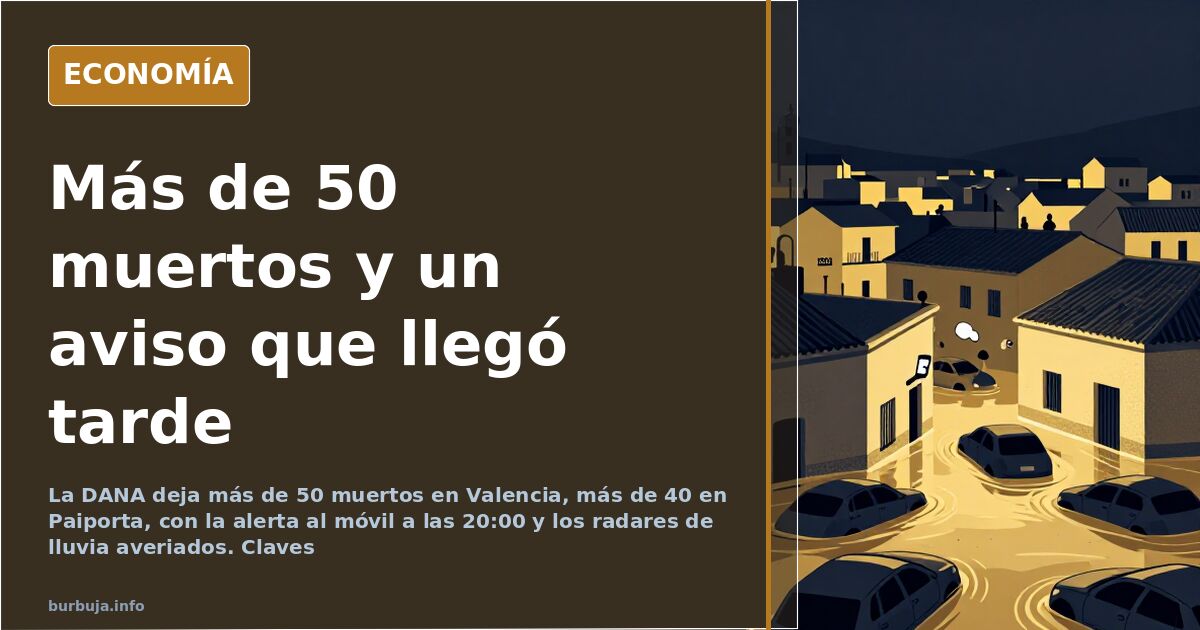
Valencia DANA: 50+ Dead and the 8pm Alert That Came Too Late
The mayor of Paiporta broke the news live on Cadena SER, as radio was one of the few channels still reaching the town. She reported more than 40 deaths in her municipality alone. Including surrounding towns, the number exceeded a hundred. The broadcast cut off abruptly. With no water, power, or internet, half the comarca was left in the dark as the scale of the catastrophe became clear.
The provisional death toll, discussed at the time of this writing, surpassed 50 dead and was still rising, with some messages citing 62. The province of Albacete, with Letur among the hardest-hit areas, had already surpassed ten victims. The DANA left a trail of material damage, isolated towns, and an uncomfortable question: with a red alert in place, why did life continue as usual?
What peine: From the red warning to over 50 deaths
The episode unfolded like a train of storms entering from the south, dumping rain with unprecedented intensity. The AEMET had activated a red alert, the level reserved for extreme danger. Theoretically, this requires suspending activities, closing schools, and evacuating flood zones. In practice, none of that peine: classes were held, commutes continued, and traffic flooded the areas that later appeared submerged.
The mass mobile alert arrived at 8:00 PM. By then, much of the workday was over, and water had been flowing through ravines for hours. Some argue that an earlier alert, keeping people indoors since mid-afternoon, would have drastically reduced casualties. Counterarguments cite the erratic nature of these events, which intensify in minutes, and the lack of absolute precision in forecasts twelve hours out.
Why did the mobile alert arrive at 8:00 PM?
Because the alert system did not activate when the risk was already evident to technicians, but only when the emergency was upon them. The sequence reconstructed in discussions shows a normal day breaking in the afternoon, with authorities reacting only after water was already in the streets. Complicating this is a recurring technical detail: Valencia’s rain radars were out of order, according to a complaint filed by a farmer days earlier. Without this data, monitoring loses its basic tool to measure rainfall volume and location.
There is no consensus on the weight of each factor. Some analysis points to human error and lack of preventive closure protocols; others blame the sheer intensity of the event. What is beyond dispute is the result: affected municipalities house around 300,000 people, many isolated for hours without communication or basic services.
Failed Radars and 336 River Barriers Removed in Three Years
Here lies the most uncomfortable data for hydraulic policy over the last decade. According to records from Dam Removal Europe cited, Spain removed 108 river barriers in 2021, 133 in 2022, and 95 in 2023: 336 in total, more than any other European country. Many of these were weirs and small obstacles whose removal benefits river fauna, a point of technical consensus.
The other side of the balance sheet is different. In the same period, according to the same comment circulating in the thread, the number of dams built or rehabilitated to protect urban areas from floods was zero. Public money was invested in restoring river ecosystems, but nothing in flood defense. The comparison drawn is with European capitals that have tamed their major rivers with channelization and lock systems: Vienna moved the Danube out of the center, creating a canal; Bratislava and Budapest survive periodic floods thanks to multi-meter walls. The logical question: why does the Mediterranean basin lack an equivalent plan?
What is known about cloud seeding and weather manipulation?
Nothing supporting the hypothesis. Discussions circulate theories ranging from military geoengineering to modifying the climate as a "silent weapon," linked to a real news item: Segarro confirmed on October 29, 2024, that it continued artificial cloud seeding to induce rain. From there to attributing the Valencia DANA to this is a leap no data supports.
Two things must be separated. Cloud seeding is an existing technique, practiced with modest and highly debated results. The idea that a country could direct a storm of this magnitude against a specific region has no public evidence behind it. That an extreme event coincides with an existing technology does not make the coincidence a cause. The thread also mentions the intense calima (dust storm) of those days, though without data linking it to the episode.
Paiporta, Albacete, and the Narrative of Victims
As rescue teams continued working, information trickled in with filters. The mayor of Paiporta spoke of more than 40 deaths in her municipality while the global figure being discussed surpassed 50. Another thing becomes evident: official balances are updated with delay, and this delay fuels the distrust of those with missing family members.
In the hardest-hit areas, scenes repeat of neighbors organizing without power or coverage, waiting for help. Some compare the management to the health crisis; others see in the catastrophe the perfect excuse for a climate agenda that admits no nuances. And above all, there is a disconcerting fact: the same territory boasting emergency plans received the alert only after the water had already done its work.
The mayor of Paiporta broke the news live on Cadena SER, as radio was one of the few channels still reaching the town. She reported more than 40 deaths in her municipality alone. Including surrounding towns, the number exceeded a hundred. The broadcast cut off abruptly. With no water, power, or internet, half the comarca was left in the dark as the scale of the catastrophe became clear.
The provisional death toll, discussed at the time of this writing, surpassed 50 dead and was still rising, with some messages citing 62. The province of Albacete, with Letur among the hardest-hit areas, had already surpassed ten victims. The DANA left a trail of material damage, isolated towns, and an uncomfortable question: with a red alert in place, why did life continue as usual?
What peine: From the red warning to over 50 deaths
The episode unfolded like a train of storms entering from the south, dumping rain with unprecedented intensity. The AEMET had activated a red alert, the level reserved for extreme danger. Theoretically, this requires suspending activities, closing schools, and evacuating flood zones. In practice, none of that peine: classes were held, commutes continued, and traffic flooded the areas that later appeared submerged.
The mass mobile alert arrived at 8:00 PM. By then, much of the workday was over, and water had been flowing through ravines for hours. Some argue that an earlier alert, keeping people indoors since mid-afternoon, would have drastically reduced casualties. Counterarguments cite the erratic nature of these events, which intensify in minutes, and the lack of absolute precision in forecasts twelve hours out.
Why did the mobile alert arrive at 8:00 PM?
Because the alert system did not activate when the risk was already evident to technicians, but only when the emergency was upon them. The sequence reconstructed in discussions shows a normal day breaking in the afternoon, with authorities reacting only after water was already in the streets. Complicating this is a recurring technical detail: Valencia’s rain radars were out of order, according to a complaint filed by a farmer days earlier. Without this data, monitoring loses its basic tool to measure rainfall volume and location.
There is no consensus on the weight of each factor. Some analysis points to human error and lack of preventive closure protocols; others blame the sheer intensity of the event. What is beyond dispute is the result: affected municipalities house around 300,000 people, many isolated for hours without communication or basic services.
Failed Radars and 336 River Barriers Removed in Three Years
Here lies the most uncomfortable data for hydraulic policy over the last decade. According to records from Dam Removal Europe cited, Spain removed 108 river barriers in 2021, 133 in 2022, and 95 in 2023: 336 in total, more than any other European country. Many of these were weirs and small obstacles whose removal benefits river fauna, a point of technical consensus.
The other side of the balance sheet is different. In the same period, according to the same comment circulating in the thread, the number of dams built or rehabilitated to protect urban areas from floods was zero. Public money was invested in restoring river ecosystems, but nothing in flood defense. The comparison drawn is with European capitals that have tamed their major rivers with channelization and lock systems: Vienna moved the Danube out of the center, creating a canal; Bratislava and Budapest survive periodic floods thanks to multi-meter walls. The logical question: why does the Mediterranean basin lack an equivalent plan?
- River barriers removed in Spain: 108 (2021), 133 (2022), 95 (2023)
- New flood-protection dams in the same period: zero, according to the comment supporting this
- Population in affected areas of Valencia: around 300,000 people
What is known about cloud seeding and weather manipulation?
Nothing supporting the hypothesis. Discussions circulate theories ranging from military geoengineering to modifying the climate as a "silent weapon," linked to a real news item: Segarro confirmed on October 29, 2024, that it continued artificial cloud seeding to induce rain. From there to attributing the Valencia DANA to this is a leap no data supports.
Two things must be separated. Cloud seeding is an existing technique, practiced with modest and highly debated results. The idea that a country could direct a storm of this magnitude against a specific region has no public evidence behind it. That an extreme event coincides with an existing technology does not make the coincidence a cause. The thread also mentions the intense calima (dust storm) of those days, though without data linking it to the episode.
Paiporta, Albacete, and the Narrative of Victims
As rescue teams continued working, information trickled in with filters. The mayor of Paiporta spoke of more than 40 deaths in her municipality while the global figure being discussed surpassed 50. Another thing becomes evident: official balances are updated with delay, and this delay fuels the distrust of those with missing family members.
In the hardest-hit areas, scenes repeat of neighbors organizing without power or coverage, waiting for help. Some compare the management to the health crisis; others see in the catastrophe the perfect excuse for a climate agenda that admits no nuances. And above all, there is a disconcerting fact: the same territory boasting emergency plans received the alert only after the water had already done its work.
Summary of a discussion on Burbuja.info - Foro de economía, actualidad y política., translated from Spanish and reviewed before publication. Read the full discussion (409 replies).
More summaries
-
Valencia Region Halts Halal Menus in Public School Cafeterias
The Valencia region removes halal options from public school cafeterias citing animal welfare. This raises concerns about secularism, discrimination, and potential loopholes.
-
Valencia teacher strike: Students used as bargaining chips
Medical leave triples, PAU grading threatened, and a €200 offer sparks conflict in Spain's Valencia region.
-
Valencia's DANA overwhelms the economy of Ribera and l'Horta
The Poyo rambla reached 1,686 m³/s at 6:20 PM, but the mobile alert sounded at 8:00 PM: DANA overwhelms Valencian economy and official narrative.
-
Ceuta: 10,000 migrants and the narrative of invasion
Thousands of migrants crossed into Ceuta in one day, causing looting and business closures. Spain's government delayed its response for weeks.
-
ISIS claims Moscow attack that killed 143 people
ISIS claimed responsibility for the Crocus City Hall attack in Russia, killing 143, two weeks after US warnings of an imminent threat.
-
Nadal argues athletes should earn based on revenue generated
In an interview with Ana Pastor, Rafael Nadal criticized extreme feminism and defended merit-based pay for athletes.