
Valdecarros: 200,000 residents at 10,000 inh/km² and no metro
Valdecarros: 200,000 residents in 19.28 km², 10,000 per km², scenarios of 150,000 cars and an incinerator 500m away. No metro or commuter rail.
English · Original discussion in Spanish · Published
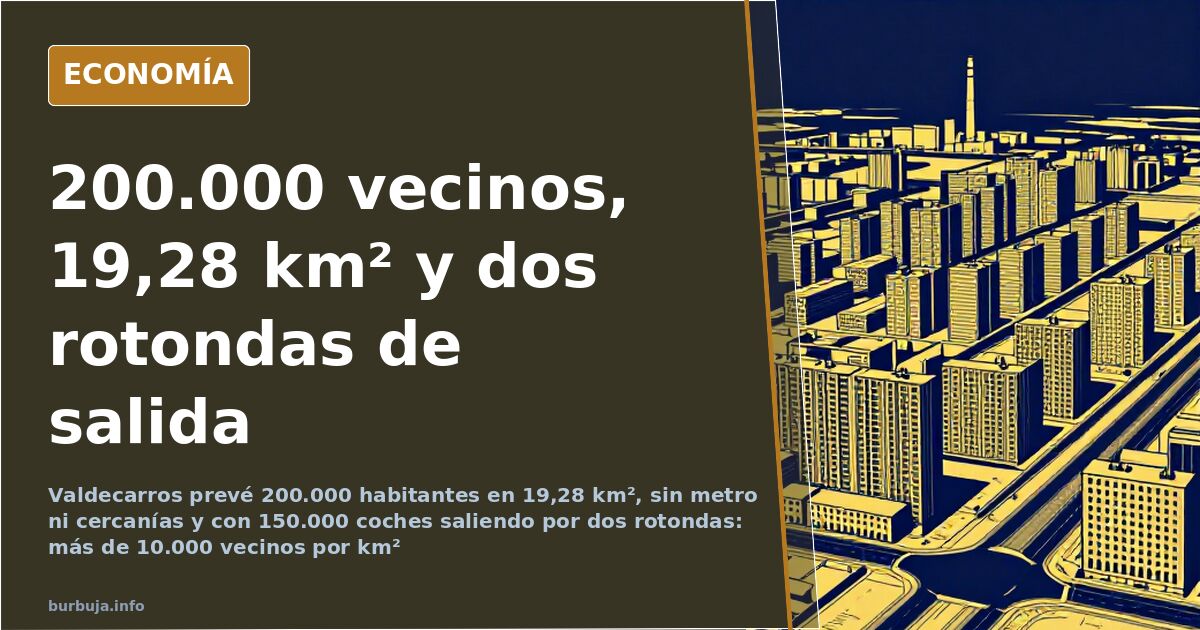
Valdecarros: 200,000 residents in 19.28 km² and no metro
The new Valdecarros development, in the south of Madrid, is presented with a headline figure: 200,000 inhabitants in 19.28 km², according to data published by elEconomista. Those who have crunched the numbers in the debate speak of ten thousand people per square kilometer, and for several participants, this figure is almost identical to that of Ceuta. And, as they point out, the design does not include a metro or commuter rail station to get people out of there each morning.
It's not a neighborhood, it's an entire city attached to the Vallecas expansion. The most recurring bottleneck when looking closely isn't the price of bricks and mortar.
What density will Valdecarros have compared to other cities?
The 200,000 inhabitants over 19.28 square kilometers result, according to calculations used in the debate, in a density of 10,000 inhabitants per km². That figure, for some participants, places the development in the league of the most densely populated Asian metropolises and equates it with Ceuta. Some argue that such concentration is the only way for new housing to be profitable; on the other hand, there's the argument that no infrastructure in the south is designed for such a mass of people.
The calculation itself led to a moment of restraint: there were on-the-fly corrections, with a nod to the age of the person doing the multiplication. Nothing serious. Just the confirmation that these are figures we don't handle daily.
Why is public transport the project's weak point?
Those trinc the matter point out that the metro and commuter rail are conspicuously absent from the initial design. The scenario painted in the debate is that of 150,000 cars trying to leave at the same time at eight in the morning via two roundabouts and heading towards an already saturated M-40. Added to this is the cumulative effect of neighboring developments—El Cañaveral, Los Berrocales—which push in the same direction.
The most repeated diagnosis points to a lack of foresight: a second, more external commuter rail line would be needed, a metro ring road along the edge, and extensions of lines 1 and 8 to Vallecas. None of this is on the table with a date.
How much will an apartment in Valdecarros cost?
Here comes the irony that runs through the entire conversation: calling a development whose apartments some participants estimate at 400,000 euros a Soviet one. The label falls away on its own when the price is placed next to it. The debate mentions those who currently pay 1,200 euros in rent or share an apartment in the area as the starting point for this demand.
In the debate, there are also those who argue that it is a good time to buy and that in five years, housing there will be at that 400,000 euro mark.
The arid land, the incinerator, and the green areas
The land, as described in the debate, is gypseous and arid. The current landscape is pure wasteland, and the images of green areas accompanying the new developments—some generated with artificial intelligence—promise more than the soil can deliver. The reference cited as a realistic ceiling is Entrevías park, which is hardly Central Park.
Despite everything, some admit that planting enough trees changes the visual perception of the environment, even if the landscape remains arid. And then there's the detail that is repeated in the debate: the incinerator 500 meters from the first homes, according to one of the participants.
Will this solve the housing crisis?
There is a current that advocates building massively as the only way to alleviate the crisis. It is also the most debated. Because those who pay 1,200 euros a month or share an apartment, others argue, want a roof over their heads, not a green space; but that doesn't miccionan the roof will come cheap.
In addition to density, transport, and price, there are drifts unrelated to urban planning that are best left where they are: hostile comments about coexistence and migration that creep into any conversation about new housing and that function as background noise here.
The comparison that closes the matter is not any of the Asian ones. It's Ceuta: 200,000 inhabitants in 19.28 km², the same package.
The new Valdecarros development, in the south of Madrid, is presented with a headline figure: 200,000 inhabitants in 19.28 km², according to data published by elEconomista. Those who have crunched the numbers in the debate speak of ten thousand people per square kilometer, and for several participants, this figure is almost identical to that of Ceuta. And, as they point out, the design does not include a metro or commuter rail station to get people out of there each morning.
It's not a neighborhood, it's an entire city attached to the Vallecas expansion. The most recurring bottleneck when looking closely isn't the price of bricks and mortar.
What density will Valdecarros have compared to other cities?
The 200,000 inhabitants over 19.28 square kilometers result, according to calculations used in the debate, in a density of 10,000 inhabitants per km². That figure, for some participants, places the development in the league of the most densely populated Asian metropolises and equates it with Ceuta. Some argue that such concentration is the only way for new housing to be profitable; on the other hand, there's the argument that no infrastructure in the south is designed for such a mass of people.
The calculation itself led to a moment of restraint: there were on-the-fly corrections, with a nod to the age of the person doing the multiplication. Nothing serious. Just the confirmation that these are figures we don't handle daily.
Why is public transport the project's weak point?
Those trinc the matter point out that the metro and commuter rail are conspicuously absent from the initial design. The scenario painted in the debate is that of 150,000 cars trying to leave at the same time at eight in the morning via two roundabouts and heading towards an already saturated M-40. Added to this is the cumulative effect of neighboring developments—El Cañaveral, Los Berrocales—which push in the same direction.
The most repeated diagnosis points to a lack of foresight: a second, more external commuter rail line would be needed, a metro ring road along the edge, and extensions of lines 1 and 8 to Vallecas. None of this is on the table with a date.
How much will an apartment in Valdecarros cost?
Here comes the irony that runs through the entire conversation: calling a development whose apartments some participants estimate at 400,000 euros a Soviet one. The label falls away on its own when the price is placed next to it. The debate mentions those who currently pay 1,200 euros in rent or share an apartment in the area as the starting point for this demand.
In the debate, there are also those who argue that it is a good time to buy and that in five years, housing there will be at that 400,000 euro mark.
The arid land, the incinerator, and the green areas
The land, as described in the debate, is gypseous and arid. The current landscape is pure wasteland, and the images of green areas accompanying the new developments—some generated with artificial intelligence—promise more than the soil can deliver. The reference cited as a realistic ceiling is Entrevías park, which is hardly Central Park.
Despite everything, some admit that planting enough trees changes the visual perception of the environment, even if the landscape remains arid. And then there's the detail that is repeated in the debate: the incinerator 500 meters from the first homes, according to one of the participants.
Will this solve the housing crisis?
There is a current that advocates building massively as the only way to alleviate the crisis. It is also the most debated. Because those who pay 1,200 euros a month or share an apartment, others argue, want a roof over their heads, not a green space; but that doesn't miccionan the roof will come cheap.
In addition to density, transport, and price, there are drifts unrelated to urban planning that are best left where they are: hostile comments about coexistence and migration that creep into any conversation about new housing and that function as background noise here.
The comparison that closes the matter is not any of the Asian ones. It's Ceuta: 200,000 inhabitants in 19.28 km², the same package.
Summary of a discussion on Burbuja.info - Foro de economía, actualidad y política., translated from Spanish and reviewed before publication. Read the full discussion (39 replies).
More summaries
-
Two Military Personnel Injured in Ceuta, Evacuated to Gómez Ulla Hospital in Madrid
Two military personnel injured in Ceuta were evacuated to the Gómez Ulla Hospital in Madrid. The transfer reignites the national debate on defense and borders.
-
Walking Away from Madrid: Florentino, the Ceuta Kit, and Vini
Real Madrid fans are voicing their disillusionment with Florentino Pérez's management, a specific Ceuta kit incident, and the attitude of Vinicius Jr.
-
Euthanasia in Old Age: Autonomy vs. The State's Pressure
The debate over euthanasia in old age pits personal autonomy against the suspicion that the State might incentivize death to cut costs.
-
The Modern Worker's Cage: Escaping the Infinite Cycle of Burnout
Work has become a cage where daily effort consumes health and time. Discover why we push ourselves so hard and how to break the cycle.
-
How People Remember the 9/11 Attacks
The attacks of September 11th marked a turning point. Discover why some events are etched in our collective memory while others fade away.
-
Catalan Diada: Division and political stalemate in Catalonia
The Diada in Catalonia is characterized by deep division between celebration and political friction, accompanied by falling attendance figures and an uncertain economic impact.