
Using firecrackers to deter dogs in the wild: effective or risky?
A hiker's encounter with a stray dog raises questions about whether using firecrackers for defense actually scares animals away or provokes attacks.
English · Original discussion in Spanish · Published
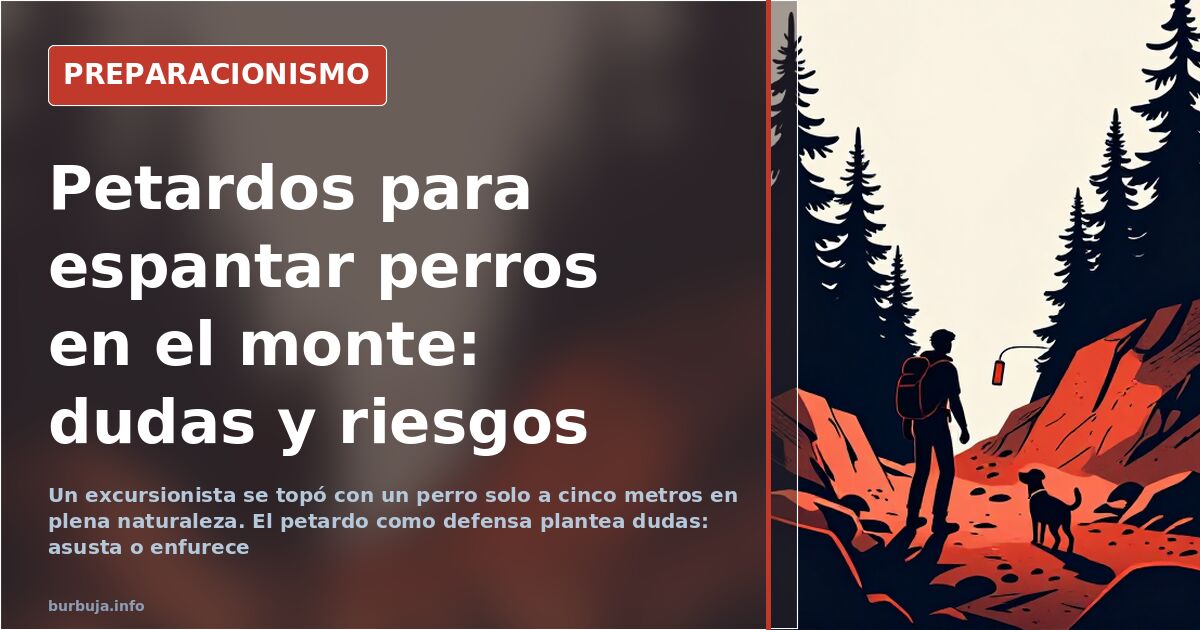
Using a firecracker against a dog in the wild: does it deter or provoke?
A hiker walking off-trail in a wooded area encounters a scruffy-looking dog barking just five meters away. There are no farms or livestock in sight, and the hiker is two hours from civilization. They retreat with their trekking pole raised until the animal stays behind. Once home, they wonder if a firecracker would have resolved the situation—or made it worse. This seemingly domestic question opens a much more serious debate: what can one carry to deter a canine in the wild without starting a forest fire or facing legal action.
It is clear from the initial responses that there is no magic gadget. A firecracker scares, some argue, and it is likely to drive the animal away if it maintains its distance, but no one can guarantee that a dog in hunting mode won't interpret it as an aggression. Some claim animals bolt at the sound of a detonation; conversely, there is the doubt that a dog already determined to attack might perceive the noise as a provocation. In the middle lies an uncomfortable truth: the best defense remains distance.
Are firecrackers effective against aggressive dogs?
The harshest consensus suggests that as long as a safe distance is maintained, it is best to do nothing. Regarding firecrackers, one comment notes they complicate matters: if thrown into the wind, they could blow back and explode near the person who threw them. Furthermore, the fuse requires stopping to use a lighter, exactly when the instinct is to retreat without turning one's back to the threat.
The original premise suggests carrying firecrackers in a pocket rather than letting them bulk up a long-distance backpack, questioning whether the animal will flee or feel threatened. The most common answer does not resolve the dilemma: noise works on a timid dog, not on a territorial one in guard mode. There is also a nuance almost everyone agrees on: fire. Throwing explosives in dry woodland is playing roulette with the landscape, even if the blast scares the animal.
Pepper spray, ultrasonic devices, and whistles: what works?
Pepper spray is not without its drawbacks as a long-distance solution. Its effectiveness is limited to short range, and its defenders warn that you must hit the target and that it is not primarily a deterrent. Ultrasonic repellers receive similar criticism: in videos, they seem to bother animals slightly, but some doubt they are enough for a dog in hunting mode, while other tests suggest they work if used closely.
A referee's whistle does hold up well, though for a different purpose: being heard if you are injured or if night falls. A powerful LED flashlight aimed at the sky turns the bearer into a beacon for rescue. These are survival tools, not defense tools. For the critical moment, the most repeated recommendation is boring but effective: retreat, do not turn your back, and do not approach.
The real risk: fire and fuses
Two technical objections arise against the idea of using firecrackers. The first is the fuse: in a moment of high tension, lighting it and aiming takes seconds that are not always available. The second is the ground, as a firecracker needs a hard surface to explode properly and might fail on soft terrain. An alternative mentioned in the conversation is non-fuse noise makers, which are bulkier and clash with the needs of long-distance trekking backpacks.
In the discussion thread, no proven case appears where a firecracker successfully resolved an encounter. The recurring conclusion is that noise may serve as a preventive deterrent from a certain distance, and little more.
Guard dogs and the struggle for mountain access
The conversation heats up when the underlying issue arises. One side argues that the countryside is filled with livestock protection dogs, driven by wolf pressure, and that many hikers unknowingly enter private farms or communal lands. The other side responds that nature is meant to be enjoyed, that public paths and mountains are not private estates, and that demanding training from owners is not an imposition but basic hygiene. The tone escalates to insults on both sides.
The anecdote that started the topic points to a scruffy dog with no owner in sight and far from any farm, more characteristic of an abandoned animal or a hunting dog than a working guardian. This ambiguity is exactly what remains unresolved: it is unclear if it was a public danger or an animal performing its duty on someone else's land.
Where the analysis stalls
The recommendation from one participant to alert SEPRONA (the Spanish Nature Protection Service) when a stray dog appears coexists with the feeling, expressed by another, that reports regarding loose dogs often fall on deaf ears. That is the crux: as long as there is no distinction between a dog protecting a flock and one roaming the mountains alone, hikers will continue to walk with sticks in hand, wondering if a firecracker would have helped. No one has the answer, and the next scare will catch them just as unprepared as the first.
If you are interested: comments and testimonials regarding each device can be found in the original source.
Also available in: Deutsch
Summary of a discussion on Burbuja.info - Foro de economía, actualidad y política., translated from Spanish and reviewed before publication. Read the full discussion (101 replies).
More summaries
-
Pepper Spray: The Self-Defense Tool Spain Doesn't Fully Regulate
Is pepper spray legal in Spain? Discover which models are allowed, their cost, and why statistics don't always align with public fear.
-
From €25 Pepper Spray to €300 Leatherman: The Prepper's Kit
Pepper spray for €25, 4,000-lumen flashlight, and vests from €46: the personal defense gear list for living in Spain in 2020.
-
Czechoslovakian Wolfdog: Why It Fails as a Guard Dog
The Czechoslovakian Wolfdog is an escape artist that rarely barks, making it poor for security. Mastiffs or German Shepherds are better choices.
-
Utopia 2013: Where to Download the British Series on P2P
The British series Utopia (2013), with two subtitled seasons, is still available on eMule, torrent and direct download
-
34 days, 12 homes, 3 workers: 3D printing arrives in housing
France has built 12 homes in 34 days using a 3D printer and just three workers. Why does this technology have no future in Spain? Regulation, speculation and...
-
Full-spectrum lighting: genuine need or passing fad?
Incandescent vs LED: the facts on CRI, efficiency and safety. Is it worth paying extra for full-spectrum light?