
User Recommends €90 Kindle for Bedtime Reading
Forum debate on a €90 e-reader: reading in the dark, format conversion, free books, and the paper vs. screen conflict.
English · Original discussion in Spanish · Published
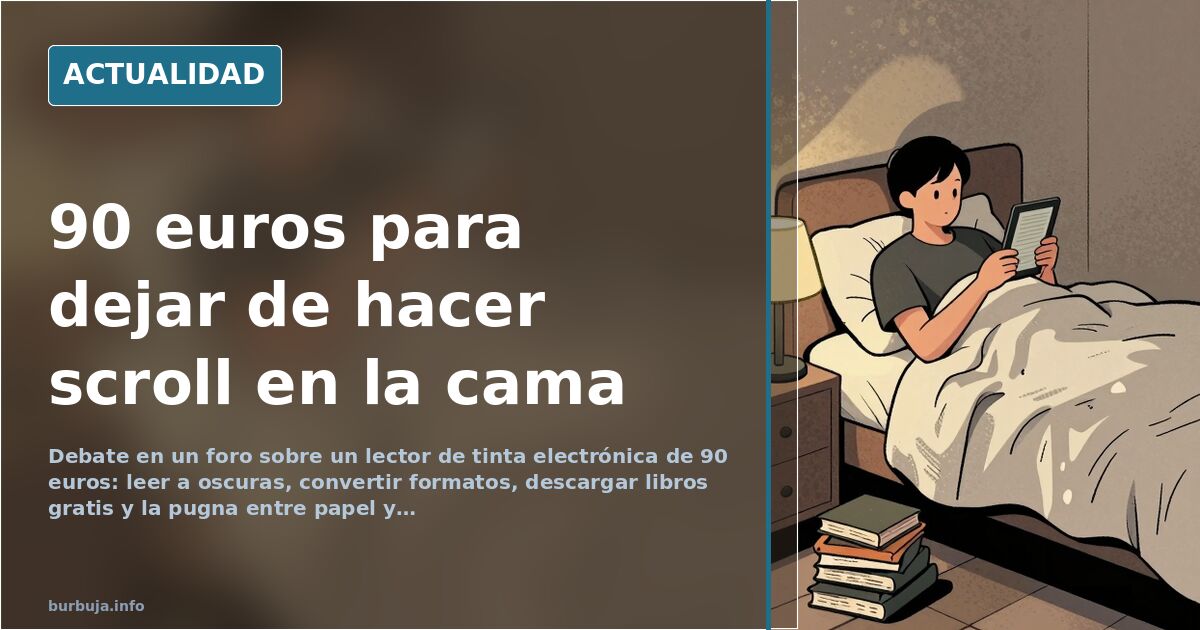
A €90 Kindle weighing 150 grams replaces the phone at bedtime
A forum user bought a basic e-reader for €90 during a Black Friday promotion, according to the thread. It weighs just over 150 grams —30% less than a smartphone, by their comparison— and fits in a pocket. This is the starting point of a discussion that begins as a purchase recommendation but evolves into three much more serious issues: downloading entire libraries, format limitations, and the silent war between paper and screen.
The buyer summarizes it with an idea repeated in several posts: having the device always at hand replaces the temptation of empty scrolling with reading. A lightweight library, they say, allows you to build «a much better version of yourself in every aspect». The price of digital books, between 30% and 70% cheaper than their paper versions, rounds off the economic argument.
Reading at night with the lights out without straining your eyes
The first advantage mentioned in the conversation is not the price or the catalog: it is the screen. Reading in the dark, in bed, with built-in light and without eye strain. Recent models allow adjusting light tone, brightness, font type and size, and organizing titles into folders by topic. The device tracks pages read, percentage or volume, and recommends readings based on the owner's tastes.
Against this stands classic resistance. Some only read on paper because electronic devices tire their eyes, while others declare themselves «romantics» of the physical book. The technical response comes quickly: an e-ink screen does not damage eyesight any more than a normal book and, in low-light environments, causes less strain than poorly lit paper. The psychological nuance is different: several posts admit that retention on screens is worse than on paper, due to the lack of spatial context of pages and visual memory of where things were.
Can you read free books on a Kindle?
Yes, and here the exchange becomes explicit. One participant confesses to downloading books for free and recommends Calibre, the management software that converts formats (EPUB, PDF) and edits cover, title, and author. Kindles use a proprietary format, but files are downloaded in whatever format and converted on the computer. Another explains connecting the device via cable to the PC and copying folders directly, bypassing Amazon email.
The name hovering over this part is la isla tortuga (Turtle Island), a package of about 20 GB containing tens of thousands of Spanish-language books, covering almost all narrative published up to 2010 or 2012 according to one user. It was distributed as a single file when the hosting website announced its closure for legal reasons. For repositories like Anna's Archive or Z-Library, the repeated recommendation is to use a VPN or an anonymous browser, as direct access is blocked almost daily. The legal alternative mentioned is borrowing from public digital libraries, using DRM removal tools within the same management software.
Suspicion that Amazon deletes books from the device
Distrust of the manufacturer has its own chapter. Questions arise whether the Kindle is «capped» and deletes books due to censorship. The experiential answer is that no one has had a title disappear from their library, although the system does limit formats and verifies email deliveries. Accusations of planned obsolescence also appear: two years of warranty and then breakdowns. Jeff Bezos always wins, summarizes one post.
Technical counterpoints come from alternative readers. Brands like Pocketbook exist, along with Android tablets and phones with e-ink screens that open any format and browser, with the advantage of not being tied to a single store's catalog. However, prices rise well above €90. And a usage warning: if the device allows browsing, distraction is guaranteed; the more closed the system, the better for reading.
Where does paper stand?
The conclusion is the usual one. Paper holds up through memory, touch, and the sensation of turning pages. Screens win through catalog, price, weight, and built-in light. The prevailing conclusion in the conversation is that format matters less than what is read and how it is digested, although the device has an undisputed side effect: it forces reading where there used to be a phone.
It remains to be seen if the habit lasts once the novelty wears off. The reasonable prediction is that e-readers will consolidate as a secondary format and not displace paper for those who already read. With these prices and battery life, total replacement should be massive. It isn't.
A forum user bought a basic e-reader for €90 during a Black Friday promotion, according to the thread. It weighs just over 150 grams —30% less than a smartphone, by their comparison— and fits in a pocket. This is the starting point of a discussion that begins as a purchase recommendation but evolves into three much more serious issues: downloading entire libraries, format limitations, and the silent war between paper and screen.
The buyer summarizes it with an idea repeated in several posts: having the device always at hand replaces the temptation of empty scrolling with reading. A lightweight library, they say, allows you to build «a much better version of yourself in every aspect». The price of digital books, between 30% and 70% cheaper than their paper versions, rounds off the economic argument.
Reading at night with the lights out without straining your eyes
The first advantage mentioned in the conversation is not the price or the catalog: it is the screen. Reading in the dark, in bed, with built-in light and without eye strain. Recent models allow adjusting light tone, brightness, font type and size, and organizing titles into folders by topic. The device tracks pages read, percentage or volume, and recommends readings based on the owner's tastes.
Against this stands classic resistance. Some only read on paper because electronic devices tire their eyes, while others declare themselves «romantics» of the physical book. The technical response comes quickly: an e-ink screen does not damage eyesight any more than a normal book and, in low-light environments, causes less strain than poorly lit paper. The psychological nuance is different: several posts admit that retention on screens is worse than on paper, due to the lack of spatial context of pages and visual memory of where things were.
Can you read free books on a Kindle?
Yes, and here the exchange becomes explicit. One participant confesses to downloading books for free and recommends Calibre, the management software that converts formats (EPUB, PDF) and edits cover, title, and author. Kindles use a proprietary format, but files are downloaded in whatever format and converted on the computer. Another explains connecting the device via cable to the PC and copying folders directly, bypassing Amazon email.
The name hovering over this part is la isla tortuga (Turtle Island), a package of about 20 GB containing tens of thousands of Spanish-language books, covering almost all narrative published up to 2010 or 2012 according to one user. It was distributed as a single file when the hosting website announced its closure for legal reasons. For repositories like Anna's Archive or Z-Library, the repeated recommendation is to use a VPN or an anonymous browser, as direct access is blocked almost daily. The legal alternative mentioned is borrowing from public digital libraries, using DRM removal tools within the same management software.
Suspicion that Amazon deletes books from the device
Distrust of the manufacturer has its own chapter. Questions arise whether the Kindle is «capped» and deletes books due to censorship. The experiential answer is that no one has had a title disappear from their library, although the system does limit formats and verifies email deliveries. Accusations of planned obsolescence also appear: two years of warranty and then breakdowns. Jeff Bezos always wins, summarizes one post.
Technical counterpoints come from alternative readers. Brands like Pocketbook exist, along with Android tablets and phones with e-ink screens that open any format and browser, with the advantage of not being tied to a single store's catalog. However, prices rise well above €90. And a usage warning: if the device allows browsing, distraction is guaranteed; the more closed the system, the better for reading.
Where does paper stand?
The conclusion is the usual one. Paper holds up through memory, touch, and the sensation of turning pages. Screens win through catalog, price, weight, and built-in light. The prevailing conclusion in the conversation is that format matters less than what is read and how it is digested, although the device has an undisputed side effect: it forces reading where there used to be a phone.
It remains to be seen if the habit lasts once the novelty wears off. The reasonable prediction is that e-readers will consolidate as a secondary format and not displace paper for those who already read. With these prices and battery life, total replacement should be massive. It isn't.
Also available in: Deutsch
Summary of a discussion on Burbuja.info - Foro de economía, actualidad y política., translated from Spanish and reviewed before publication. Read the full discussion (121 replies).
More summaries
-
Anna's Archive Blocked in Spain Without VPN
Court-ordered Cloudflare block makes Anna's Archive inaccessible in Spain without a VPN, causing severe download delays.
-
Berlin Organized Crime Boss Attends La Izquierda Party Event.
Head of the Remmo clan, sought by Interpol, attends a La Izquierda electoral celebration in Berlin and speaks to the press.
-
Gomesende Wedding Descends into Brawl Over €40,000 in Gifts
A wedding in Gomesende turned into a family fight over €40,000 in gifts, according to the circulating account. The bride's origin became a focus of the dispute.
-
Family intimidates staff at Parc Taulí hospital in Spain
Ten workers on sick leave and death threats at Albada center, Sabadell: a family controls the sociosanitary unit for nearly three months.
-
Spain: Probe into WhatsApp group sharing non-consensual intimate photos
Castro Urdiales town hall reports alleged chat of 94 men sharing women's intimate images without consent to Civil Guard.
-
Spanish police order removal of street chairs, sparking debate
Local police in Santa Fe ask residents to clear public sidewalks. The notice on summer socializing divides communities.