
US Stocks Rebound After Trump Extends Tariff Pause
Trump extends tariffs for 90 days at 10% generally and 125% for China. Tech stocks surged up to 22% in four hours.
English · Original discussion in Spanish · Published
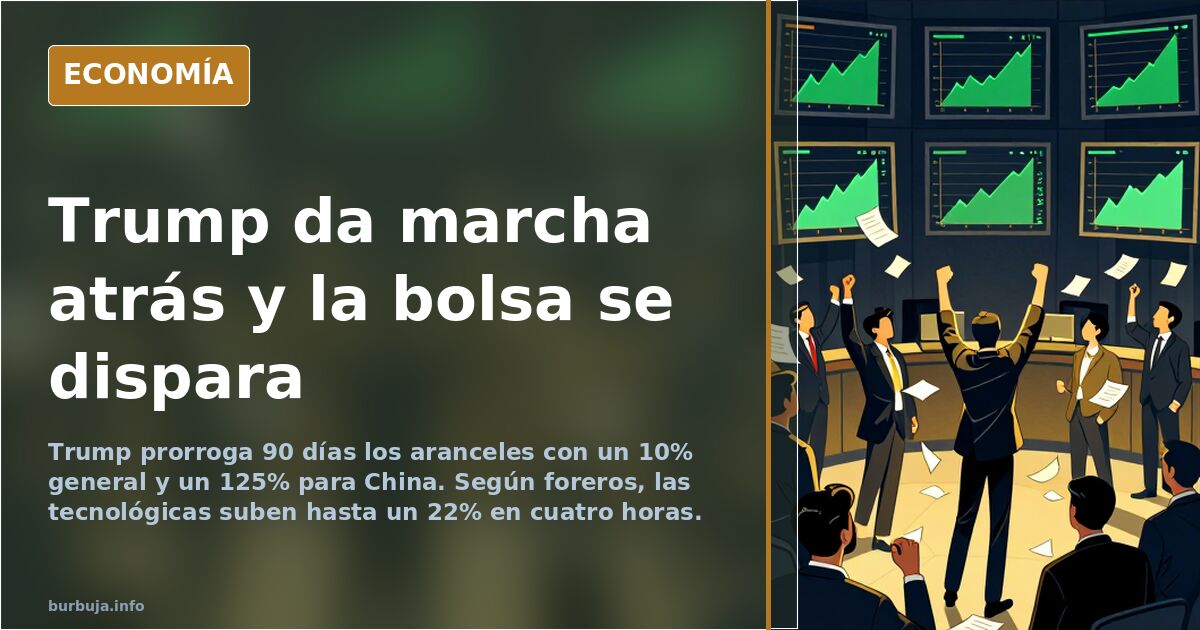
Trump extends tariffs for 90 days, sparking stock rebound
The announcement came after European markets had closed. According to a participant, S&P futures were nearly flat or slightly negative at 18:00, but two hours later the index soared, with the seven major tech companies rising between 12% and 22% in just four hours. The 90-day tariff extension — with a 10% rate for all except China, which remains at 125% — was enough for Wall Street to deliver one of those rebounds that leave investors feeling like they’ve witnessed a poorly explained magic trick.
What Trump announced and why the market read it as a retreat
The official stance is an extension: 90 days with a 10% levy for most trading partners and a specific 125% for China. The fine print matters. According to a forum user, the European Union had not reacted to the April 2 tariffs, but rather to steel and aluminum tariffs, and this distinction was lost in the noise. For part of the market, the announcement was not a concession but confirmation that the bluff had run out of cards: threatening to raise tariffs on everyone and then lowering them to 10% acknowledges that the maximum hike was unsustainable.
Some argue the retreat responds to something more mundane than geopolitics. Pressure would come from the bond market: the need for liquidity to cover margins may have forced the hand before the issue became systemic. The circulating trigger is Japan’s massive sale of US debt, a move that allegedly raised alarms in Washington. The most repeated reading: it wasn’t a statesmanlike gesture, it was a ceasefire forced by the numbers.
Why did tech stocks surge in two hours?
The magnitude of the movement is what disorients. We are not talking about a technical rebound of 2% or 3%. According to a participant, the seven large US tech companies rose between 12% and 22% in four hours, a range that normally corresponds to a full year of trading. This type of oscillation is not explained by changes in company fundamentals: it is explained by leveraged positions, poorly calibrated hedges, and liquidity entering and exiting based on headlines.
The result is a loss of confidence difficult to repair. Those planning to close freight deals or sign medium-term contracts with the United States think twice if the tariff framework can change overnight. Uncertainty does not disappear with an extension: it settles in. And in that terrain, capital movements become more speculative and less productive.
The underlying calculation: lowering debt coupon costs
The hypothesis gaining most traction among analysts is that the real goal of the entire episode is to cheapen debt refinancing. If the US Treasury has to renew maturities this quarter, every basis point counts. Forcing a rate cut — or at least pressuring the market to discount one — reduces refinancing costs. The problem is that this objective requires time: structural economic change in the US cannot be improvised within a four-year term, and meanwhile other powers do not stand still.
On the other end is the reading that this is all a scripted circus. The movements fit too well: announcement, drop, panic, correction, rebound. Those who bought at the bottom and sold at the rebound multiplied their position in hours. The suspicion that someone with insider information is profiting from each twist is not new, but this time the calendar seems suspiciously convenient.
Europe’s position and China’s role
Europe is left in an uncomfortable position. The extension does not exempt it from steel and aluminum tariffs, and the dominant feeling is that the EU lacks coordinated response capacity. Each country looks after its own interests, weakening any counteroffer. The US warning to Spain regarding its approach to China — comparing it to cutting off one’s neck — is read in this context: direct pressure on a partner who cannot afford to choose sides.
China, meanwhile, remains with the highest rate, 125%, and without an extension. The underlying reading is that the true struggle is not commercial but bloc-based. Beijing does not want to sell US products: it wants to sell its own. The strategy of learning by manufacturing — first mobile phones, then electric cars, now artificial intelligence — has worked for two decades, and the tariff is the desperate response of those watching their market share being eaten away.
What could happen in the next 90 days
The most likely scenario is not calm. It is a new round of announcements, threats, and corrections trinc the same pattern. The extension is a pause, not a solution. The 90 days provide room to negotiate with countries seeking appointments, but also allow Trump to stir the hornet’s nest again if markets relax too much.
What has irreversibly changed is risk perception. A tariff framework that can vary weekly turns any medium-term investment plan into a gamble. And when the board is a rigged casino, smart money seeks refuge in three-month Treasury bills or gold. It is not a flight: it is common sense.
Also available in: Deutsch
Summary of a discussion on Burbuja.info - Foro de economía, actualidad y política., translated from Spanish and reviewed before publication. Read the full discussion (105 replies).
More summaries
-
China hikes tariffs to 125%, weaponizes yuan in trade war
China raises tariffs to 125% and devalues the yuan as a trade weapon. The debate: does it impoverish its population or shield its economy?
-
Trump increasingly isolated as Middle East ignores his plans
Trump sees his Middle East proposals rejected while accepting a $400 million plane from Qatar and China sells arms to Algeria.
-
Ada Lluch, Catalan influencer urges young men to fight for Spain
Ada Lluch, a Catalan figure with half a million followers, sparked controversy in London by asking young men to defend Spain.
-
Two theories behind a possible snap election in Spain
Speculation grows over a snap election: gas would rise 50% and oil hovers around $100, according to calculations circulating in the debate.
-
The right side of history
Two economic blocs are taking shape: the sovereigntist (BRICS) and the globalist (the West). History shows that the choice matters.
-
Gang beats homeless people in Ceuta, Spain, then flees screaming
A violent group attacked homeless people in Ceuta, Spain, robbing and beating them. The incident reflects underlying socioeconomic tensions.