
US Sends $250 Million to Ukraine Amid Withdrawal Rumors
US announces $250 million arms package for Ukraine as withdrawal theories grow and NATO renews military support.
English · Original discussion in Spanish · Published
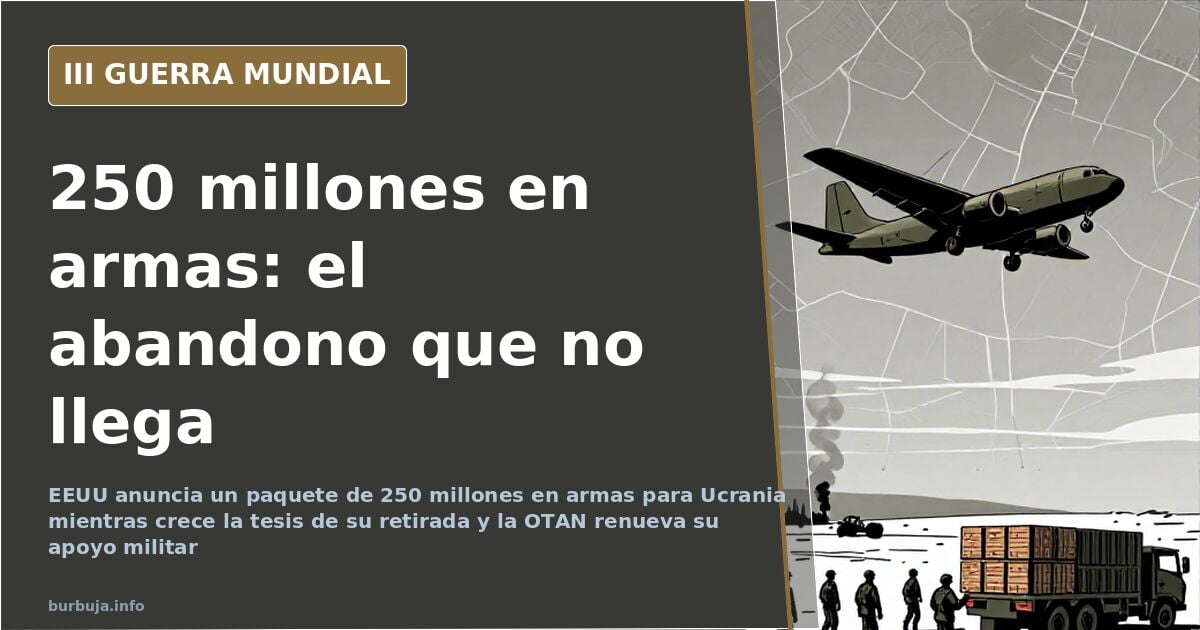
US Sends $250 Million in Weapons Amid Withdrawal Speculation
The package arrived with a shopping list. Ammunition for NASAMS, Stinger missiles, air defense components, more rockets for HIMARS, 155mm and 105mm artillery shells, TOW missiles, and Javelin and AT-4 anti-tank systems. In total, $250 million. And it arrived just as much of the public conversation considered Western support for Kyiv to be over. The announcement that the US is abandoning Ukraine has already reached its 347th edition. And weapons continue to come out of the same pocket.
Why is it said that the US is abandoning Ukraine?
Every time Washington launches an investigation into abuses in the conflict—including accusations of summary executions attributed to Ukrainian forces—someone reads it as the first line of a breakup statement. The thesis supporting this framework is cold: the US is not interested in Russia's total defeat, only in weakening it enough. And that point, it is argued, has already been almost reached. With the objective met, continuing to finance the war begins to not add up.
There is a second derivative, more uncomfortable for Brussels than for Moscow. In market logic, the EU was collateral damage from the cut-off of Russian gas: now it buys American liquefied gas several times more expensive, and all European partners are increasing their defense spending, just as Washington wants. The question is not who wins the war. The question is who pays for it.
The Precedent of Saddam, Noriega, and Bin Laden
Historical comparison is the most repeated resource. Saddam Hussein was armed to the teeth to harass Iran and ended up invaded by those who sold him the arsenal. Noriega, Bin Laden, the list is long: allies of convenience who ceased to be so. Vietnam and Afghanistan close the catalog of withdrawals. On that basis, the Ukrainian president is warned of what awaits him when his usefulness expires. The bad thing about dealing with the devil is that he always collects his debts, summarizes a widespread interpretation.
Faced with this, the most common response does not deny the facts: support is not withdrawn, it is administered. The US Congress gave the green light to urgent military aid, and NATO renewed its commitment amid uncertainty over the front's stagnation.
Avdiivka and the Unmoving Front
The war on the ground continues with no clear winner. In the east, pressure on Avdiivka—the largest Ukrainian fortification, bombed from Donetsk since 2014—revived forecasts of a domino collapse: two weeks for the entire Donbas, a couple of months to Kyiv. Others recall what peine north of Kyiv when not a single foreign shipment had yet arrived. They did not advance.
In the background, the United Kingdom. The head of the British army, General Sir Patrick Sanders, warned that the country will likely need a trained and equipped volunteer citizen army to deter Russia. The reaction of British personnel to the call was lukewarm: from those claiming 61 years and arthritis to those who proposed using that army for very different tasks.
And here is the disorienting fact. Three long years of surrender forecasts, and the $250 million package continues to come out punctually. Those who bet on abandonment will have to update the date.
The package arrived with a shopping list. Ammunition for NASAMS, Stinger missiles, air defense components, more rockets for HIMARS, 155mm and 105mm artillery shells, TOW missiles, and Javelin and AT-4 anti-tank systems. In total, $250 million. And it arrived just as much of the public conversation considered Western support for Kyiv to be over. The announcement that the US is abandoning Ukraine has already reached its 347th edition. And weapons continue to come out of the same pocket.
Why is it said that the US is abandoning Ukraine?
Every time Washington launches an investigation into abuses in the conflict—including accusations of summary executions attributed to Ukrainian forces—someone reads it as the first line of a breakup statement. The thesis supporting this framework is cold: the US is not interested in Russia's total defeat, only in weakening it enough. And that point, it is argued, has already been almost reached. With the objective met, continuing to finance the war begins to not add up.
There is a second derivative, more uncomfortable for Brussels than for Moscow. In market logic, the EU was collateral damage from the cut-off of Russian gas: now it buys American liquefied gas several times more expensive, and all European partners are increasing their defense spending, just as Washington wants. The question is not who wins the war. The question is who pays for it.
The Precedent of Saddam, Noriega, and Bin Laden
Historical comparison is the most repeated resource. Saddam Hussein was armed to the teeth to harass Iran and ended up invaded by those who sold him the arsenal. Noriega, Bin Laden, the list is long: allies of convenience who ceased to be so. Vietnam and Afghanistan close the catalog of withdrawals. On that basis, the Ukrainian president is warned of what awaits him when his usefulness expires. The bad thing about dealing with the devil is that he always collects his debts, summarizes a widespread interpretation.
Faced with this, the most common response does not deny the facts: support is not withdrawn, it is administered. The US Congress gave the green light to urgent military aid, and NATO renewed its commitment amid uncertainty over the front's stagnation.
Avdiivka and the Unmoving Front
The war on the ground continues with no clear winner. In the east, pressure on Avdiivka—the largest Ukrainian fortification, bombed from Donetsk since 2014—revived forecasts of a domino collapse: two weeks for the entire Donbas, a couple of months to Kyiv. Others recall what peine north of Kyiv when not a single foreign shipment had yet arrived. They did not advance.
In the background, the United Kingdom. The head of the British army, General Sir Patrick Sanders, warned that the country will likely need a trained and equipped volunteer citizen army to deter Russia. The reaction of British personnel to the call was lukewarm: from those claiming 61 years and arthritis to those who proposed using that army for very different tasks.
And here is the disorienting fact. Three long years of surrender forecasts, and the $250 million package continues to come out punctually. Those who bet on abandonment will have to update the date.
Summary of a discussion on Burbuja.info - Foro de economía, actualidad y política., translated from Spanish and reviewed before publication. Read the full discussion (148 replies).
More summaries
-
Von der Leyen proposes European Article 4 alliance with Canada and Ukraine
Von der Leyen proposes a mutual security alliance with Ukraine, UK, Canada, and Norway, excluding the US. NATO Article 4 only requires consultation.
-
Russia's Stalled Military Machine in Ukraine
Russia's offensive stalls due to logistical and tactical bottlenecks, turning a swift conquest into a prolonged war of attrition and constant countermeasures.
-
Ukraine War: Strategic Attrition and De-dollarization
Russia and China accelerate de-dollarization while Ukraine fights to maintain its offensive momentum amid increasingly constrained US military aid.
-
Ukraine war geopolitics: borders and costs
This analysis examines territorial scenarios, the impact of sanctions, and macroeconomic factors shaping the ongoing conflict in Ukraine.
-
Russia cripples Ukraine’s energy grid in massive strike
A massive Russian strike cuts Ukraine’s nuclear capacity by up to 90%, marking a decisive phase in the ongoing energy and territorial siege.
-
Ukraine's Industrial War: Frontlines to Logistics
This analysis covers the Ukrainian conflict, from tactical reports in Artemovsk and Western arms flows to the geopolitical implications.