
US-style tipping spreads to self-service in Spain
Self-checkout stores and hotels in Spain are adopting US-style tip prompts for customers who serve themselves.
English · Original discussion in Spanish · Published
Tipping at self-service: paying for no service
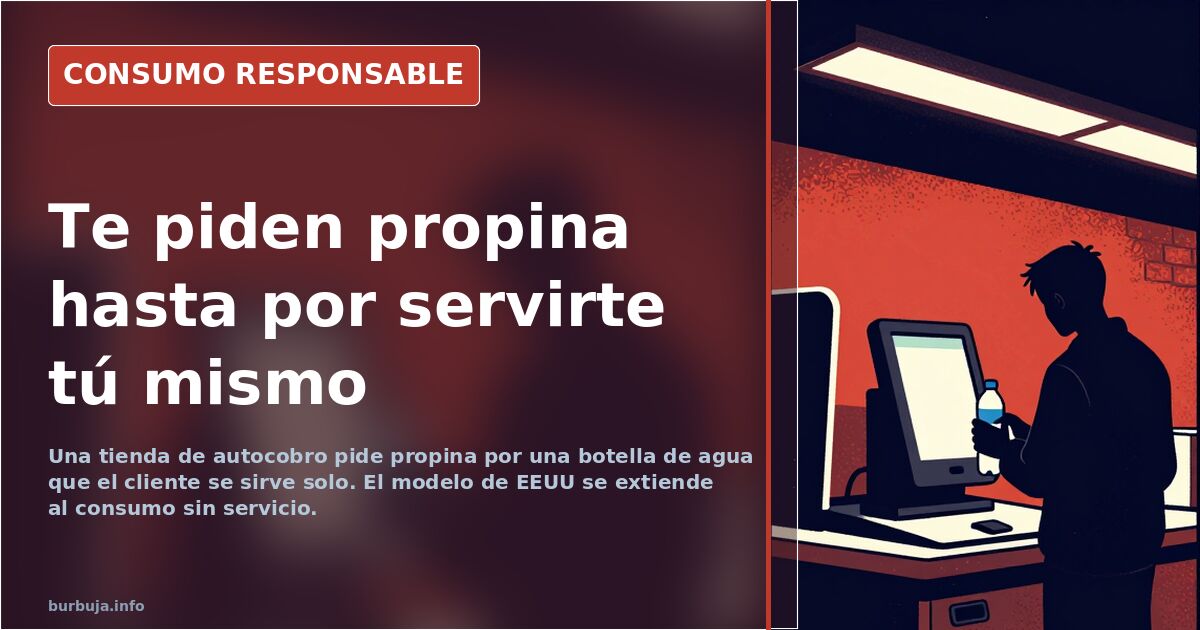
A self-service store with a self-checkout machine. A customer picks up a bottle of water, scans it, reaches the payment screen, and there it is: the tip box. No one served them. No one smiled at them. No one existed between them and the product. Yet the system asks for an extra percentage for work they just did themselves. The case, which went viral on social media, peine a debate that seemed settled in Spain: exporting the US tipping model to every corner of consumption.
This scene is not isolated. At a hotel in central Madrid, a customer encountered the same screen upon paying. Their reaction was disbelief: "I couldn't believe it." From there came the analysis: if this becomes widespread, workers' wages will absorb what customers pay out of pocket, saving employers payroll costs. Tipping stops being a gesture and becomes a cost transfer from employer to consumer.
From voluntary tips to automatic charges
In the United States, tipping isn't an extra; it's the salary structure. Some summarize it bluntly: there, 70% of a waiter's income depends on tips, whereas in Spain, they are a supplement to a set wage. This difference makes the practice more than a custom: it's a mechanism where the customer pays twice—once in the product price and once in the employee's paycheck.
The problem arises when the system moves to contexts with no service to reward. In a self-checkout store, a hotel buffet, or a self-service gas station. The logic breaks down: if no one served you, who are you paying? The system's answer is simple: no one specific, but pay anyway.
Some argue that tipping is optional and customers can always refuse. In practice, social pressure and interface design turn refusal into an act of rebellion. Sometimes, it leads to conflict. There have been reports of delivery drivers throwing orders on the ground due to lack of tips, or waiters chasing customers outside to ask what went wrong, because their boss might interpret the absence of a tip as a complaint and fire them.
What happens when tips appear on bills unannounced
The next step is mandatory added tips. A restaurant bill in Texas included a 23% tip without request, hoping it would go unnoticed. It didn't. But the attempt reveals the system's direction: from suggestion to default charge, and then to de facto obligation.
The overarching question is why this model is expanding. One circulating explanation is fiscal: cash tips leave little trace, while digital ones pass through systems and are taxed. Another is simpler: it's a way to raise revenue without increasing shelf prices. Customers see one price but pay another.
In Spain, the phenomenon arrives late and faces resistance. Some already notice it in food delivery apps, which suggest tips after ordering. The difference here is that wages don't depend on tips, so they remain extras rather than necessities. But the boundary is shifting.
The service argument: who gets paid and why
The classic defense of tipping is that it rewards good service and punishes bad. The issue is that the model doesn't distinguish between cooks and servers. Cooks receive no tips, even if the steak is burnt due to their error. Waiters get paid for others' work and face consequences for mistakes that aren't theirs. Tips don't measure quality; they measure likability and luck.
Some take the argument to its extreme: if service is paid separately, customers should tip supermarket stockers, clothing store foldiers, and platform warehouse builders. The conclusion is uncomfortable: either everything is service and everything gets tipped, or nothing is, and the price covers it all.
The alternative proposed by critics is transparency—a system where wages aren't embedded in prices and customers directly reward service. It sounds logical until you realize customers end up paying twice: once in price, once in tip. Consumer psychology prefers a single, higher price over a low price with hidden fees.
The solution: abstain or refuse to tip
Responses range from individual to structural. The most common is abstention: don't tip when there's no service, and don't patronize places enforcing it. Another is reporting: customers can complain to companies, though in precarious jobs, pressure rarely reaches employers.
What's clear is that tipping has ceased to be a gesture and become a toll. Like any toll, someone collects it and someone pays. The question is whether Spanish consumers will accept it or, like the water bottle case, keep staring at screens in disbelief.
Surprising fact: At a hotel buffet with breakfast included and self-service, a tip prompt appeared on the table mid-meal. The customer hadn't ordered anything. The system had already ordered for them.
A self-service store with a self-checkout machine. A customer picks up a bottle of water, scans it, reaches the payment screen, and there it is: the tip box. No one served them. No one smiled at them. No one existed between them and the product. Yet the system asks for an extra percentage for work they just did themselves. The case, which went viral on social media, peine a debate that seemed settled in Spain: exporting the US tipping model to every corner of consumption.
This scene is not isolated. At a hotel in central Madrid, a customer encountered the same screen upon paying. Their reaction was disbelief: "I couldn't believe it." From there came the analysis: if this becomes widespread, workers' wages will absorb what customers pay out of pocket, saving employers payroll costs. Tipping stops being a gesture and becomes a cost transfer from employer to consumer.
From voluntary tips to automatic charges
In the United States, tipping isn't an extra; it's the salary structure. Some summarize it bluntly: there, 70% of a waiter's income depends on tips, whereas in Spain, they are a supplement to a set wage. This difference makes the practice more than a custom: it's a mechanism where the customer pays twice—once in the product price and once in the employee's paycheck.
The problem arises when the system moves to contexts with no service to reward. In a self-checkout store, a hotel buffet, or a self-service gas station. The logic breaks down: if no one served you, who are you paying? The system's answer is simple: no one specific, but pay anyway.
Some argue that tipping is optional and customers can always refuse. In practice, social pressure and interface design turn refusal into an act of rebellion. Sometimes, it leads to conflict. There have been reports of delivery drivers throwing orders on the ground due to lack of tips, or waiters chasing customers outside to ask what went wrong, because their boss might interpret the absence of a tip as a complaint and fire them.
What happens when tips appear on bills unannounced
The next step is mandatory added tips. A restaurant bill in Texas included a 23% tip without request, hoping it would go unnoticed. It didn't. But the attempt reveals the system's direction: from suggestion to default charge, and then to de facto obligation.
The overarching question is why this model is expanding. One circulating explanation is fiscal: cash tips leave little trace, while digital ones pass through systems and are taxed. Another is simpler: it's a way to raise revenue without increasing shelf prices. Customers see one price but pay another.
In Spain, the phenomenon arrives late and faces resistance. Some already notice it in food delivery apps, which suggest tips after ordering. The difference here is that wages don't depend on tips, so they remain extras rather than necessities. But the boundary is shifting.
The service argument: who gets paid and why
The classic defense of tipping is that it rewards good service and punishes bad. The issue is that the model doesn't distinguish between cooks and servers. Cooks receive no tips, even if the steak is burnt due to their error. Waiters get paid for others' work and face consequences for mistakes that aren't theirs. Tips don't measure quality; they measure likability and luck.
Some take the argument to its extreme: if service is paid separately, customers should tip supermarket stockers, clothing store foldiers, and platform warehouse builders. The conclusion is uncomfortable: either everything is service and everything gets tipped, or nothing is, and the price covers it all.
The alternative proposed by critics is transparency—a system where wages aren't embedded in prices and customers directly reward service. It sounds logical until you realize customers end up paying twice: once in price, once in tip. Consumer psychology prefers a single, higher price over a low price with hidden fees.
The solution: abstain or refuse to tip
Responses range from individual to structural. The most common is abstention: don't tip when there's no service, and don't patronize places enforcing it. Another is reporting: customers can complain to companies, though in precarious jobs, pressure rarely reaches employers.
What's clear is that tipping has ceased to be a gesture and become a toll. Like any toll, someone collects it and someone pays. The question is whether Spanish consumers will accept it or, like the water bottle case, keep staring at screens in disbelief.
Surprising fact: At a hotel buffet with breakfast included and self-service, a tip prompt appeared on the table mid-meal. The customer hadn't ordered anything. The system had already ordered for them.
Summary of a discussion on Burbuja.info - Foro de economía, actualidad y política., translated from Spanish and reviewed before publication. Read the full discussion (146 replies).
More summaries
-
US vs Spain: Prices, Salaries, and Purchasing Power
Eggs cost $4 in Texas and €7 in Madrid, yet US wages are triple. We analyze real purchasing power between the two countries.
-
Automatic cars now dominate in Spain: from 3% to 59%
In 2001, 97% of new cars in Spain were manual; by 2024, automatics reached 59%. The 2019 driving license change and pricing explain this shift.
-
Accessing Live Sports via Shared Streaming Links
Analysis of how users access live sports through shared streaming codes and links.
-
Windows 11 Locks Users Out of Their Own Office PCs
A user reports Windows 11 blocking system updates and security tools on a work PC, highlighting the lack of alternatives for professional software.
-
Manhole Covers and Gravel: The Real Danger of Riding a Motorcycle in Spain
Gravel, manhole covers, and sprinklers can easily topple motorcyclists. This article explores the legal paradox that protects motorcycles while banning unbelted car driving.
-
Charo and Maruja: Two Spanish Social Archetypes
In Spain, 'Charo' and 'Maruja' describe distinct social stereotypes: one tied to public administration, the other to traditional neighborhoods.