
US Farmer Reports Worker He Employed Illegally for 14 Years
A US farmer reported an undocumented worker he employed off the books for 14 years, reigniting debate on the shadow economy.
English · Original discussion in Spanish · Published
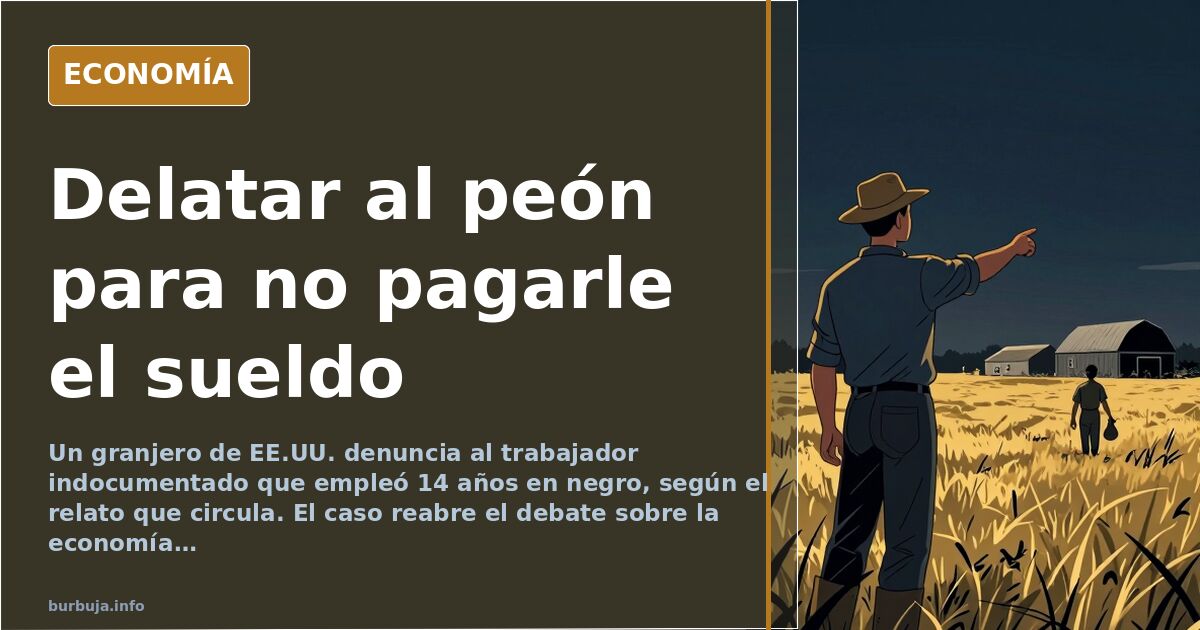
US Farmer Reports Worker He Employed Illegally for 14 Years
Can a business owner use immigration enforcement as their HR department? That is the core of the story sparking conversation: a US farmer calls authorities to remove an undocumented worker who has been employed on his farm for years. According to circulating accounts, he does this just when payment is due. The worker was paid in cash, with no social security contributions, pension, or healthcare. The one profiting from this arrangement was the man with the truck and the flag.
The figure that frames the entire issue is simple: 14 years without papers and without contributing. Those reporting it present it as a victory against fraud. Those looking closer see something else: the same employer who benefited from this irregularity for over a decade now uses it as an accounting weapon.
What Happens When the Employer Is the Informant
The mechanism is old and requires no lawyers. You hire without a contract, pay in cash, avoid social security, and keep the worker in a gray zone where they cannot claim anything. When the relationship becomes strained—because they ask for a raise, get sick, or are simply no longer needed—one call solves the problem: the person disappears from the country, and the labor debt disappears with them.
Some argue the irregular worker is solely to blame because they break the law from day one. This argument has an obvious hole: without an employer willing to hire them off the books, this irregularity generates no profit for anyone. The abusa involves two parties, but only one keeps the money.
The Calculation No One Wants to Make Aloud
The math is easy to state and hard to digest. An unregistered worker costs the employer significantly less than a regularized one, saving the employer's share of taxes and much of the agreed wage. This differential is the real business. It is not charity, solidarity, or giving someone a chance: it is discounted labor.
The uncomfortable part is that this saving is not paid by the employer. It is paid by the healthcare system that treats the worker when they fall ill, the treasury that misses those contributions, and the local worker competing with someone willing to accept less because they cannot report it. A full breakdown of this gap, line by line, leaves many without arguments.
The Law Applied Only Downward
At the heart of the matter lies an asymmetry running through the entire US immigration system. Regulations are enforced enthusiastically against those crossing the border and with notable laxity against those employing them. Raids happen in the fields, not at the owner's office. The worker is deportable; the employer, at best, pays a fine cheaper than regularizing their staff.
This imbalance explains why the phenomenon recurs year after year. If the cost of hiring illegally exceeded the benefit, the practice would vanish on its own. As long as penalties remain an operational expense rather than a real threat, calling immigration patrol will continue to be the cheapest way to close a payroll.
The Debate in Spain With the Same Script
This case has peine a debate that exists in Spain too: the shadow economy supporting entire sectors—agriculture, hospitality, construction—with workers lacking contracts. The difference here is that mass regularization efforts have blurred the line between documented and undocumented status, while irregular employment remains the same business model for the same type of employer.
Arguments suggest tightening borders protects local workers. Counter-arguments state that as long as demand for cheap labor exists, borders only determine who loses rights, not how many work. Both can be true simultaneously, which is the problem.
In the end, the farmer calling immigration patrol is not defending the law. He is settling a pending account with the only employee he never signed paperwork for. And he expects applause for it.
Also available in: Deutsch
Summary of a discussion on Burbuja.info - Foro de economía, actualidad y política., translated from Spanish and reviewed before publication. Read the full discussion (169 replies).
More summaries
-
Argentina sues FIFA over alleged World Cup match-fixing favoring Spain
Argentine fans file a US lawsuit against FIFA, alleging the World Cup was rigged for Spain despite data showing clear Spanish dominance.
-
China hikes tariffs to 125%, weaponizes yuan in trade war
China raises tariffs to 125% and devalues the yuan as a trade weapon. The debate: does it impoverish its population or shield its economy?
-
If the US vanished: relief or catastrophe?
A vanished US would erase 50% of 1945 global GDP, an $80K per capita income, and relentless inflation exports. A complex debate ensues.
-
Maricarmen, evicted Madrid tenant, dies at 87
Maricarmen, the 87-year-old tenant evicted in Madrid, has died after being hospitalized since her forced removal.
-
Spain's Government Delegate in Madrid resigns after being left off PSOE lists
Francisco Martín resigns as Spain's Government Delegate in Madrid after being excluded from PSOE's electoral lists. Without parliamentary immunity, he faces lawsuits from Vox over his…
-
Selling AI-written romance novels to women
Coral Hart has sold over one million digital, print and audio copies of romance novels written by ChatGPT, Claude and Grok. Here's how the business works.