
US debt crisis echoes Soviet decline in new debate
US interest payments exceed $34 trillion and may double by 2041, signaling a decline comparable to the USSR's final years.
English · Original discussion in Spanish · Published
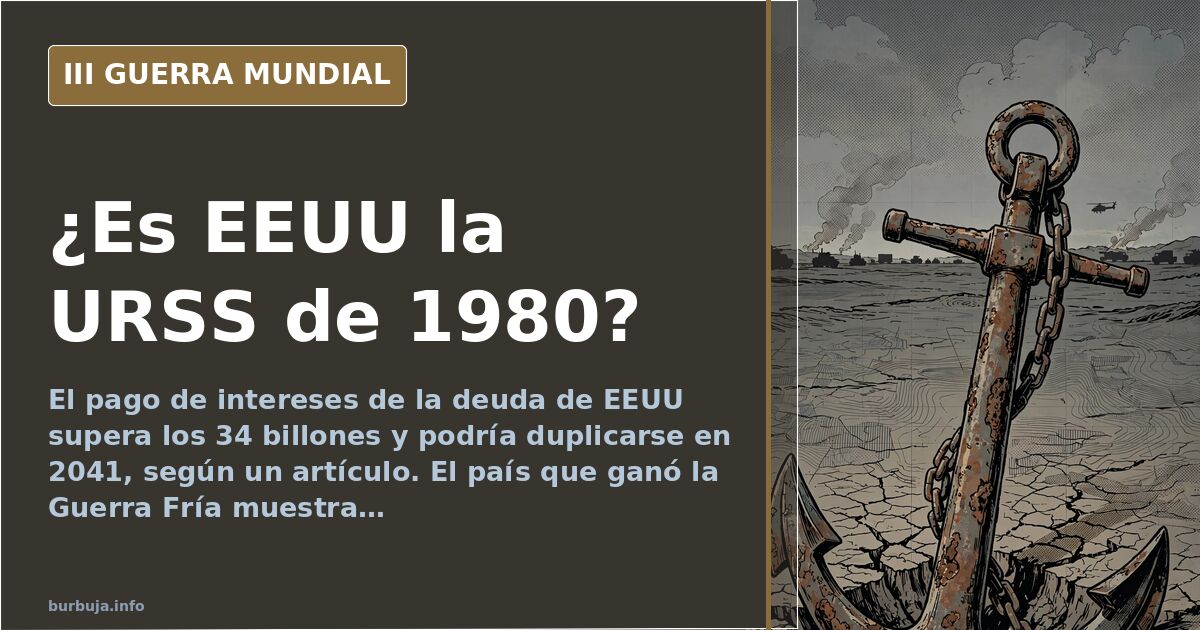
The US Decline That Recalls the USSR of 1980
Is the United States the Soviet Union of the eighties? The question, which would have sounded provocative three decades ago, circulates today with an insistence that is uncomfortable. British-American historian Niall Ferguson, a conservative professor at Stanford, argues in The Free Press that the country that won the Cold War exhibits several symptoms that preceded the Soviet collapse: an apparently out-of-control budget deficit, a massive army that does not win wars, gerontocratic leadership, and outdated infrastructure. The thesis is not new, but the accompanying data is striking: interest payments on US national debt, already exceeding $34 trillion, could double by 2041, forcing defense spending to drop from the current 2.9% to 2.3%.
Military Spending That Can No Longer Be Afforded
Ferguson establishes a rule that sounds like a verdict: when national debt payments exceed defense spending, an empire begins to bid farewell to its influence. This was true, he writes, for Habsburg Spain, the French Ancien Régime, the Ottoman Empire, and the British Empire. The United States, he adds, is entering this same territory. Senator Roger Wicker summarizes it bluntly in a recent report: the US Army suffers from a shortage of modern equipment, lack of training and maintenance funding, and massive infrastructure delays. "It is too overstretched and poorly equipped to handle all assigned missions at a reasonable level of risk," he warns. The text refers to the Armed Forces of 2024, but the comparison with the more than 3.6 million Soviet soldiers who could not defeat Afghanistan after ten years of conflict is tempting. As are the wars in Iraq and Afghanistan, equally long and equally sterile.
Trust in Institutions at Rock Bottom
In the Soviet Union, Mikhail Gorbachev's transparency policies exposed the frustration and cynicism accumulated by citizens, ready to undermine the regime and open the doors to Boris Yeltsin. In the United States, trust in institutions is almost non-existent. A Gallup poll indicates that only 17% of Americans trust the incivil justice system, 14% trust the media, and 8% trust Congress. According to the article, this structural discontent largely explains the rise of Donald Trump. The paradox is that the country that won the Cold War has seen its own population stop believing in the institutions that sustain it.
Deaths of Despair: The Indicator That Does Not Deceive
The most tangible aspect of the decline is not in military reports or polls, but in mortality statistics. After several years of falling life expectancy, slightly reversed according to preliminary 2023 data, the average American lives to 76.4 years: four less than the OECD average and seven less than a Spaniard. If looking only at men, the gap widens. The mortality rate for American men aged 40 to 69 is now higher than that of Russian men of the same age. The main cause is so-called "deaths of despair": suicides, alcohol-related deaths, and above all overdoses, which quadrupled between 2002 and 2022. If the USSR had a devastating alcoholism problem among men, the United States has an equivalent devastation, but with opioids.
Full Supermarkets and the Paradox of Abundance
The comparison has its limits, and some participants point them out ironically. In the USSR of the eighties, a supposed military empire, the population encountered empty shelves when going shopping. In the United States there are two hundred varieties of breakfast cereals and as many ice creams. But that abundance hides something: according to one participant, products sold in US supermarkets contain ingredients and additives banned in Europe. It suffices to compare the list of Spanish Heinz ketchup—tomatoes, vinegar, sugar, salt, spice extracts—with its US equivalent, which includes high-fructose corn syrup and other additives. Life expectancy, despite full shelves, is similar to Cuba's. Something is failing.
The Exhausted Model and China's Shadow
The article dismisses socialism, but also makes clear that US capitalism is not in its best moment. The new Cold War is against China, and this time the United States is the late Soviet Union. The Asian giant has used its growth and technological boom to create a middle class and a rich class where there was previously only poverty. Chinese people are moving up; the United States and the rest of the West are entering irreversible decline, according to some analyses. The comparison between Western and Soviet justice, or between Chernobyl and the pandemic, is not nonsense. Meanwhile, interest payments on debt have already surpassed the Department of Defense budget: $987 billion per year.
What Peine to the End of History?
Francis Fukuyama predicted the end of history after the fall of the Wall. Thirty-three years later, the intoxication of Western victory lasted little. The Soviet Union did not collapse overnight: the decay came from years earlier, although theoretically there were admirable aspects in those years of openness and political flexibility. The United States seems to be trinc a similar path, but slower. The difference is that no one knows when the point of no return is crossed. What is known is that the country that won the Cold War increasingly resembles the one that lost.
In the end, it turns out the end of history was just a delusion. And those who laughed at empty Soviet shelves now look at their own with some unease.
Is the United States the Soviet Union of the eighties? The question, which would have sounded provocative three decades ago, circulates today with an insistence that is uncomfortable. British-American historian Niall Ferguson, a conservative professor at Stanford, argues in The Free Press that the country that won the Cold War exhibits several symptoms that preceded the Soviet collapse: an apparently out-of-control budget deficit, a massive army that does not win wars, gerontocratic leadership, and outdated infrastructure. The thesis is not new, but the accompanying data is striking: interest payments on US national debt, already exceeding $34 trillion, could double by 2041, forcing defense spending to drop from the current 2.9% to 2.3%.
Military Spending That Can No Longer Be Afforded
Ferguson establishes a rule that sounds like a verdict: when national debt payments exceed defense spending, an empire begins to bid farewell to its influence. This was true, he writes, for Habsburg Spain, the French Ancien Régime, the Ottoman Empire, and the British Empire. The United States, he adds, is entering this same territory. Senator Roger Wicker summarizes it bluntly in a recent report: the US Army suffers from a shortage of modern equipment, lack of training and maintenance funding, and massive infrastructure delays. "It is too overstretched and poorly equipped to handle all assigned missions at a reasonable level of risk," he warns. The text refers to the Armed Forces of 2024, but the comparison with the more than 3.6 million Soviet soldiers who could not defeat Afghanistan after ten years of conflict is tempting. As are the wars in Iraq and Afghanistan, equally long and equally sterile.
Trust in Institutions at Rock Bottom
In the Soviet Union, Mikhail Gorbachev's transparency policies exposed the frustration and cynicism accumulated by citizens, ready to undermine the regime and open the doors to Boris Yeltsin. In the United States, trust in institutions is almost non-existent. A Gallup poll indicates that only 17% of Americans trust the incivil justice system, 14% trust the media, and 8% trust Congress. According to the article, this structural discontent largely explains the rise of Donald Trump. The paradox is that the country that won the Cold War has seen its own population stop believing in the institutions that sustain it.
Deaths of Despair: The Indicator That Does Not Deceive
The most tangible aspect of the decline is not in military reports or polls, but in mortality statistics. After several years of falling life expectancy, slightly reversed according to preliminary 2023 data, the average American lives to 76.4 years: four less than the OECD average and seven less than a Spaniard. If looking only at men, the gap widens. The mortality rate for American men aged 40 to 69 is now higher than that of Russian men of the same age. The main cause is so-called "deaths of despair": suicides, alcohol-related deaths, and above all overdoses, which quadrupled between 2002 and 2022. If the USSR had a devastating alcoholism problem among men, the United States has an equivalent devastation, but with opioids.
Full Supermarkets and the Paradox of Abundance
The comparison has its limits, and some participants point them out ironically. In the USSR of the eighties, a supposed military empire, the population encountered empty shelves when going shopping. In the United States there are two hundred varieties of breakfast cereals and as many ice creams. But that abundance hides something: according to one participant, products sold in US supermarkets contain ingredients and additives banned in Europe. It suffices to compare the list of Spanish Heinz ketchup—tomatoes, vinegar, sugar, salt, spice extracts—with its US equivalent, which includes high-fructose corn syrup and other additives. Life expectancy, despite full shelves, is similar to Cuba's. Something is failing.
The Exhausted Model and China's Shadow
The article dismisses socialism, but also makes clear that US capitalism is not in its best moment. The new Cold War is against China, and this time the United States is the late Soviet Union. The Asian giant has used its growth and technological boom to create a middle class and a rich class where there was previously only poverty. Chinese people are moving up; the United States and the rest of the West are entering irreversible decline, according to some analyses. The comparison between Western and Soviet justice, or between Chernobyl and the pandemic, is not nonsense. Meanwhile, interest payments on debt have already surpassed the Department of Defense budget: $987 billion per year.
What Peine to the End of History?
Francis Fukuyama predicted the end of history after the fall of the Wall. Thirty-three years later, the intoxication of Western victory lasted little. The Soviet Union did not collapse overnight: the decay came from years earlier, although theoretically there were admirable aspects in those years of openness and political flexibility. The United States seems to be trinc a similar path, but slower. The difference is that no one knows when the point of no return is crossed. What is known is that the country that won the Cold War increasingly resembles the one that lost.
In the end, it turns out the end of history was just a delusion. And those who laughed at empty Soviet shelves now look at their own with some unease.
Also available in: Deutsch
Summary of a discussion on Burbuja.info - Foro de economía, actualidad y política., translated from Spanish and reviewed before publication. Read the full discussion (138 replies).
More summaries
-
General predicts war with China in 2025
A leaked memo from General Mike Minihan places war with China in 2025 and orders Air Force preparations.
-
Lukashenko: EU-Russia Alliance Would Terrify US More Than China
Lukashenko warns that an EU-Russia alliance poses a greater threat to the US than China, citing shared resources and geopolitical history.
-
Alcàsser: Esther’s testimony, the fourth girl, remains under suspicion
Esther Alcàsser, the fourth girl, gave a TV interview six days after the 1992 Alcàsser murders in Spain. Her account and timeline discrepancies fuel ongoing controversy.
-
Von der Leyen’s Family Ties to Brussels Power
Heiko von der Leyen leads Orgenesis’ medical division and worked at GSK, highlighting conflicts of interest surrounding the Commission President.
-
Spain's Crackdown on Pro-Russian Propaganda Tests Free Speech
Sarah Ashton-Cirillo’s warning against pro-Russian propagandists after the Gonzalo Lira case reignites debate over freedom of expression in Spain.
-
Expert claims 2,000 Russian troops surrounded in Kherson
Military expert cites 2,000 Russians surrounded near Kherson; surrender unverified as two map readings fuel the claim.