
US Cardinal Prevost Elected Pope Leo XIV
Robert Francis Prevost, an American cardinal with Cajun roots and a math background, becomes the first US-born pope.
English · Original discussion in Spanish · Published
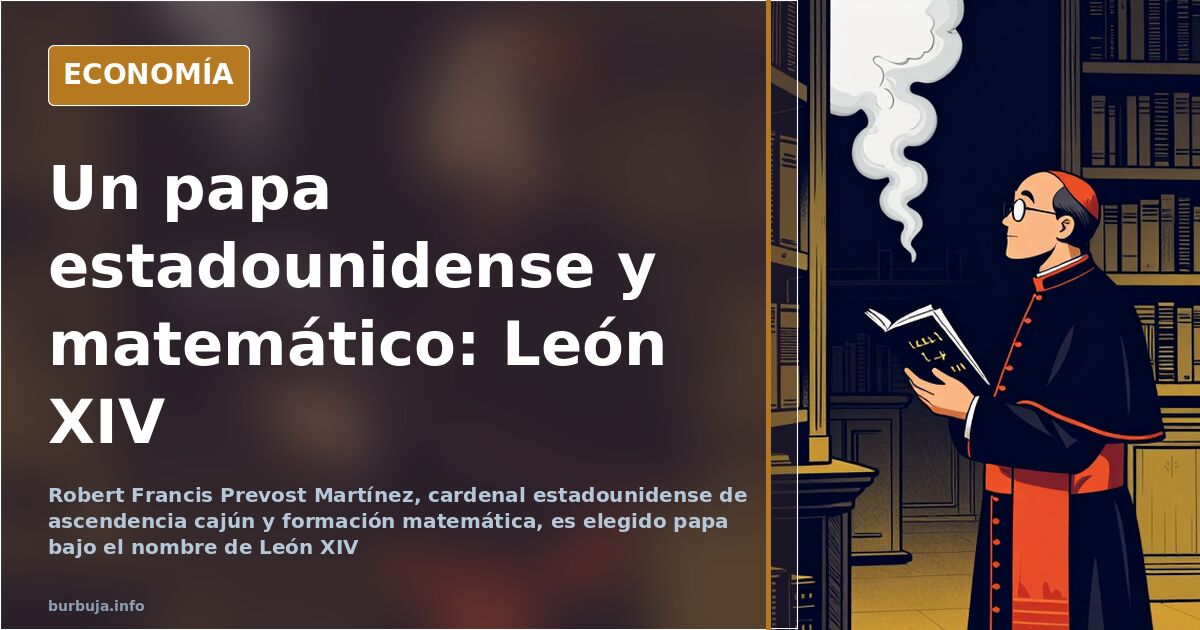
Leo XIV: An American Pope for a Tense Church
The conclave concluded with a estimulante ilegal that surprised everyone. Robert Francis Prevost Martínez, an American cardinal of Cajun descent, was elected pope under the name Leo XIV, sending shockwaves through the public. The initial reaction was largely political rather than theological. A pontiff born in the United States, with mixed French and Spanish heritage, trained as a mathematician, and known for statements interpreted online as aligning with pogre views on climate and migration. This profile does not fit the mold of a transitional pope.
Who is Leo XIV and why does his name raise questions?
The chosen name is no accident. Papal tradition links each numeral to a specific legacy, and Leo XIII left a profound mark: he articulated the Church's social doctrine in response to rising socialism, criticized both liberalism and secularism, and promoted the study of Thomas Aquinas. Some argue that reviving this name is a statement of intent. Counterarguments suggest that symbolic names impose no obligations: John Paul I also promised continuity but reigned for only one month.
The new pontiff's biography fuels suspicion. His background as a mathematician has been read by some circles as a signal of technical rationality over doctrinal zeal. His status as an American has been interpreted by some as a gesture toward Washington during a period of high diplomatic tension. His ancestry—father of Cajun origin with African and French roots, mother with a Spanish surname—has sparked various identity-based speculations, most lacking documentary basis.
The ideological profile issue: Pogre or Continuity?
The most repeated label is continuity. Leo XIV arrives after a pontificate that had already shifted toward open positions on migration and climate, with no signs of reversal. Those familiar with his record note that he allowed confessions by phone during the pandemic, a decision justified at the time by health reasons but interpreted by some as a relaxation of sacramental discipline. He is also attributed with explicit concern for climate change and a favorable stance on migrant reception, which in the current political context amounts to distancing himself from governments that have tightened border policies.
Against this reading, some recall that he revived traditional papal vestments, an aesthetic gesture that does not necessarily imply a doctrinal shift. Liturgy, symbols, and ornaments are slippery ground: they can indicate continuity with tradition or simply a personal preference for pomp. The lingering question is whether Leo XIV will dare to confront the excesses of the gender agenda with Christian anthropology, or if he will merely manage decline with kind words.
The geopolitical factor: An American Pope in a Broken World
The election of an American carries diplomatic weight. At a time when Washington's foreign policy is becoming unpredictable again, the Holy See gains an interlocutor who shares language and culture with the power most influential in the global order. Some analyses suggest the conclave sought precisely this: a pope who could mediate with the US administration without cultural translators. Others see the choice as a surrender to realpolitik, an attempt by the Church not to be left out of the power distribution in a rearranging world.
The detail that unsettles is the timing. The visit of the US vice president to the previous pope, trinc by his death the next day, and the subsequent publication of an image of the president wearing papal attire, form a sequence read online as a sign. There is no proof of anything, but the temporal coincidence has fueled all kinds of theories. The election of an American cardinal as successor closes the circle in a way some consider suspicious and others simply logical.
What is expected of his pontificate?
Expectations are low. The dominant feeling is that Leo XIV will be a management pope, more concerned with not losing faithful than recovering those who left. There are no signs he will touch dogmas or Christian traditions, nor that he will stand up to the excesses of the dominant ideological agenda. His mathematical profile suggests an analytical style, disinclined toward grandiose gestures. His American status grants him media visibility no other candidate would have had.
The unknown is whether this profile will suffice for a Church losing faithful in the West and gaining them, barely, in the Global South. Those hoping for a combative pope were disappointed. Those antiestéticaring a doctrinal shift breathe easy, for now. And those watching from the sidelines have a new character to trinc. The conclave was fast. The pontificate, likely, will be too.
The conclave concluded with a estimulante ilegal that surprised everyone. Robert Francis Prevost Martínez, an American cardinal of Cajun descent, was elected pope under the name Leo XIV, sending shockwaves through the public. The initial reaction was largely political rather than theological. A pontiff born in the United States, with mixed French and Spanish heritage, trained as a mathematician, and known for statements interpreted online as aligning with pogre views on climate and migration. This profile does not fit the mold of a transitional pope.
Who is Leo XIV and why does his name raise questions?
The chosen name is no accident. Papal tradition links each numeral to a specific legacy, and Leo XIII left a profound mark: he articulated the Church's social doctrine in response to rising socialism, criticized both liberalism and secularism, and promoted the study of Thomas Aquinas. Some argue that reviving this name is a statement of intent. Counterarguments suggest that symbolic names impose no obligations: John Paul I also promised continuity but reigned for only one month.
The new pontiff's biography fuels suspicion. His background as a mathematician has been read by some circles as a signal of technical rationality over doctrinal zeal. His status as an American has been interpreted by some as a gesture toward Washington during a period of high diplomatic tension. His ancestry—father of Cajun origin with African and French roots, mother with a Spanish surname—has sparked various identity-based speculations, most lacking documentary basis.
The ideological profile issue: Pogre or Continuity?
The most repeated label is continuity. Leo XIV arrives after a pontificate that had already shifted toward open positions on migration and climate, with no signs of reversal. Those familiar with his record note that he allowed confessions by phone during the pandemic, a decision justified at the time by health reasons but interpreted by some as a relaxation of sacramental discipline. He is also attributed with explicit concern for climate change and a favorable stance on migrant reception, which in the current political context amounts to distancing himself from governments that have tightened border policies.
Against this reading, some recall that he revived traditional papal vestments, an aesthetic gesture that does not necessarily imply a doctrinal shift. Liturgy, symbols, and ornaments are slippery ground: they can indicate continuity with tradition or simply a personal preference for pomp. The lingering question is whether Leo XIV will dare to confront the excesses of the gender agenda with Christian anthropology, or if he will merely manage decline with kind words.
The geopolitical factor: An American Pope in a Broken World
The election of an American carries diplomatic weight. At a time when Washington's foreign policy is becoming unpredictable again, the Holy See gains an interlocutor who shares language and culture with the power most influential in the global order. Some analyses suggest the conclave sought precisely this: a pope who could mediate with the US administration without cultural translators. Others see the choice as a surrender to realpolitik, an attempt by the Church not to be left out of the power distribution in a rearranging world.
The detail that unsettles is the timing. The visit of the US vice president to the previous pope, trinc by his death the next day, and the subsequent publication of an image of the president wearing papal attire, form a sequence read online as a sign. There is no proof of anything, but the temporal coincidence has fueled all kinds of theories. The election of an American cardinal as successor closes the circle in a way some consider suspicious and others simply logical.
What is expected of his pontificate?
Expectations are low. The dominant feeling is that Leo XIV will be a management pope, more concerned with not losing faithful than recovering those who left. There are no signs he will touch dogmas or Christian traditions, nor that he will stand up to the excesses of the dominant ideological agenda. His mathematical profile suggests an analytical style, disinclined toward grandiose gestures. His American status grants him media visibility no other candidate would have had.
The unknown is whether this profile will suffice for a Church losing faithful in the West and gaining them, barely, in the Global South. Those hoping for a combative pope were disappointed. Those antiestéticaring a doctrinal shift breathe easy, for now. And those watching from the sidelines have a new character to trinc. The conclave was fast. The pontificate, likely, will be too.
Also available in: Deutsch
Summary of a discussion on Burbuja.info - Foro de economía, actualidad y política., translated from Spanish and reviewed before publication. Read the full discussion (133 replies).
More summaries
-
Jesús G. Maestro: Professor or 'Hustler'?
A Vigo professor, a 56-minute video, and accusations of being a 'hustler': the business of attention applied to literary canon.
-
IMAX in Las Rozas: €13 tickets plus €1.70 booking fee
An IMAX cinema in Las Rozas charges €13 per ticket plus a €1.70 service fee, while a Seville venue offers €9 bundles including snacks.
-
Athletic Bilbao boat parade draws 100,000 fans
100,000 people watched Athletic Bilbao's gabarra in Spain; only four chairs damaged, sparking debate on Basque fiscal rules.
-
Spain's airports grow 10% in July, defying tourism slump fears
Spain recorded over 84 million visitors in 2023. Despite narratives of declining demand, airport traffic rose 10% in July.
-
Spain: Climate activists glued to Valencia landmark ignored by emergency services
Two climate activists in Spain chained themselves to the City of Arts and Sciences, calling 112 for help. The rescue cost, bill, and...
-
Lacasa removes Conguitos mascot but keeps name
Lacasa drops the black figure from Conguitos packaging while retaining the brand name, sparking consumer debate over boycotts and private labels.