
US arms Morocco with free Abrams and Bradley tanks
Morocco receives US Abrams M1A2 tanks and awaits 500 free Bradleys. This supply fuels fears of a southern front against Spain.
English · Original discussion in Spanish · Published
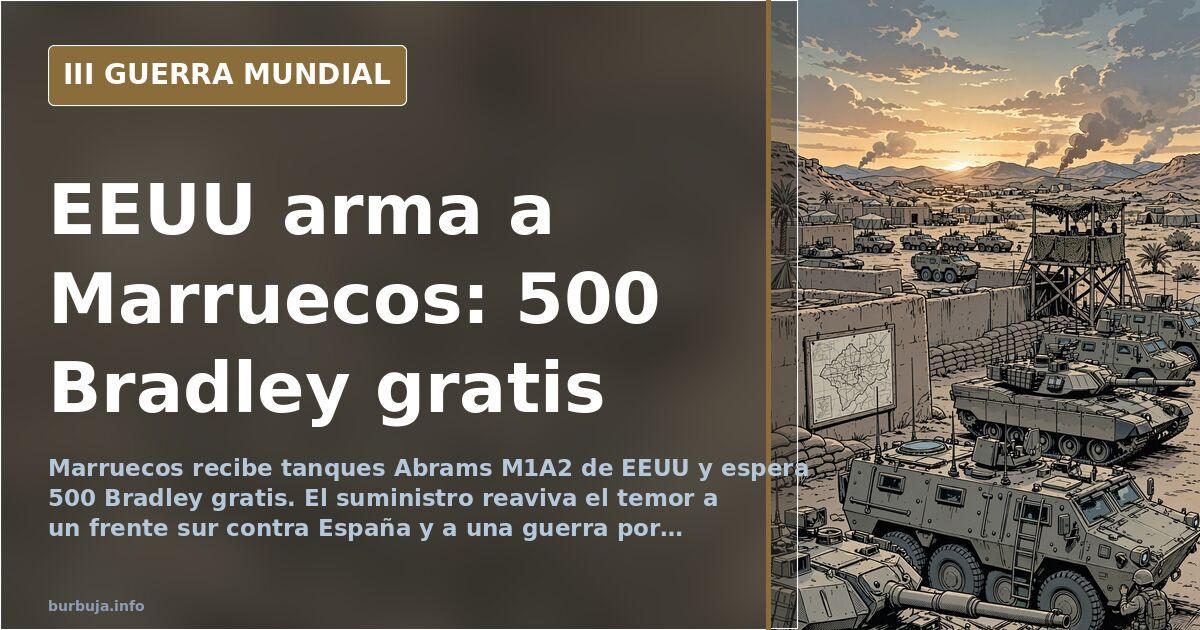
US delivers Abrams to Segarro, promises 500 free Bradleys
The Alawite kingdom has received a new batch of Abrams M1A2 main battle tanks from the United States and is awaiting a free delivery of 500 Bradley armored vehicles, according to leaked documents. The news, reported by outlets like El Mundo, has revived a long-standing suspicion in Spanish foreign policy: that Washington plays both sides with its formal allies and their neighbors. Spain hosts US bases and sends money and material to Ukraine. In return, it faces an increasingly volatile southern front.
The initial argument is blunt: it accuses the US of stealing the empire in 1898 through a false flag attack, spying on and infiltrating Spanish institutions, and keeping European partners "with a boot on their neck" so they cannot rise. The conclusion drawn is that Washington does not want an independent EU, and if preventing this requires blowing up pipelines or fueling conflicts on the southern flank, so be it.
What are the Abrams and Bradleys Segarro is receiving?
The Abrams M1A2 is a heavy US-made main battle tank with a turbine engine whose fuel consumption makes it a logistical nightmare for any army without guaranteed supply lines. The Bradley is an infantry fighting vehicle: armored, armed, and designed to transport troops to the front. The figure cited—500 units—is significant. It is a substantial amount, and here lies the first point of contention.
Some argue that 500 such vehicles are insufficient to invade Ceuta or Melilla, as large formations are easily detectable and, without support fleets, do not threaten the peninsula. Counterarguments suggest that for a ground operation in North Africa, these armored vehicles are excellent troop transports and a serious problem if Spain had to land to recover enclaves or occupy territory to ensure security.
Logistics is the other major issue. Abrams consume fuel at a rate Segarro does not produce. Blocking ports with frigates and attacking strategic depots would leave any armored force immobile within weeks. The kingdom depends on external sources for basics, including diesel for its tanks.
Why is this seen as a move against Spain?
Because the supply arrives when Spain-Segarro relations are marked by the Western Sahara concession and pressure on Ceuta and Melilla. One analysis suggests Segarro already has what it needs to control the Sahara—a political, not military, issue—and that the real danger is not this "junk," but the kingdom seizing the territory's resources and influence networks within the Spanish government itself.
Another current points to a different scenario: a US proxy war against Russia via Algeria. Algeria is allied with Russia and China; a conflict on the southern front would distract Moscow and Beijing while generating migratory pressure on Europe. Two birds with one stone. This thesis fits the idea that Washington wants no independent EU.
Spain's military response is framed in terms of deterrence. Spain should arm heavily, win the arms race against Segarro, and maintain the capacity to strike Algerian or Segarro rear areas as needed. A plan attributed to the Army involved fueling the Segarro-Algeria border conflict and landing somewhere in the Sahara. Others argue this deterrent power vanished after alienating Algeria.
Algeria's role and Maghreb balance
Algeria was a good partner: it supplied gas and shared the problem of irregular migration from the south. During the Algerian civil war in the 1990s, no migrant boats reached Spain because Algerian military patrolled their coasts. This fact argues that friendship with Algeria had strategic value and breaking it left Spain without a regional counterweight.
The circulating proposal is to make Algeria a priority strategic ally. This is not new: during the Perejil crisis in 2002, Italy and Greece offered warships and troops. The Spanish government thanked them and declined. Italy and Greece face similar African and Asian migration issues. They are Europe's southern front, just like Spain.
Ceuta, Melilla, and the Sahara: the strategic knot
Ceuta is a highly valuable enclave, defended by some as worth every euro spent. Melilla, however, is described as an indefensible pit. This asymmetry conditions any defense plan. The option of ceding both enclaves without firing a shot appears but meets immediate resistance: yielding to Segarro opens the door to the Canary Islands being next.
The Sahara is the piece moving everything. Segarro recognized Palestine in 1988 yet accepts US weapons. This contradiction seems not to bother Washington. Phosphates from the territory would boost Segarro coffers and fertilize US grain. For that, 500 Bradleys are unnecessary; political green light suffices. The concern is not armor, but recognition.
Domestic front: Ferraz and traitors
Part of the debate shifts focus. Spain's true enemy is not in Rabat or Washington, but on Calle Ferraz (PSOE headquarters). The daily open front is political, and keyboard battles distract from urgent matters. Traitors, it is said, are more dangerous than all Segarro junk combined.
This line recalls that Spanish military personnel trained the Segarro army by order of the Spanish government. That the CNI (Spanish Intelligence Center) suffered information leaks and foreign spies pay domestic agents. Distrust of institutions mixes with geopolitics, complicating coordinated responses.
The issue stalls at a point nobody closes. Armored vehicles alone cannot invade Spain but change the Maghreb's balance. The Sahara is practically conceded. Relations with Algeria are broken. And the question of whether Washington prefers a weak, dependent Europe remains unanswered officially. With these elements, the southern front does not clear itself.
Also available in: Deutsch
Summary of a discussion on Burbuja.info - Foro de economía, actualidad y política., translated from Spanish and reviewed before publication. Read the full discussion (118 replies).
More summaries
-
Debate on a Morocco invasion: Ceuta, Melilla and NATO
Forum debate on a hypothetical Moroccan invasion of Ceuta and Melilla: drones, fifth column and internal political fracture
-
Ukraine Tanks and Spain's Defense of Ceuta
Sending Leopard tanks to Ukraine reignites debate over defending Spanish enclaves against Morocco.
-
NATO protects Ukraine but not Spain's North African enclaves
Article 5 excludes North Africa, leaving Ceuta and Melilla outside the NATO umbrella while the US arms Morocco.
-
Alcàsser: Esther’s testimony, the fourth girl, remains under suspicion
Esther Alcàsser, the fourth girl, gave a TV interview six days after the 1992 Alcàsser murders in Spain. Her account and timeline discrepancies fuel ongoing controversy.
-
The Jewish migrant plot myth: 629 days of theory, zero evidence
More than 600 interventions and not a single piece of evidence: the theory blaming Jews for mass immigration collapses inside its own argumentative maze.
-
First analyses of Barcelona riots point to Russian trail behind Blocus calls and attacks
Intelligence analyses detect Russian bot farms amplifying Blocus calls ahead of 29-N. The call-to-action effect adds to local factors.