
US Aircraft Carriers and Fentanyl Crisis: A Paradox
Debate on US avoiding symmetric wars and the fentanyl crisis: eleven carriers, demographics, and internal decline.
English · Original discussion in Spanish · Published
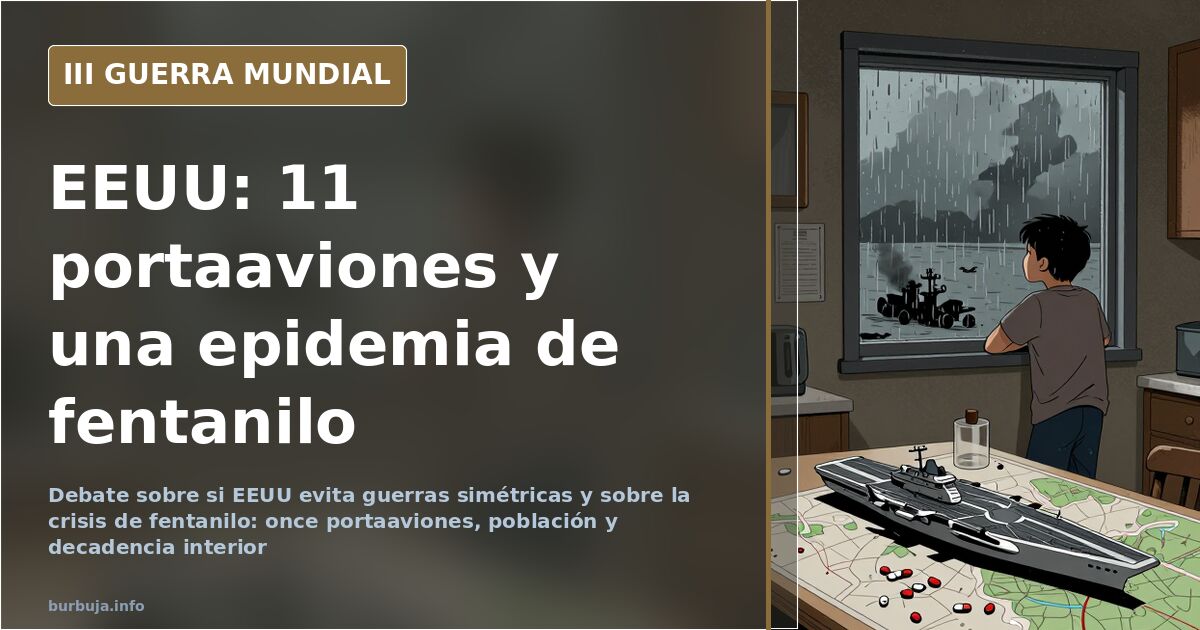
Eleven aircraft carriers, zero symmetric wars: fentanyl as a weapon
There is a scene that sums it up: a country with eleven carrier strike groups navigating half the globe while, at home, an entire generation dies from overdoses on the sidewalks of California, Philadelphia, or New York. The premise opening this discussion is brutal and unvarnished: the world's leading military power does not mobilize its aircraft carriers in direct conflict against a nuclear power, instead managing internal decay through opioids. The thesis, stated without nuance, argues that Washington prefers sending others to the slaughterhouse rather than entering a symmetric war, while its youth fades away with fentanyl as elites look the other way.
What is debated: eleven aircraft carriers that don't cross the Atlantic
The central argument is that aircraft carriers are only useful for asymmetric wars: Libya, Serbia, Afghanistan, Iraq. Against a rival with submarines and nuclear capability, a carrier strike group becomes a €20 billion target floating adrift. The reference cited is analysis by Colonel Macgregor, who maintains that no Western aircraft carrier can cross the Atlantic in a conflict against a real peer competitor.
In contrast, the most repeated counterargument is demographic: the United States has three times Russia's population, and this structural advantage is not offset by rhetoric. The discussion shifts toward NATO, Ukraine's role as a buffer state, and the idea that Europe bears the economic consequences of a conflict it does not control.
Fentanyl as state policy: the accusation running through the debate
Here the tone rises. It is claimed that killing the poor with drugs is US state policy, not an error. This thesis rests on the idea that the elite live well and those in power do not give a damn about what happens on the street. The counterargument comes from another angle: if the US needs people, it opens borders and brings in immigrants, so youth is not an asset being sacrificed but a replaceable resource.
The data used indicates the epidemic is concentrated in California, Philadelphia, and New York—on the coast, not inland. The conclusion drawn is that there is no public health response because implementing one is not in their interest.
Russia, Ukraine, and attrition: who really wins the war?
The thread splits into two irreconcilable blocks. One block argues Russia has the guts to defend itself against an existential threat generated by Washington, which throws stones and hides its hand using the Ukrainian population to achieve its goals. The other block responds that Russia invaded a smaller country with an army a thousand times weaker, and all it does is entrench behind three hundred meters of minefields while bombing civilians.
The uncomfortable question remaining is: when has the United States won a symmetric war? The answer given is never. Its greatest achievement has been avoiding them or sending others to the slaughterhouse. And the final, almost resigned recognition is that the Russians picked the wrong side.
Europe, stagflation, and the gas that no longer arrives
The economic analysis deployed points out that Germany, and with it all of Europe, has entered stagflation as a consequence of the repercussions of the Ukrainian conflict, including the destruction of the Nord Stream pipelines. It is maintained that Gazprom is bankrupt and that purchases of liquefied gas do not reach pre-sanction levels, although they buy from wherever possible.
The political accusation is direct: any pro-European behavior is labeled "russophobe," which, according to the writer, amounts to condemning one's own environment by legitimizing the gang of US agents holding Europe hostage.
The final twist: from fentanyl to cheap firing and self-employment
As often happens, the conversation drifts toward the labor market. There is debate on whether making dismissal cheaper increases hiring, whether worker costs in Spain are higher than in the Netherlands or Germany, and whether the self-employed sustain employment while being taxed heavily. The comparison with France and Germany is used as a mirror: there you can fire for free, but you must justify it before a judge.
The closure never arrives. The feeling remains that the problem is not the diagnosis, but that no one wants to pay for the treatment. Meanwhile, eleven aircraft carriers remain moored.
Also available in: Deutsch
Summary of a discussion on Burbuja.info - Foro de economía, actualidad y política., translated from Spanish and reviewed before publication. Read the full discussion (188 replies).
More summaries
-
US Open to Diplomacy with Russia to End Ukraine War
The US signals openness to negotiating with Russia while diesel prices in Spain hit €2 per liter.
-
Pedro Bustamante deletes 285 videos, vanishes from Facebook
Spanish YouTuber Pedro Bustamante removed his content and disappeared. Rumors place him in Munich, reading German press.
-
Who makes Ukraine's drones? Kitchens, workshops and a Madrid factory
Ukrainian drones are assembled in kitchens, workshops and even a factory in Madrid. This is how the decentralized network that evades Russian bombing works.
-
The Jewish 'trump card' was bound to be played: 'Sánchez is an antisemite'
Israel's ambassador to Spain accuses Pedro Sánchez of antisemitism. Is the charge grounded or a political ploy? An analysis of the debate.
-
How Israel plans to fulfill prophecy (or try to) in this war
Can Israel break free from the US and become an empire? An analysis of the Pax Judaica, the prophecies and the military reality.
-
Music, Politics and Religion: A Cultural Battlefield
Music as a tool of influence: an analysis of how metal and classical music intertwine with politics, religion and the culture war.