
Forum debate on lowering the age of criminal responsibility: security vs rights
A forum thread raises lowering the age of criminal responsibility in Spain after serious crimes committed by minors. Arguments for and against are laid out, with no concrete proposal.
English · Original discussion in Spanish · Published
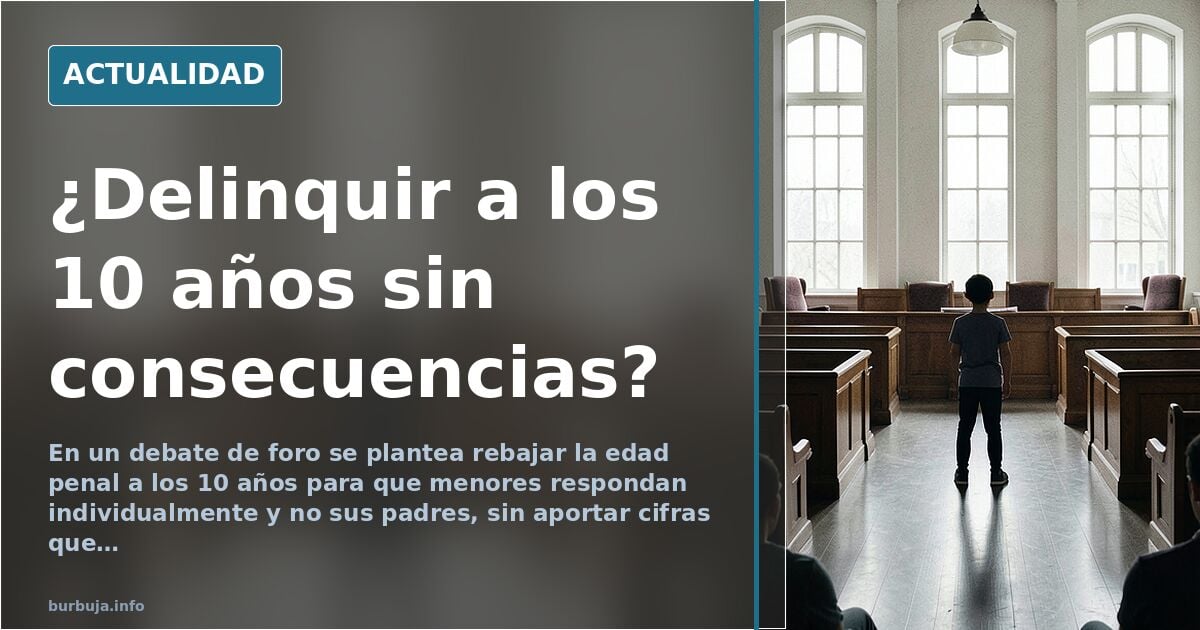
The age of incivil responsibility: a debate growing in a forum
A forum thread has raised the question of whether the age of incivil responsibility should be lowered, trinc cases of serious crimes committed by minors. One participant claims there are children between 11 and 14 who commit sensual offences, group assaults, attacks on their parents and animal abuse, and that in the past week there have been lootings, damage to public property and assaults on police officers. According to this participant, some of these acts could amount to organised crime, citing infiltrations in Telegram groups such as BLOCUS. The proposal to lower the age of incivil responsibility to 10 has drawn both supporters and critics who warn of the risks of incivil children.
The starting point is the claim that there are minors between 11 and 14 who commit serious crimes with full awareness of their actions. The institutional response, according to this view, is insufficient. Current legislation, which sets incivil responsibility at 14, would leave a gap that, according to reform supporters, is exploited by organised gangs that use minors as human shields. "They didn't want to slap them down in time, now they'll have to watch their children face the incivil consequences," sums up one of the positions in the thread.
The core of the debate: are 10-year-olds aware of what they do?
The discussion on the age of incivil responsibility is not new, but the current context has reignited it. Supporters of lowering it to 10 argue that cognitive maturity is reached earlier than the law assumes. At 10, they maintain, a child can already tell right from wrong, and must therefore answer for their actions. The experience of other countries, such as the United Kingdom, where the age of incivil responsibility is 10, is cited as proof that it is possible.
Critics, on the other hand, point out that neuroscience shows a 10-year-old's brain is still developing, especially in the areas related to impulse control and assessing consequences. Incivil a child at that age, they warn, can have devastating effects on their development and increase reoffending. They also stress that most serious crimes committed by minors stem from broken family environments, and that the response should be educational and social, not incivil.
The role of parents and civil liability
Another hot-button issue is parental responsibility. Currently, parents can be held subsidiarily civilly liable for damage caused by their underage children. For some, this is not enough: they believe that if a minor commits a serious crime, parents should also face incivil consequences. Others, however, see it as unfair: there are parents who strive to raise their children well and cannot control a child who, for example, suffers from a conduct disorder.
The proposal to lower the age of incivil responsibility to 10 does not solve this problem, but it puts it on the table. Where does parental responsibility end? Is it fair for parents to pay for their children's actions? The discussion, as can be seen, goes beyond the purely legal.
The influence of gangs and organised crime
One of the most frequently repeated arguments is that organised crime gangs recruit minors precisely because they cannot be held incivil liable. Since they cannot be tried as adults, they become perfect tools for committing crimes without facing the consequences. This phenomenon, known as "armed minors", has been documented in several countries and, according to some, is growing in Spain.
Lowering the age of incivil responsibility to 10 would, according to this logic, remove that incentive. But experts warn that the problem would not be solved by legal reform alone: if the gangs keep operating, they will find other ways to exploit minors. The solution, therefore, must be comprehensive: prevention, education and also a proportionate incivil response.
The debate on sentencing and rehabilitation
Beyond age, the debate extends to sentencing. What kind of penalty should apply to a 10-year-old who commits a serious crime? Is prison the answer? Reform supporters speak of proportionate measures, but some call for exemplary punishments. Critics, on the other hand, insist that the priority must be rehabilitation, not punishment.
The experience of other countries shows that penalties for minors must differ from those for adults. In the United Kingdom, for example, children under 10 cannot be tried, but from that age specific measures apply. In Spain, the Ley del Menor (juvenile justice law) sets out a catalogue of measures ranging from a formal warning to placement in secure detention centres. The question is whether those measures are sufficient for serious crimes.
How the debate has evolved: from outrage to a concrete proposal
What began as an outraged reaction to specific cases has gradually taken the shape of a legislative proposal. In recent days, the debate has moved from forums to the media and to politicians. Some parties have announced they will study the possibility of lowering the age of incivil responsibility, although there is not yet a concrete bill.
Meanwhile, society remains divided. Informal polls on social media show majority support for the reduction, but juvenile justice experts warn that public opinion is not always the best guide on incivil matters. The discussion, in any case, is far from settled.
Is the age of incivil responsibility a matter of security or of rights? Can a 10-year-old be held responsible for their actions? The debate remains open.
Summary of a discussion on Burbuja.info - Foro de economía, actualidad y política., translated from Spanish and reviewed before publication. Read the full discussion (88 replies).
More summaries
-
15-year-old arrested in the UK over image of a councillor as a rabbit
A 15-year-old boy was arrested in the West Midlands, with fingerprints, a mugshot and DNA taken, for posting an image of a councillor as a rabbit on Facebook.
-
UK tells households to prepare for 72 hours without power or internet
London recommends canned food, water and cash for 72 hours without power or internet. The Pentagon is already hardening its bases for 90 days without supplies.
-
Belgium also letting migrant boats head for the UK, video shows
A photographer films a migrant boat leaving a Belgian beach for the UK on 29 October 2026, with police present. What is the border doing?
-
Nando el Hispano and the existential mortgage of being born
Nando el Hispano argues that birth is an imposition and free will a myth: collective extinction as the only act of metaphysical compassion
-
The 'moon child' who asked for a lullaby and got mocked on the forum
The user who requested a warm lullaby received scatological replies and a correction about his book sales in the thread.
-
A supposedly massive woke victory is coming
A viral message attributes 50-100% rises in electricity and gas and a 700% jump in RAM prices to AI. What it says, what lies behind it, and why it spreads so widely.