
Urban Vigilance: Self-Defense and the Gravity of Unexpected Encounters
Self-defense in the city: an analysis of using spray, knife, and taser, and the legal implications of carrying defensive items.
English · Original discussion in Spanish · Published
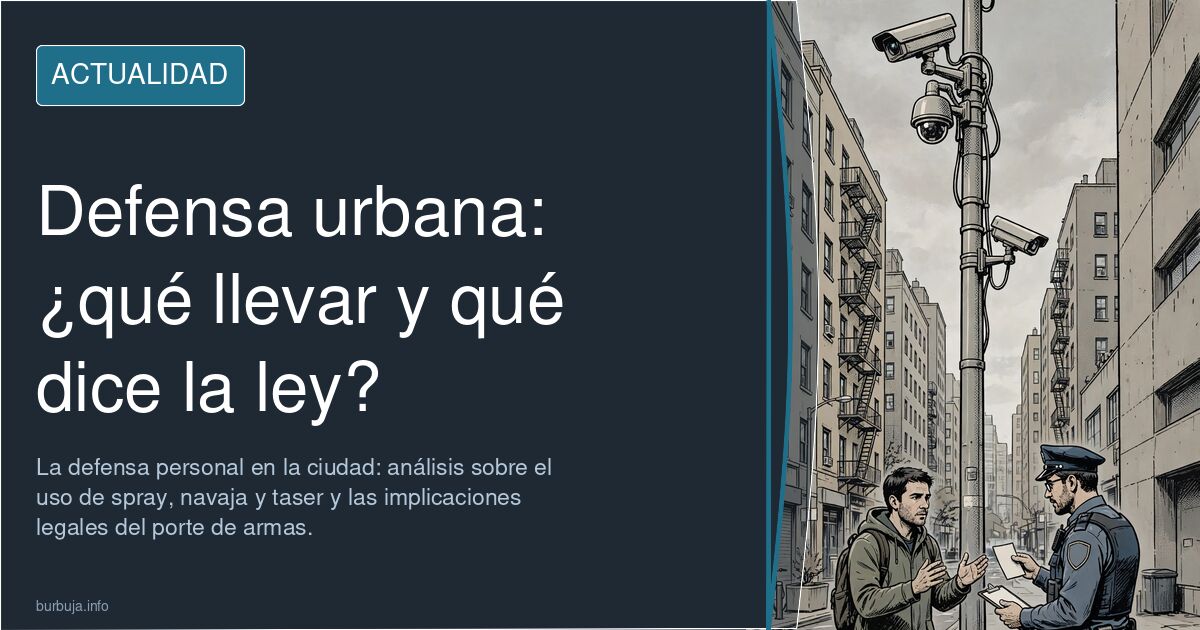
Vigilance in the Urban Environment: When Self-Defense Becomes a Necessity
The experience of being attacked or, at least, unexpectedly confronted in public space challenges the modern sense of security. A sudden blow, such as that received by an individual outdoors after being assaulted with an aluminum ball, is only the tip of the iceberg regarding this contemporary need to be prepared.
And these types of encounters in the city quickly force a shift from anecdotal accounts to a much more technical discussion: how to defend oneself? The conversation centers on the need for foresight, covering the use of spray as a deterrent, from taser to knife, the latter being a point where personal intentions meet the legal framework.
The Spectrum of Self-Defense
The response to danger in urban environments is varied. While some suggest that physical preparation, such as knowledge of martial arts, is sufficient to repel an attack, others agree that the presence of physical defense means—from spray to bladed weapons—is a crucial element for facing the recklessness of walking through a large city.
However, appropriate equipment comes at a cost. The knife or blade is perhaps the most debated item, as its carrying carries drastically different legal implications. The law establishes an important threshold: while small keychain knives may pass as a minor administrative offense, objects with blades exceeding eleven centimeters elevate the situation to a serious crime, depending on the urban context.
The Law and Added Risk
The cost of imprudence is twofold: physical and economic. One must consider not only the risk of attack but also the possibility of police control or a hefty fine. While spray may be legal in many contexts, it is the correct justification for carrying any defense that determines whether the encounter will be a mere nuisance or a incivil matter.
The conclusion is that, whether recounting an assault or seeking the ideal equipment, staying alert in the city requires more than goodwill; it demands a cold analysis of the risks and legal consequences of every action.
The experience of being attacked or, at least, unexpectedly confronted in public space challenges the modern sense of security. A sudden blow, such as that received by an individual outdoors after being assaulted with an aluminum ball, is only the tip of the iceberg regarding this contemporary need to be prepared.
And these types of encounters in the city quickly force a shift from anecdotal accounts to a much more technical discussion: how to defend oneself? The conversation centers on the need for foresight, covering the use of spray as a deterrent, from taser to knife, the latter being a point where personal intentions meet the legal framework.
The Spectrum of Self-Defense
The response to danger in urban environments is varied. While some suggest that physical preparation, such as knowledge of martial arts, is sufficient to repel an attack, others agree that the presence of physical defense means—from spray to bladed weapons—is a crucial element for facing the recklessness of walking through a large city.
However, appropriate equipment comes at a cost. The knife or blade is perhaps the most debated item, as its carrying carries drastically different legal implications. The law establishes an important threshold: while small keychain knives may pass as a minor administrative offense, objects with blades exceeding eleven centimeters elevate the situation to a serious crime, depending on the urban context.
The Law and Added Risk
The cost of imprudence is twofold: physical and economic. One must consider not only the risk of attack but also the possibility of police control or a hefty fine. While spray may be legal in many contexts, it is the correct justification for carrying any defense that determines whether the encounter will be a mere nuisance or a incivil matter.
The conclusion is that, whether recounting an assault or seeking the ideal equipment, staying alert in the city requires more than goodwill; it demands a cold analysis of the risks and legal consequences of every action.
Summary of a discussion on Burbuja.info - Foro de economía, actualidad y política., translated from Spanish and reviewed before publication. Read the full discussion (24 replies).
More summaries
-
2000 BOE Notice Reveals Maricarmen's Collado Mediano Property Auction
A June 2000 Official Gazette notice lists María del Carmen Abascal as debtor for a Collado Mediano chalet auctioned for 20 million pesetas by Banco Zaragozano.
-
AI identifies track at minute 16, according to a forum user
A forum user claims AI identifies the track at minute 16 of a techno set, but there is no entry for a viral sample without an author
-
MH370 disappearance: The enigma of 239 lives in the Indian Ocean
The mystery of MH370: We analyze the data from the disappearance of the Malaysia Airlines flight and the theories surrounding the 239 passengers.
-
2024 bullfighting season kicks off on TV and with paid Fallas
The 2024 bullfighting season begins on free-to-air TV with events in Olivenza and Villaseca, while the Fallas are only available on pay-per-view via Onetoro.
-
Reactionary Quotes: The Intellectual Resistance Against Modernity
Over 2,000 quotes from authors like Evola, Chesterton, and Gómez Dávila form an anthology of reactionary thought that challenges modern dogmas.
-
Gifted students and school phobia: the education system
Analysis of the tension between giftedness and school phobia in today's education system