
2024 bullfighting season kicks off on TV and with paid Fallas
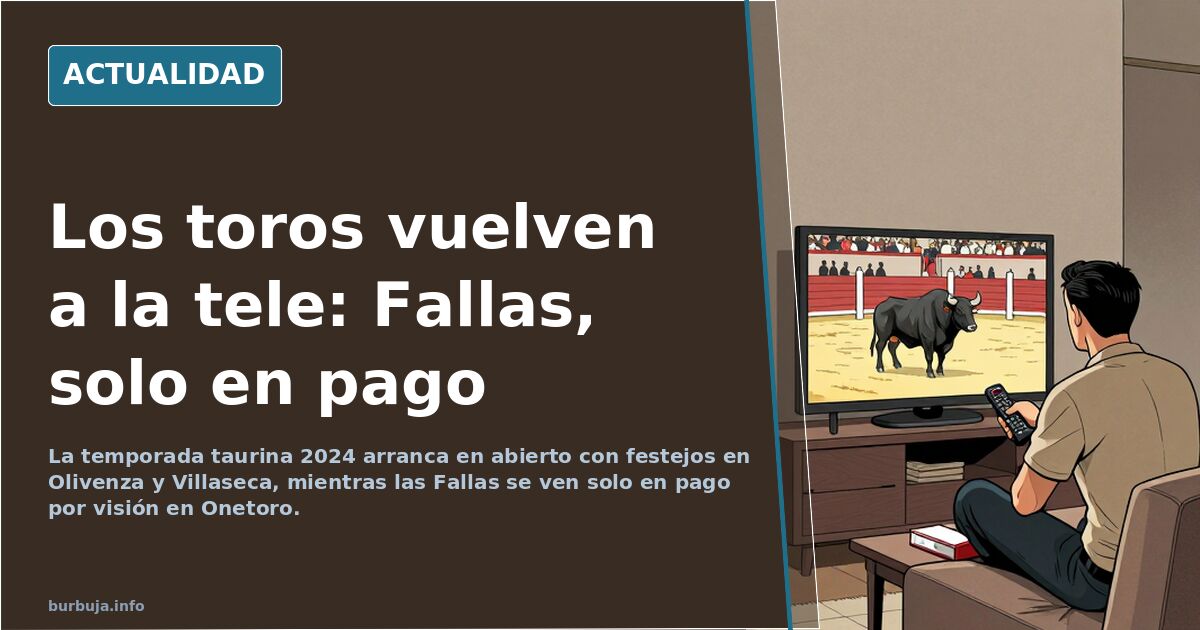
The 2024 bullfighting season begins on free-to-air TV with events in Olivenza and Villaseca, while the Fallas are only available on pay-per-view via Onetoro.
English · Original discussion in Spanish · Published
From Olivenza to the Maestranza: this is how the 2024 bullfighting season kicks off
At 5:30 p.m. on Friday, March 1, 2024, Canal Extremadura peine its schedule to the first televised novillada of the season. From Olivenza (Badajoz), with picadores, novillos from La Cercada and three young names on the bill: Carlos Domínguez, Sergio Sánchez and «El Mella». Twenty-four hours later, at 5:00 p.m., Castilla-La Mancha Media broadcast another bullfight, this one from Villaseca de la Sagra (Toledo), with a charitable purpose —the Fundación de Oncohematología Infantil del Hospital Niño Jesús— and bulls from Peñajara de Casta Jijona for Morenito de Aranda, Damián Castaño and Gómez del Pilar.
With those two events, the televised calendar got underway. February had already made its move: Valdemorillo presented its posters for the 9th, 10th and 11th, with Núñez del Cuvillo and Alcurrucen among the ranches and the alternativa of García Pulido as one of the announcements; and the Kilómetro Cero contest held its second edition at the Palacio Vistalegre on the 23rd, 24th and 25th.
Why are the 2024 Fallas only available on pay-per-view?
Because the Valencian fair returned to television after a year's absence, but it did so behind a paywall. The announced events were broadcast on Onetoro under a pay-per-view (PPV) model. On Saturday, March 9, novillos from Chamaco for Alejandro Peñaranda, Samuel Navalón and Alberto Donaire. On Sunday the 10th, an unusual bill: six ranches —Victorino Martín, Domingo Hernández, El Parralejo, Pedraza de Yeltes, Fuente Ymbro and Hermanos García Jiménez— for a single matador, Román, who was announced alone. On Thursday the 14th there was another novillada with picadores.
It is the pattern that repeats at the start of the season: what doesn't make it onto a regional channel ends up on a subscription platform. The Valencian fair was shown, yes, but not on free-to-air.
The fine print of viewing: the Onetoro app
Access wasn't free and not just because of the price. A fan asked about the Onetoro application before installing it on his father's device and cited the negative reviews it has accumulated in the app store. The answer he got was as terse as it was telling: there is no more information than those same comments. The detail is not minor. If a fair is only available through a specific app and that app raises doubts, the real reach of the event is up in the air. Between what is broadcast and what is actually seen there is a gap that no one measures.
The underlying complaint: the same names on the posters
As posters were published, the criticism was repeated: the same matadors, the same ranches as always. The feeling of a loop is not exclusive to one plaza; it appears in Valdemorillo, at the Feria de la Magdalena or at the San José fair in Arnedo, where the poster again brings together Sarracena, Urdiales and Talavante. Against that, the season also shows new faces: at the Valdemorillo novillada on February 9, Ismael Martín, Romero Nek and Samuel Navalón were announced, and the latter repeated at the Fallas novillada. Some see in that list the generational relay that is coming; others suspect that the ranks are renewed much less than is claimed.
The Maestranza and the campaign «Who will occupy the throne?»
The great showcase of the first half of the year is Seville, and the Pagés company sold it as a dispute for the throne. The spot for the 2024 season insisted on the idea of the Maestranza as the crown jewel and repeated that all roads lead to it. The posters: on Easter Sunday, March 31, bulls from Hermanos García Jiménez for Sarracena de la Puebla, Sebastián Castella and Roca Rey; on April 7, bulls from Fermín Bohórquez for Lama de Góngora, José Ruiz Muñoz and Calerito; and on April 9, bulls from Santiago Domecq. Kingdom marketing for a plaza that, one more year, is sold as the final exam of the ranks.
The photographic work that portrays the new matadors
Alongside the posters, other material circulated: «The Matador», a photographic project carried out in Spain in 2023 with the support of the Joan Wakelin Bursary and The Guardian. The work trinc young aspiring matadors and captured the growing division over whether the death of an animal should remain a spectacle. Those portrayed spoke of what they said they had learned in the ring: respect, courage, discipline. The text placed the origin of the fiesta as far back as the year 711. No season campaign answers that question.
Ciudad Rodrigo, Arnedo and Illescas: the rest of the calendar
The season is not limited to the big plazas. Ciudad Rodrigo unveiled the program of the preCarnaval Cultural and the Carnaval del Toro 2024. Illescas announced what it described as luxury and clash at its Feria del Milagro. And even the Fundación del Toro de Lidia launched a fan question online: what is the difference between casta and bravura. In a bullfighting gathering, that question is worth as much as a poster.
The 2024 season started with two signs that don't quite fit. Bulls returned to free-to-air television on regional channels. The Fallas, however, only reached those who paid for the platform. The applause was free; watching it was not.
At 5:30 p.m. on Friday, March 1, 2024, Canal Extremadura peine its schedule to the first televised novillada of the season. From Olivenza (Badajoz), with picadores, novillos from La Cercada and three young names on the bill: Carlos Domínguez, Sergio Sánchez and «El Mella». Twenty-four hours later, at 5:00 p.m., Castilla-La Mancha Media broadcast another bullfight, this one from Villaseca de la Sagra (Toledo), with a charitable purpose —the Fundación de Oncohematología Infantil del Hospital Niño Jesús— and bulls from Peñajara de Casta Jijona for Morenito de Aranda, Damián Castaño and Gómez del Pilar.
With those two events, the televised calendar got underway. February had already made its move: Valdemorillo presented its posters for the 9th, 10th and 11th, with Núñez del Cuvillo and Alcurrucen among the ranches and the alternativa of García Pulido as one of the announcements; and the Kilómetro Cero contest held its second edition at the Palacio Vistalegre on the 23rd, 24th and 25th.
Why are the 2024 Fallas only available on pay-per-view?
Because the Valencian fair returned to television after a year's absence, but it did so behind a paywall. The announced events were broadcast on Onetoro under a pay-per-view (PPV) model. On Saturday, March 9, novillos from Chamaco for Alejandro Peñaranda, Samuel Navalón and Alberto Donaire. On Sunday the 10th, an unusual bill: six ranches —Victorino Martín, Domingo Hernández, El Parralejo, Pedraza de Yeltes, Fuente Ymbro and Hermanos García Jiménez— for a single matador, Román, who was announced alone. On Thursday the 14th there was another novillada with picadores.
It is the pattern that repeats at the start of the season: what doesn't make it onto a regional channel ends up on a subscription platform. The Valencian fair was shown, yes, but not on free-to-air.
The fine print of viewing: the Onetoro app
Access wasn't free and not just because of the price. A fan asked about the Onetoro application before installing it on his father's device and cited the negative reviews it has accumulated in the app store. The answer he got was as terse as it was telling: there is no more information than those same comments. The detail is not minor. If a fair is only available through a specific app and that app raises doubts, the real reach of the event is up in the air. Between what is broadcast and what is actually seen there is a gap that no one measures.
The underlying complaint: the same names on the posters
As posters were published, the criticism was repeated: the same matadors, the same ranches as always. The feeling of a loop is not exclusive to one plaza; it appears in Valdemorillo, at the Feria de la Magdalena or at the San José fair in Arnedo, where the poster again brings together Sarracena, Urdiales and Talavante. Against that, the season also shows new faces: at the Valdemorillo novillada on February 9, Ismael Martín, Romero Nek and Samuel Navalón were announced, and the latter repeated at the Fallas novillada. Some see in that list the generational relay that is coming; others suspect that the ranks are renewed much less than is claimed.
The Maestranza and the campaign «Who will occupy the throne?»
The great showcase of the first half of the year is Seville, and the Pagés company sold it as a dispute for the throne. The spot for the 2024 season insisted on the idea of the Maestranza as the crown jewel and repeated that all roads lead to it. The posters: on Easter Sunday, March 31, bulls from Hermanos García Jiménez for Sarracena de la Puebla, Sebastián Castella and Roca Rey; on April 7, bulls from Fermín Bohórquez for Lama de Góngora, José Ruiz Muñoz and Calerito; and on April 9, bulls from Santiago Domecq. Kingdom marketing for a plaza that, one more year, is sold as the final exam of the ranks.
The photographic work that portrays the new matadors
Alongside the posters, other material circulated: «The Matador», a photographic project carried out in Spain in 2023 with the support of the Joan Wakelin Bursary and The Guardian. The work trinc young aspiring matadors and captured the growing division over whether the death of an animal should remain a spectacle. Those portrayed spoke of what they said they had learned in the ring: respect, courage, discipline. The text placed the origin of the fiesta as far back as the year 711. No season campaign answers that question.
Ciudad Rodrigo, Arnedo and Illescas: the rest of the calendar
The season is not limited to the big plazas. Ciudad Rodrigo unveiled the program of the preCarnaval Cultural and the Carnaval del Toro 2024. Illescas announced what it described as luxury and clash at its Feria del Milagro. And even the Fundación del Toro de Lidia launched a fan question online: what is the difference between casta and bravura. In a bullfighting gathering, that question is worth as much as a poster.
The 2024 season started with two signs that don't quite fit. Bulls returned to free-to-air television on regional channels. The Fallas, however, only reached those who paid for the platform. The applause was free; watching it was not.
Summary of a discussion on Burbuja.info - Foro de economía, actualidad y política., translated from Spanish and reviewed before publication. Read the full discussion (2474 replies).
More summaries
-
PNV Bilbao Candidate Mikel Hidalgo Marries His Partner
Mikel Hidalgo, the PNV candidate for mayor of Bilbao, marries his partner at 33 and announces it on social media.
-
Man Arrested in Lleida for Sexual Assault with Minor Witness
A man was arrested in Lleida for allegedly sexually assaulting his daughter in front of a minor.
-
Spain's Fátima Ofkir freed in Oman after seven years
Detained in Oman at 18 with 7kg of morphine, Fátima Ofkir is released after serving seven years of her sentence.
-
Spanish roundabouts: Why 99% of drivers get it wrong
Most drivers in Spain misuse roundabouts. Legal vs. civic norms, forgotten indicators, and the Dutch solution now arriving in Vigo.
-
Only 15% of Spaniards Know How to Play Chess
A forum post reveals that just 15% of Spaniards know how to play chess, compared to 30% in Europe and 5% in South America, highlighting a cultural gap.
-
Leggings on the street: comfort or early exhibition in Spain?
Analysis of the daily leggings trend: Is it genuine comfort or early exhibitionism in Spanish cities?