
Unwanted Solitude: The Daily Routine of Living Alone in Spain
Work, shopping, and farm chores define the daily routine of those living alone in rural Spain, lacking weekend plans or nearby support.
English · Original discussion in Spanish · Published
The Life of Those Who Are Alone: Daily Routines and Unplanned Weekends
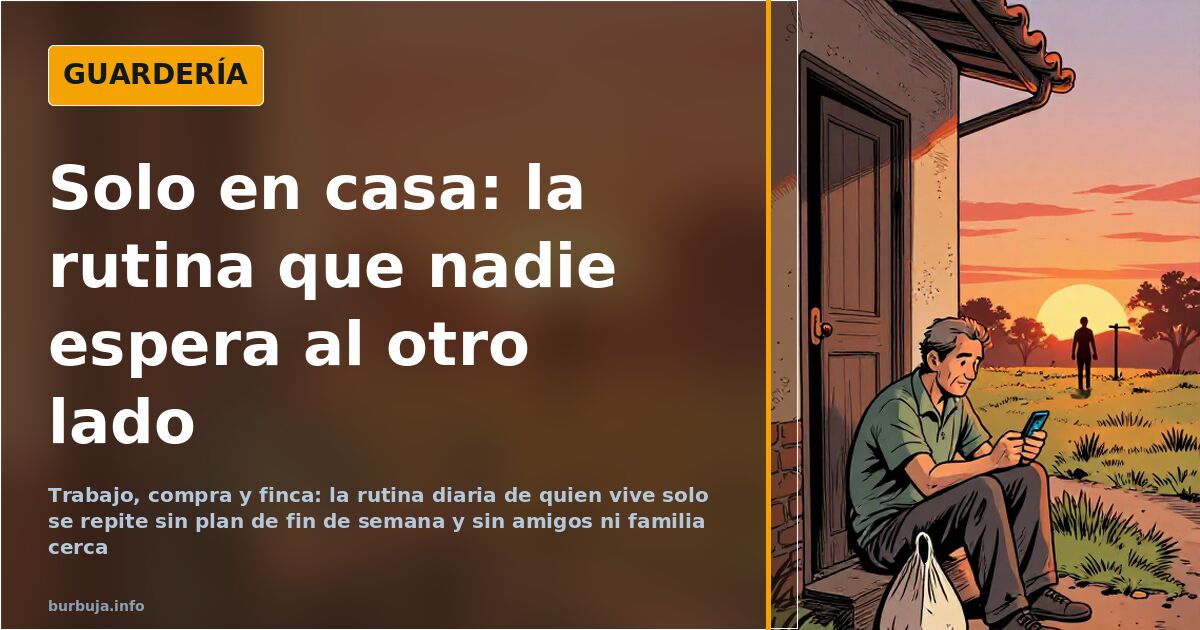
There is a routine that repeats without surprises: work in the morning, shopping, some exercise or farm work in the afternoon, and a weekend with no plan. Those who describe it say they live in an area far from everything, without close family or friends, with only "hello-and-goodbye acquaintances" as their social fabric. Despair arrives when one realizes the next day will be identical to the previous one. And this is not an isolated case: every time someone asks aloud how life is organized without anyone on the other side, dozens of similar stories appear.
How many hours a day can you spend doing nothing?
The question is literal, not rhetorical. Those who ask it admit struggling to fill dead time and that lack of motivation has settled into almost every facet of their lives. "Sometimes I think living in a mental prison is worse than a physical one," they summarize. Around them are textbook routines: a mechanical sequence that starts and ends in bed—sleeping, gym, eating, television, computer, dinner, and sleeping—and the memory of friendships that vanished without anyone slamming a door.
Monotony, however, has its defenders. One current holds that partnering up breaks nothing: life, whether alone or accompanied, is always monotonous, same faces, same places, same activities. From this perspective, solitude would not be the cause of boredom, but merely the backdrop where it is played out.
What do people who live alone do to fill their time?
The repertoire expands when ideas are requested. Outdoor sports and swimming pools, hiking, motorcycle rides with stops for a drink, reading, home cinema, land to cultivate, online English courses, and short story contests that require research. Some care for bonsai trees, design things, or raise birds, while others argue that any hobby works if it generates the perception that time is being used well. Music acts as a refuge: one account logs 3,700 hours in a year and drags along six years without working with that soundtrack in the background.
No one claims this is enough. The author of the initial question admits they will sign up for a gym when bad weather arrives and considers vocational training for adults, though they doubt it will fill the gaps. More experienced individuals warn that individual sports calm but do not socialize: swimming or running improves the body but leaves the agenda just as empty.
Is it chosen solitude or what remains?
Both coexist and are not always distinguishable. One line of accounts defends solitary walks as a privilege: contemplating the landscape at one's own pace, without filler conversations and without depending on anyone, is, they say, a marvel. Others have learned to enjoy a beer in the city center, a motorcycle ride, or a classic film without company, and some place doing absolutely nothing among available pleasures.
Opposite to this is unchosen solitude. Rural areas worsen the cocktail: 17 years in an environment where everyone is partnered, without a single friend or relative nearby, ceases to be an anecdote. There are those who maintain intact friendships—more than 35 years of relationship—but only see each other five or six times a year, and those who care for a 91-year-old relative while confessing to feeling very comfortable like this, with five years without relationships and no rush to change it. The distance between wanting to be alone and having no one is measured in nuances.
What solutions are proposed to break the routine?
Practical proposals repeat themselves: volunteering at animal shelters, music as an unpretentious hobby, gyms with windows onto natural landscapes—the only format that, according to one testimony, works—language courses, hiking, and adult education. The community path also appears: brotherhoods and religious communities offer social networks, retreats, and structure, with the warning that they demand commitment and consistency in return.
The problem is geography. Those living in remote areas recall that many of these options are impractical. The municipal pool where they used to swim has closed by decision of the town hall (ayuntamiento).
The uncomfortable diagnosis: the problem is also personal
When someone asks for advice, the same recommendation always appears, and it is not comfortable: change oneself. Learning to value oneself, this current argues, is a prerequisite for relating to others, because no one else will do that work for you. The argument adds that the world is full of people with high self-esteem who, precisely for that reason, move about without complexes.
Not everyone accepts this framework. Another current shifts the blame to the system: modern society rewards competitiveness and leaves behind those who do not fit, so self-flagellation would be a diagnostic error. Between individual responsibility and social structure moves much of the exchange, with a shared warning: those who systematically deflect blame do not fix their situation either.
What happens when health dismantles the self-imposed routine?
One testimony cuts to the chase. Someone accumulating two jobs, a doctoral thesis, gym, and swimming to avoid boredom discovered their limit when a vertigo problem prevented them from driving. Unable to even go to the doctor's office, all those activities collapsed at once. Everything had to stop, they recount. The conclusion is uncomfortable: a packed schedule functions as scaffolding, and one dizzy spell is enough to check that there was little substance underneath.
To this is added the background noise. There are those who fill the void with alcohol after work, those who reduce the week to a mechanical succession of tasks, and those who simply wait for something to change without making a move. None ask for pity. They ask, at most, for ideas that do not sound like brochures.
In the end, one account summarizes their life plan with dark humor: may they find me fossilized at home when someone calls due to the smell. And the data is disorienting. Among the most applauded responses, five years without relationships does not prevent declaring oneself comfortable, while those with a job, farm, and ordered routine say they live with despair. The difference is not in what is done during the day. It is in whether someone is waiting on the other side.
There is a routine that repeats without surprises: work in the morning, shopping, some exercise or farm work in the afternoon, and a weekend with no plan. Those who describe it say they live in an area far from everything, without close family or friends, with only "hello-and-goodbye acquaintances" as their social fabric. Despair arrives when one realizes the next day will be identical to the previous one. And this is not an isolated case: every time someone asks aloud how life is organized without anyone on the other side, dozens of similar stories appear.
How many hours a day can you spend doing nothing?
The question is literal, not rhetorical. Those who ask it admit struggling to fill dead time and that lack of motivation has settled into almost every facet of their lives. "Sometimes I think living in a mental prison is worse than a physical one," they summarize. Around them are textbook routines: a mechanical sequence that starts and ends in bed—sleeping, gym, eating, television, computer, dinner, and sleeping—and the memory of friendships that vanished without anyone slamming a door.
Monotony, however, has its defenders. One current holds that partnering up breaks nothing: life, whether alone or accompanied, is always monotonous, same faces, same places, same activities. From this perspective, solitude would not be the cause of boredom, but merely the backdrop where it is played out.
What do people who live alone do to fill their time?
The repertoire expands when ideas are requested. Outdoor sports and swimming pools, hiking, motorcycle rides with stops for a drink, reading, home cinema, land to cultivate, online English courses, and short story contests that require research. Some care for bonsai trees, design things, or raise birds, while others argue that any hobby works if it generates the perception that time is being used well. Music acts as a refuge: one account logs 3,700 hours in a year and drags along six years without working with that soundtrack in the background.
No one claims this is enough. The author of the initial question admits they will sign up for a gym when bad weather arrives and considers vocational training for adults, though they doubt it will fill the gaps. More experienced individuals warn that individual sports calm but do not socialize: swimming or running improves the body but leaves the agenda just as empty.
Is it chosen solitude or what remains?
Both coexist and are not always distinguishable. One line of accounts defends solitary walks as a privilege: contemplating the landscape at one's own pace, without filler conversations and without depending on anyone, is, they say, a marvel. Others have learned to enjoy a beer in the city center, a motorcycle ride, or a classic film without company, and some place doing absolutely nothing among available pleasures.
Opposite to this is unchosen solitude. Rural areas worsen the cocktail: 17 years in an environment where everyone is partnered, without a single friend or relative nearby, ceases to be an anecdote. There are those who maintain intact friendships—more than 35 years of relationship—but only see each other five or six times a year, and those who care for a 91-year-old relative while confessing to feeling very comfortable like this, with five years without relationships and no rush to change it. The distance between wanting to be alone and having no one is measured in nuances.
What solutions are proposed to break the routine?
Practical proposals repeat themselves: volunteering at animal shelters, music as an unpretentious hobby, gyms with windows onto natural landscapes—the only format that, according to one testimony, works—language courses, hiking, and adult education. The community path also appears: brotherhoods and religious communities offer social networks, retreats, and structure, with the warning that they demand commitment and consistency in return.
The problem is geography. Those living in remote areas recall that many of these options are impractical. The municipal pool where they used to swim has closed by decision of the town hall (ayuntamiento).
The uncomfortable diagnosis: the problem is also personal
When someone asks for advice, the same recommendation always appears, and it is not comfortable: change oneself. Learning to value oneself, this current argues, is a prerequisite for relating to others, because no one else will do that work for you. The argument adds that the world is full of people with high self-esteem who, precisely for that reason, move about without complexes.
Not everyone accepts this framework. Another current shifts the blame to the system: modern society rewards competitiveness and leaves behind those who do not fit, so self-flagellation would be a diagnostic error. Between individual responsibility and social structure moves much of the exchange, with a shared warning: those who systematically deflect blame do not fix their situation either.
What happens when health dismantles the self-imposed routine?
One testimony cuts to the chase. Someone accumulating two jobs, a doctoral thesis, gym, and swimming to avoid boredom discovered their limit when a vertigo problem prevented them from driving. Unable to even go to the doctor's office, all those activities collapsed at once. Everything had to stop, they recount. The conclusion is uncomfortable: a packed schedule functions as scaffolding, and one dizzy spell is enough to check that there was little substance underneath.
To this is added the background noise. There are those who fill the void with alcohol after work, those who reduce the week to a mechanical succession of tasks, and those who simply wait for something to change without making a move. None ask for pity. They ask, at most, for ideas that do not sound like brochures.
In the end, one account summarizes their life plan with dark humor: may they find me fossilized at home when someone calls due to the smell. And the data is disorienting. Among the most applauded responses, five years without relationships does not prevent declaring oneself comfortable, while those with a job, farm, and ordered routine say they live with despair. The difference is not in what is done during the day. It is in whether someone is waiting on the other side.
Also available in: Deutsch
Summary of a discussion on Burbuja.info - Foro de economía, actualidad y política., translated from Spanish and reviewed before publication. Read the full discussion (136 replies).
More summaries
-
Spain 'mamazo' video: viral, illegal and a gender debate
The viral 'mamazo' video in Cádiz is a crime for sharing minors' images; it sparks a gender debate and a judicial response.
-
Russell Crowe was 36 in Gladiator: Hollywood's age debate
Russell Crowe was 36 during Gladiator. We analyze if this fit Maximus and Hollywood's trend of casting older actors.
-
Aging and Apathy: The Silent Loss of Interest
Men describe losing interest in hobbies like sports and books. This existential boredom, often mistaken for depression, reflects a deeper crisis of meaning.
-
Alfredo Landa as Vito Corleone: Why the Spanish Icon Didn't Fit
Forum debates suggest Alfredo Landa's physique and typecasting in comedy prevented him from being a credible Don Corleone.
-
Valencia Speed-Dating Event Draws Viral Attention Amid Dating Market Criticism
A viral video from a Valencia speed-dating event highlights dating market disparities, featuring bald men and selective women alongside Tinder data analysis.
-
Debate: Covers That Outshine The Originals
Forum users discuss if covers can surpass originals, citing Joe Cocker, Johnny Cash, Hendrix and Tina Turner.