
Aging and Apathy: The Silent Loss of Interest
Men describe losing interest in hobbies like sports and books. This existential boredom, often mistaken for depression, reflects a deeper crisis of meaning.
English · Original discussion in Spanish · Published
Silent Anhedonia: When Nothing Interests You
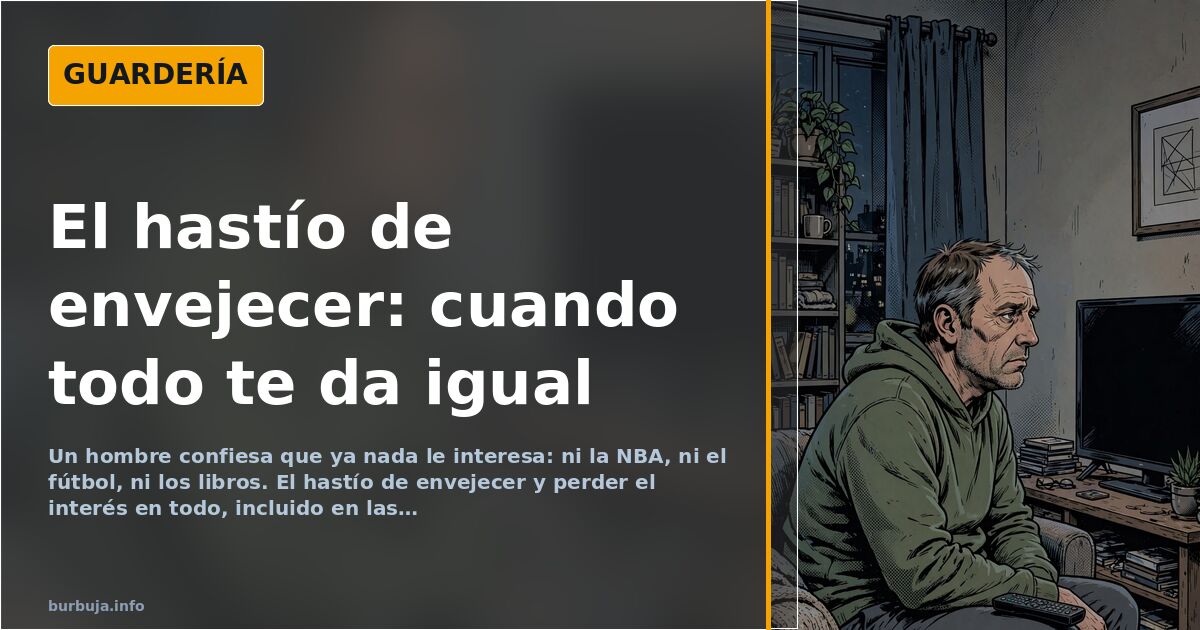
Why do we stop enjoying what once passionate us? One man sums it up bluntly: he used to wake up early for the NBA, now he can't even watch three-minute highlights. Football seems like "Europe's baseball," video games offer no satisfaction, and his last book was read eight years ago. It isn't clinical depression, he says, but something else: the realization that our individual small worlds lead nowhere.
The phenomenon has a colloquial name: midlife apathy syndrome. And it is not an isolated case. Several participants confirm they feel the same. The conversation shifts to causes: social media, easy adrenaline, and the inability to coexist with boredom.
The Trap of Constant Adrenaline
One of the most repeated explanations points to overstimulation. Social media bombards users with quick stimuli: short videos, instant validation, permanent comparison. The brain gets used to that pace, and slow things become boring. "Everything is fast and it's burning their brains without them realizing," one participant argues.
The cited remedy is ataraxia: if you expect nothing positive, you don't feel the void either. The problem, it is argued, is that current society does not conceive of boredom as part of life. Everyone wants to live adventures, have lots of sens, be the best-looking. And that is an explosive cocktail.
The Void That Comes With Age
Others attribute it simply to age. When you've seen everything, fewer things surprise you. A child marvels because they are discovering the world; a 40-year-old adult has had enough experiences so that nothing catches them off guard again. "It's refining tastes," someone says. Less entertainment, but higher quality.
But there is a darker variant: loss of interest in people. It is not a lack of empathy, clarifies the author of the initial message, it is seeing that everyone's small worlds lead nowhere. The rat race. Living in boxes, working in boxes, dying in a box.
Isolation as Refuge
The conversation drifts toward social isolation. One admits he has withdrawn, that his partner is deeply antisocial, and that virtual contact replaces face-to-face interaction. "The NPC-ism of others is touching," he says. Ultimately, why socialize?
The phenomenon has a generational dimension. Young people grow up surrounded by the need for online approval. This sets expectations that in most cases are unrealistic. And when reality doesn't meet them, frustration arrives.
Old Age as an Uncomfortable Mirror
A participant describes a scene: researching a curious building, discovering it is a nursing home, entering its Facebook page, and seeing photos of residents in their activities. The depression that hit him was monumental. "This is how I'll end up," he thinks.
Another adds an uncomfortable nuance: the problem with old age isn't losing interest in others, but others losing interest in you. Friendship is a transaction. No one invests time in someone who cannot give anything back. Unless you are Marlon Brando.
Possible Ways Out
Proposals vary. Sign up for boxing. Cook a new dish once a week. Look for long-term projects. Make a list of new hobbies and try them. The most repeated advice: accept that boredom is part of life and you shouldn't flee from it.
"There is a middle ground between anhedonia and the constant search for adrenaline," someone summarizes. The problem is that we live at the opposite extreme. Kids grow up surrounded by the need for online validation. And that leads to setting expectations that in practically all cases are unrealistic.
In the end, the conclusion hovering above is that losing interest in everything is liberating. "The only good thing about aging," someone says. Not caring about things and going through life with fewer filters. Or perhaps not. Perhaps all that remains is to die.
Why do we stop enjoying what once passionate us? One man sums it up bluntly: he used to wake up early for the NBA, now he can't even watch three-minute highlights. Football seems like "Europe's baseball," video games offer no satisfaction, and his last book was read eight years ago. It isn't clinical depression, he says, but something else: the realization that our individual small worlds lead nowhere.
The phenomenon has a colloquial name: midlife apathy syndrome. And it is not an isolated case. Several participants confirm they feel the same. The conversation shifts to causes: social media, easy adrenaline, and the inability to coexist with boredom.
The Trap of Constant Adrenaline
One of the most repeated explanations points to overstimulation. Social media bombards users with quick stimuli: short videos, instant validation, permanent comparison. The brain gets used to that pace, and slow things become boring. "Everything is fast and it's burning their brains without them realizing," one participant argues.
The cited remedy is ataraxia: if you expect nothing positive, you don't feel the void either. The problem, it is argued, is that current society does not conceive of boredom as part of life. Everyone wants to live adventures, have lots of sens, be the best-looking. And that is an explosive cocktail.
The Void That Comes With Age
Others attribute it simply to age. When you've seen everything, fewer things surprise you. A child marvels because they are discovering the world; a 40-year-old adult has had enough experiences so that nothing catches them off guard again. "It's refining tastes," someone says. Less entertainment, but higher quality.
But there is a darker variant: loss of interest in people. It is not a lack of empathy, clarifies the author of the initial message, it is seeing that everyone's small worlds lead nowhere. The rat race. Living in boxes, working in boxes, dying in a box.
Isolation as Refuge
The conversation drifts toward social isolation. One admits he has withdrawn, that his partner is deeply antisocial, and that virtual contact replaces face-to-face interaction. "The NPC-ism of others is touching," he says. Ultimately, why socialize?
The phenomenon has a generational dimension. Young people grow up surrounded by the need for online approval. This sets expectations that in most cases are unrealistic. And when reality doesn't meet them, frustration arrives.
Old Age as an Uncomfortable Mirror
A participant describes a scene: researching a curious building, discovering it is a nursing home, entering its Facebook page, and seeing photos of residents in their activities. The depression that hit him was monumental. "This is how I'll end up," he thinks.
Another adds an uncomfortable nuance: the problem with old age isn't losing interest in others, but others losing interest in you. Friendship is a transaction. No one invests time in someone who cannot give anything back. Unless you are Marlon Brando.
Possible Ways Out
Proposals vary. Sign up for boxing. Cook a new dish once a week. Look for long-term projects. Make a list of new hobbies and try them. The most repeated advice: accept that boredom is part of life and you shouldn't flee from it.
"There is a middle ground between anhedonia and the constant search for adrenaline," someone summarizes. The problem is that we live at the opposite extreme. Kids grow up surrounded by the need for online validation. And that leads to setting expectations that in practically all cases are unrealistic.
In the end, the conclusion hovering above is that losing interest in everything is liberating. "The only good thing about aging," someone says. Not caring about things and going through life with fewer filters. Or perhaps not. Perhaps all that remains is to die.
Also available in: Deutsch
Summary of a discussion on Burbuja.info - Foro de economía, actualidad y política., translated from Spanish and reviewed before publication. Read the full discussion (135 replies).
More summaries
-
Coto Matamoros returns on YouTube: the tattooed bald man phenomenon
The 70-year-old Crónicas Marcianas veteran has become a YouTube regular. Why this resurgence? Political readings are not clear...
-
Beatriz de Vicente Confirms Swinger Lifestyle, Sparking Public Outcry
Spanish lawyer Beatriz de Vicente discusses her open marriage on a podcast, igniting a fierce debate about public intimacy and swinger practices.
-
Paula Púa Sparks Gender Debate in Spanish Comedy
Criticism of comedian Paula Púa quickly devolves into the cliché that women aren't funny. Is it humor or prejudice?
-
Latin American Migration in Poland: Low Wages and Overcrowding
With €600 salaries and flats shared by 20 people, Latin American migration to Poland grows amid jobs locals reject.
-
Covadonga Torres: Online Forum Divided Over Her Appearance
Covadonga Torres, linked to the 'Colonel', sparks forum debate on her physique, diet, and love life.
-
Anonymous Photographer Documented Spain's Housing Bubble
The story of an anonymous chronicler who photographed Spain's housing bubble since 2007, creating a historical archive contrasting with deniers.