
Unverified photos of dead Russian soldier spark propaganda debate
Unverified images attributed to a fallen Russian conscript fuel ridicule and reopen debates on war narratives and propaganda.
English · Original discussion in Spanish · Published
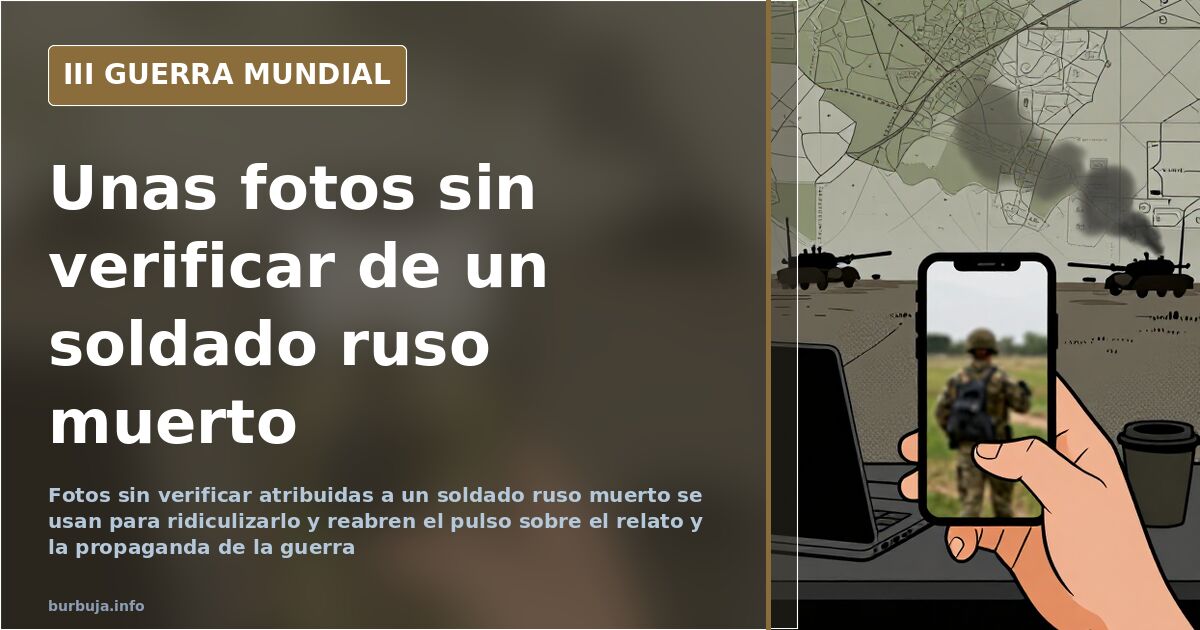
Photos of dead Russian soldier ignite controversy over mocking the fallen
Booth photographs attributed to a deceased Russian soldier, presented as found among his belongings, have turned a personal item into wartime ammunition. The serviceman was reportedly no older than 20. No one has proven the images are authentic, yet they have already been used to mock a dead man, accuse critics of hypocrisy, and reopen the question of who controls the narrative of the conflict in Ukraine.
Are the photos of the fallen Russian soldier verified?
There is no independent confirmation of the material's origin or date. Some who spread it assume the snapshots were found in the deceased's gear; others suspect fabrication, citing the format itself—booth copies, still made at stations and malls—to doubt that a battlefield produces such images. Between these extremes lies a more mundane hypothesis: Russian recruits are ordered to carry identification, lacking dog tags, both for corpse recognition and checkpoint verification. If true, a soldier keeping a personal photo in his pocket is hardly extraordinary. And if not, the image still proves nothing about who he was.
Why does a twenty-year-old end up on the Russian front?
Age is the undisputed fact underpinning most criticism. Arguments suggest mandatory conscription pushes young people without military training into ranks, facing the classic choice of prison or service, while anti-war protests predominantly involve those unfit for the front: women, the elderly, and minors. War as a meat grinder for youth. This clashes with an older debate: whether the boy was sent by a state treating him as disposable material or is where his own country led him. A veteran cited his old pay—100 pesetas monthly as a private, 14,000 as a sergeant—to temper expectations about professionalism in a draft army.
The double standard wielded by both sides
Each side sees the other's hypocrisy in this episode. Some argue much of the scandal over mocking a dead soldier comes from those who despise gai people in peacetime, now discovering convenient compassion. Conversely, defenders argue ridiculing a deceased youth—not the invader—is tasteless, serves no just cause, and turns tragedy into spectacle. The deceased's sensual orientation becomes a weapon in the conversation for both sides. The dead man remains unnamed and unverified in the middle.
From individual case to media front
The striking aspect isn't the photos but the scale jump. Unconfirmed material has been integrated into a broader campaign. Ukrainian leadership is accused of encouraging humiliation of the fallen enemy, while the response asserts there can be no humiliation for those invading a sovereign nation. The discussion shifts to media roles: some claim informational pressure established a narrative where, three months ago, much of the public couldn't locate Ukraine on a map. The political calculation is clear: the more viral the mockery, the more profitable the confrontation.
Sovereignty, foreign bases, and NATO
Each piece drags in the full geopolitical framework. Debates arise over whether a country hosting foreign military bases is fully sovereign, recalling claims that Ukraine ceased to be so in 2014 according to one version, and comparing NATO interventions with the Russian invasion. References to Alliance crisis management exercises, the CMX of 2004 whose documents remain published, appear as proof the ground was prepared long before. None of these pieces resolve the core question: what to do with the image of a dead man.
The photo of a twenty-year-old serves today for almost everything except knowing who he was. How many more images will we accept as good without verifying them before asking if spreading them was worth it?
Also available in: Deutsch
Summary of a discussion on Burbuja.info - Foro de economía, actualidad y política., translated from Spanish and reviewed before publication. Read the full discussion (165 replies).
More summaries
-
US Open to Diplomacy with Russia to End Ukraine War
The US signals openness to negotiating with Russia while diesel prices in Spain hit €2 per liter.
-
Lavrov: US leads 100-country war against Russia
Lavrov claims the US is leading a 100-country war against Russia through NATO and the EU. The Kremlin pushes the figure while the West denies it.
-
Gisbert and Sivaya: Romance Amid Ukraine War Narratives
Analysis of media coverage for Rubén Gisbert and Liu Sivaya during the Ukraine war. Is this digital propaganda or reality?
-
500 soldiers wounded in attack on Tirana base: cover-up?
More than 500 wounded and billions in losses: Scott Ritter denounces a covert Iranian attack. Is Washington lying?
-
Venezuelan opposition's support would fit in a taxi
The taxi and minibus metaphor questions the Venezuelan opposition's real level of support, amid the ongoing dispute over electoral tally sheets.
-
Kyiv's air defense fails to stop Russian missiles
A Russian missile attack devastates warehouses of Rozetka, Epicenter and Nova Poshta in Kyiv. Not a single ballistic missile was shot down.