
Unverified claims of human shields in Mariupol
Zero deaths and one injury: the disputed Mariupol toll highlights a war of numbers where human shield allegations lack verification.
English · Original discussion in Spanish · Published
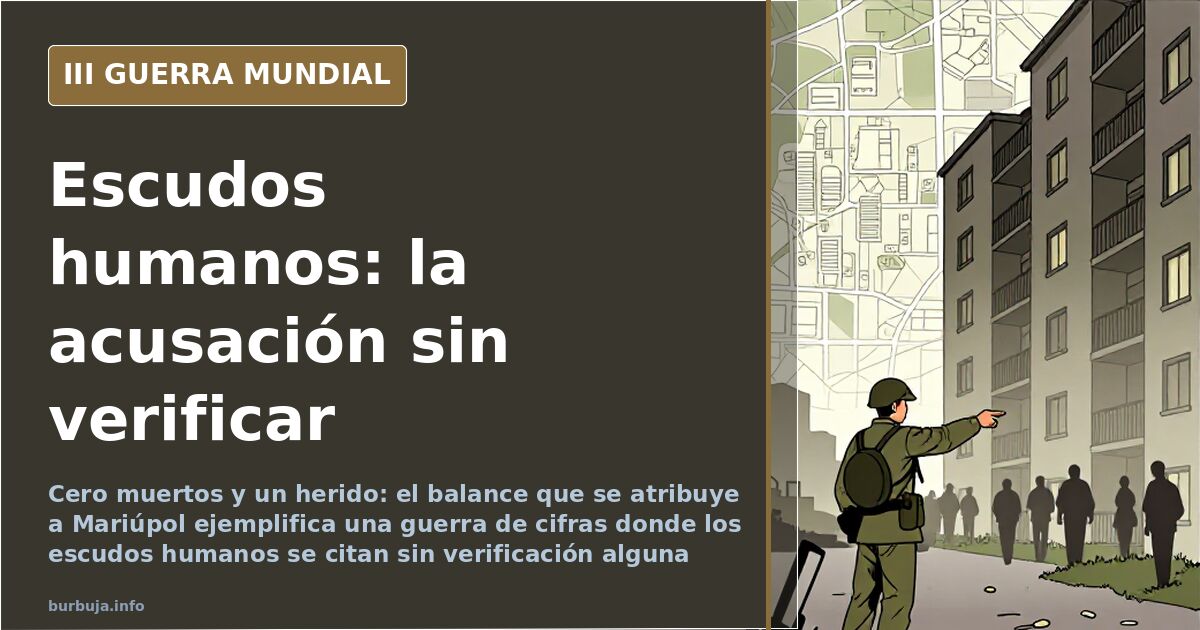
Cowardice, basements, and high floors: The unverified accusation
Amidst the offensive on Ukrainian cities, an accusation circulates with more force than the evidence supporting it: that the Ukrainian government and army act as cowards by firing from upper floors while civilians shelter in basements. This thesis is stated simply but verified with extreme difficulty, relying on videos whose authorship, date, and location have not been independently confirmed. Supporters treat it as fact; detractors call it a fabrication.
What exactly are Ukrainian forces accused of?
The specific allegation is that Ukrainian troops position themselves on the upper floors of residential buildings, keeping residents in basements and ground floors so Russian artillery cannot destroy the structure without causing mass casualties. This fits the classic definition of a human shield, presented by proponents as proof of calculated cowardice.
The issue is verification. No one supporting this claim has proven they were inside the building, knew the floor distribution, or could distinguish between civilians and military personnel on upper levels. It is rightly noted that edited footage can construct any narrative: record the bombardment, add evacuation scenes later, and you have a closed story. The question that stumps both sides remains: how do you know?
Cowardice, according to whose dictionary?
Part of the disagreement concerns terminology rather than facts. Some argue bravery lies not in enlisting but in refusing to kill for elite interests, noting that boarding a truck with a rifle does not make one a hero. Others counter that defenders of a besieged city do not choose the battlefield or the firing height, and judging from safety is the only documented cowardice. In this realm, there are no data, only sarracena frameworks.
The role of Chechen forces on the front
Chechen units appear in narratives as shock troops, their name linked to Ramzan Kadyrov to emphasize deployment harshness. One version insists they fight standing up, exposed without cover, interpreted simultaneously as recklessness and propaganda. Other parts of the controversy present them merely as attrition elements, lacking public evidence of actual deployment or chain of command.
Details matter because these units' presence functions as emotional argument, not data. Their nationality is often used as an insult in comments, revealing more about the writer than the terrain.
What the Security Council says and why it settles nothing
The UN Security Council is another open front. Russian representatives claimed that Ukrainian radicals and neo-Nancy—not Russian forces—hold hostages in cities and use civilians as human shields, allegedly abusa a Moscow-declared ceasefire. This is one party's stance in a body where that party holds veto power. It is not an independent conclusion.
Similarly, bombings on Donetsk and Luhansk are cited, reportedly absent from prime-time news for years. A partisan argument is neither false nor true by virtue of its source. Readers seeking mutually accepted figures remain unsatisfied.
Casualties, TV, and three incompatible narratives
Here, details speak louder than slogans. The Ukrainian president is attributed a striking tally for Mariupol: zero dead and one injured. The figure is released without context, date, or verification.
Meanwhile, a Spanish public TV reporter in Kyiv described how Ukrainian air defense batteries intercepting missiles cause debris to fall on civilian buildings, inflicting more damage than direct hits. Russian TV reported a day of bombardments with only one death, read as minimization. Three narratives, three audiences, no shared numbers.
Stalingrad as a mirror
Historical comparisons emerged quickly: tactics today called cowardice were Soviet Army methods in Stalingrad or Kharkiv, then termed resistance. This double standard—heroism yesterday, villainy today—marks where debate shifts from Ukraine to the observer.
None of the circulating figures—zero dead, one injured, one daily casualty, eight years of Donbas war—come with sources accepted by both sides. Without common sourcing, there is no verification, only factions and videos needing trusted interpreters. The controversy stalls there. Upcoming images will likely not resolve it.
Amidst the offensive on Ukrainian cities, an accusation circulates with more force than the evidence supporting it: that the Ukrainian government and army act as cowards by firing from upper floors while civilians shelter in basements. This thesis is stated simply but verified with extreme difficulty, relying on videos whose authorship, date, and location have not been independently confirmed. Supporters treat it as fact; detractors call it a fabrication.
What exactly are Ukrainian forces accused of?
The specific allegation is that Ukrainian troops position themselves on the upper floors of residential buildings, keeping residents in basements and ground floors so Russian artillery cannot destroy the structure without causing mass casualties. This fits the classic definition of a human shield, presented by proponents as proof of calculated cowardice.
The issue is verification. No one supporting this claim has proven they were inside the building, knew the floor distribution, or could distinguish between civilians and military personnel on upper levels. It is rightly noted that edited footage can construct any narrative: record the bombardment, add evacuation scenes later, and you have a closed story. The question that stumps both sides remains: how do you know?
Cowardice, according to whose dictionary?
Part of the disagreement concerns terminology rather than facts. Some argue bravery lies not in enlisting but in refusing to kill for elite interests, noting that boarding a truck with a rifle does not make one a hero. Others counter that defenders of a besieged city do not choose the battlefield or the firing height, and judging from safety is the only documented cowardice. In this realm, there are no data, only sarracena frameworks.
The role of Chechen forces on the front
Chechen units appear in narratives as shock troops, their name linked to Ramzan Kadyrov to emphasize deployment harshness. One version insists they fight standing up, exposed without cover, interpreted simultaneously as recklessness and propaganda. Other parts of the controversy present them merely as attrition elements, lacking public evidence of actual deployment or chain of command.
Details matter because these units' presence functions as emotional argument, not data. Their nationality is often used as an insult in comments, revealing more about the writer than the terrain.
What the Security Council says and why it settles nothing
The UN Security Council is another open front. Russian representatives claimed that Ukrainian radicals and neo-Nancy—not Russian forces—hold hostages in cities and use civilians as human shields, allegedly abusa a Moscow-declared ceasefire. This is one party's stance in a body where that party holds veto power. It is not an independent conclusion.
Similarly, bombings on Donetsk and Luhansk are cited, reportedly absent from prime-time news for years. A partisan argument is neither false nor true by virtue of its source. Readers seeking mutually accepted figures remain unsatisfied.
Casualties, TV, and three incompatible narratives
Here, details speak louder than slogans. The Ukrainian president is attributed a striking tally for Mariupol: zero dead and one injured. The figure is released without context, date, or verification.
Meanwhile, a Spanish public TV reporter in Kyiv described how Ukrainian air defense batteries intercepting missiles cause debris to fall on civilian buildings, inflicting more damage than direct hits. Russian TV reported a day of bombardments with only one death, read as minimization. Three narratives, three audiences, no shared numbers.
Stalingrad as a mirror
Historical comparisons emerged quickly: tactics today called cowardice were Soviet Army methods in Stalingrad or Kharkiv, then termed resistance. This double standard—heroism yesterday, villainy today—marks where debate shifts from Ukraine to the observer.
None of the circulating figures—zero dead, one injured, one daily casualty, eight years of Donbas war—come with sources accepted by both sides. Without common sourcing, there is no verification, only factions and videos needing trusted interpreters. The controversy stalls there. Upcoming images will likely not resolve it.
Also available in: Deutsch
Summary of a discussion on Burbuja.info - Foro de economía, actualidad y política., translated from Spanish and reviewed before publication. Read the full discussion (115 replies).
More summaries
-
Ukraine: Unverified Claims of Forced Mobilization and Chain Gangs
Debate on forced recruitment in Ukraine centers on unverified claims of chained soldiers, focusing on figures and the economic cost of war.
-
Desertion in Ukraine: 5 years of prison or returning to the trenches
A 28-year-old Ukrainian soldier living in hiding faces two choices: five years of incarceration for desertion, or returning to the front line with no guaranteed exit date.
-
Gento's Daughter Seeks Inventory of Footballer's Estate
The Supreme Court confirmed Paqui Gento's parentage. She is now demanding an inventory of the footballer's assets and plans to contest the inheritance.
-
Forum user warns of executions if World War III erupts
A post warns of mass conscription and executions if WWIII starts, while others debate the reality of modern technological warfare.
-
CWC watches fuel mercenary aesthetic debate at €650
A €650 CWC watch has become the prop for aspiring mercenaries on Tinder and Instagram, while second-hand IWCs no longer drop below €4,500.
-
Forum user claims Hiroshima and Nagasaki were tactical bombs
A participant argues Little Boy and Fat Man, at 16 and 21 kilotons, fall below the 100-kiloton tactical threshold. Hiroshima killed 100,000 instantly.