
Universal healthcare in Spain: the tourist who ended up in intensive care
A South American tourist ends up in the ICU, gets registered as a local resident and receives free healthcare. The case reopens the debate over who pays for universal healthcare in Spain.
English · Original discussion in Spanish · Published
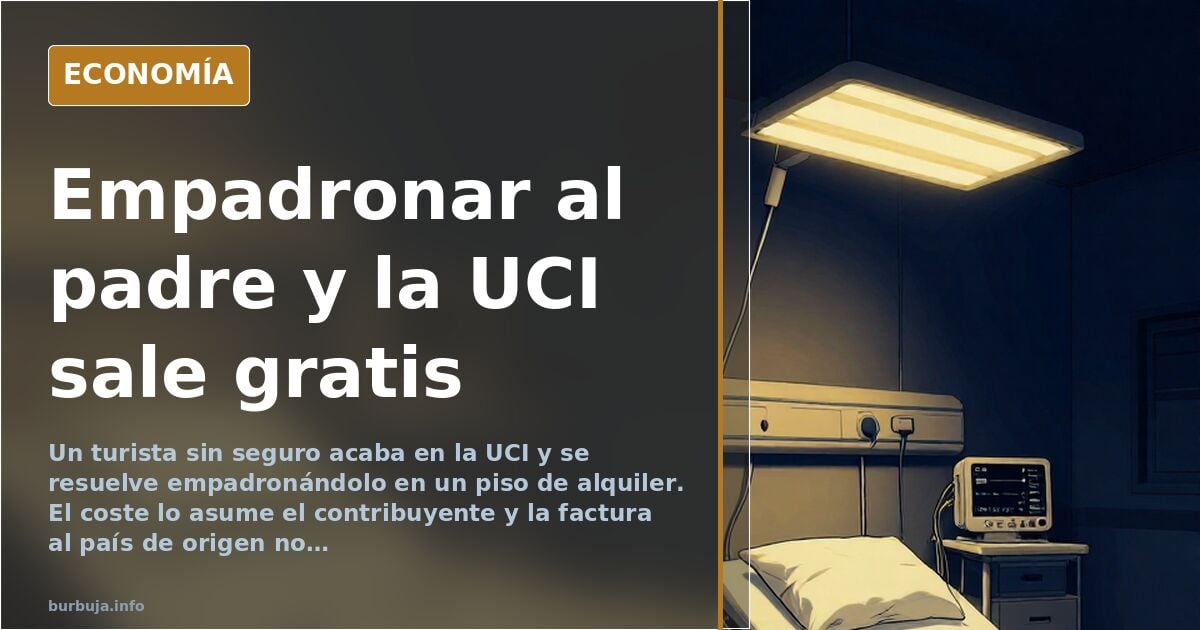
Universal healthcare: the case of the tourist who ended up in the ICU
A man arrives in Spain as a tourist to visit his son. Within hours, he is admitted to the ICU with a serious condition. His son registers him as a resident at his rented flat, and from that moment on, he receives treatment at a public hospital at no cost. This is not a hypothetical scenario: it is a real case that has circulated on economics forums and reopens the debate over who pays for public healthcare and who benefits from it. Far from being settled, the discussion branches out: from the legality of emergency care to its impact on waiting lists, including the bill that never reaches the country of origin.
The case that sparked the debate
The story is specific: a South American citizen enters Spain on a tourist visa, suffers a serious health problem and ends up in intensive care. His son, a resident in Spain, registers him at his rented home. With that administrative step, the father becomes linked to a municipality and, in practice, gains access to public healthcare. The cost of an ICU bed runs into thousands of euros per day. No one has billed him. No one has claimed it.
The first reaction in the debate is to recall that life-saving emergency care is open by law in Spain and in much of the developed world. The argument is that denying care to a critically ill patient is not only a humanitarian issue but a practical one: an untreated patient can lead to a larger public health problem. Up to that point, consensus is broad. The rift appears afterwards: should the state bear the cost of an uninsured non-resident? And should it claim the money back later?
Who pays the bill for an uninsured tourist?
In theory, the state bills the country of origin. In practice, that bill is rarely collected. The European Health Insurance Card covers EU citizens, but not the rest of the world. For a South American patient, there is no automatic reimbursement mechanism. The cost is borne by the Spanish taxpayer. Some argue that these cases are exceptional and that the system is designed to absorb them. Others point to a constant trickle that, added up, strains the system.
The most frequently repeated argument is that of waiting lists. Every ICU bed occupied by a non-resident patient is a bed unavailable to a resident. Every postponed operation is a cost in health and quality of life. There are no official figures broken down by nationality in the available material, but the perception of unfairness is real and growing.
The precedent nobody mentions: Spaniards abroad
The comparison is inevitable. A 22-year-old Spaniard in a coma after an accident in Australia generates a bill of more than 83,000 Australian dollars in just 16 days. His family launches a fundraiser to pay it. In Australia, without insurance, there is no free care. In Spain, with residency registration, there is. The asymmetry is at the core of the resentment: Spaniards pay abroad and are not always reimbursed at home.
This contrast fuels a current of opinion calling for tighter access requirements. It is not about denying emergency care, but about separating immediate treatment from ongoing coverage. The question is how to do it without sliding into healthcare exclusion, a minefield.
Overcrowding as a political argument
The debate drifts into politics. It is claimed that public healthcare is being dismantled to push those who can afford it towards private care. Doctors are accused of having demanded care for irregular immigrants during past strikes. The 2030 Agenda is mentioned. These are claims circulating without verification in the available material and should be treated as what they are: attributed opinions, not proven facts.
What is a fact is that the Spanish healthcare system is universal by design. Law 16/2003 on cohesion and quality of the National Health System establishes care for every person, regardless of their administrative status. That universality comes at a cost. The discussion is not whether it exists, but whether it is sustainable under the current funding model and current migration flows.
The case of the tourist who ended up in the ICU is an anecdote. But anecdotes, when repeated, stop being just that. The bill for universal healthcare is not paid by the rich or by politicians. It is paid by those who vote, those who wait on a list, those who contribute. And meanwhile, the debate remains open: how far should solidarity without reciprocity go?
Summary of a discussion on Burbuja.info - Foro de economía, actualidad y política., translated from Spanish and reviewed before publication. Read the full discussion (17 replies).
More summaries
-
Spain: Lose Health Card After 90 Days Abroad, Irregulars Keep It
Spaniards abroad lose coverage after 90 days; irregular immigrants retain access. Key rules on residency, social security, and healthcare rights explained.
-
Spain plans to cover glasses and contacts in public health by 2026
Spain's health ministry aims to include vision care in the common service portfolio by 2026, though specific conditions remain undefined.
-
Spain's universal healthcare faces scrutiny over medical tourism
A viral video on care for new arrivals reignites debate: emergency coverage is universal, but waiting lists and billing non-contributors remain contentious.
-
Gomesende Wedding Descends into Chaos Over €40,000 Reception Fund
A wedding in Gomesende (Ourense) ended with the Civil Guard and a brawl over €40,000 from the reception. The groom denies claims of a marriage of convenience...
-
Forum user claims Alvise could cost PP and Vox up to 10 seats
A forum poster argues Alvise Pérez will win no seats of his own but could cost the PP and Vox up to ten seats in Spain's general election. Some doubt he can repeat his 800,000 votes.
-
Spain debates death of 87-year-old woman after eviction and the political narrative
A forum thread mixes the death of an 87-year-old woman with her eviction, Spain's rental law and the political narrative, without confirming any causal link.