
UnitedHealth: CEO buys $25M as retail investors hesitate
UnitedHealth Group shares fell over 50% in a month. The new CEO bought $25 million in stock, leaving retail investors torn between catching the rebound or waiting for stability.
English · Original discussion in Spanish · Published
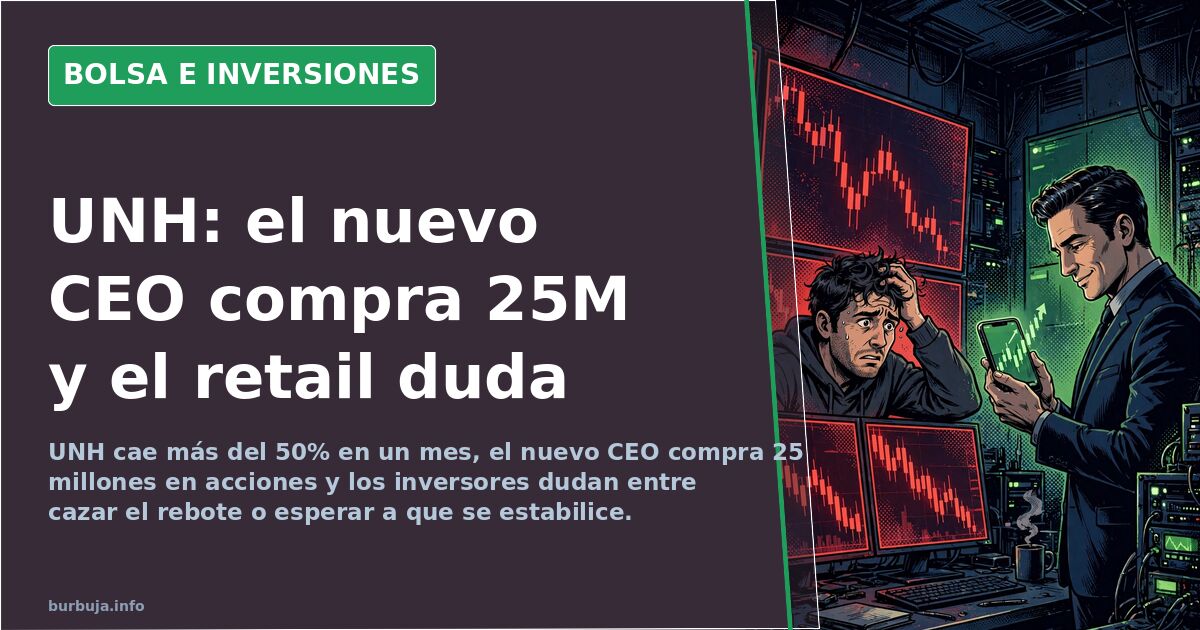
UnitedHealth: New CEO buys $25M as retail investors hesitate
A paradox defines UnitedHealth Group (UNH) recently: despite losing more than 50% of its value in a month, with an outgoing CEO and withdrawn 2025 guidance, the new chief executive purchased $25 million worth of shares. The stock, which plunged 15% in one session due to lawsuits, traded around $250-$300 when these lines were written, far from the $500 some retail investors projected. The debate on whether to enter now or wait for stabilization is live.
The crash: From $500 to $250
UNH's decline is not isolated. The initial trigger was the withdrawal of 2025 guidance, causing a 20% drop. This was compounded by the CEO's resignation, an investigation published by The Wall Street Journal, and a wave of lawsuits turning the company into a case study on regulatory and fruta risk. At its lowest point, the share price fell below $250, with a P/E ratio considered ridiculously low by some for a firm operating almost like a monopoly in US healthcare.
The thread's opening post, by an opportunistic investor, summarizes the thesis: "It dropped 50%, so I bought heavily, because I tell you it will be at $500 or more in a year." Their plan is not to marry the company: "Since they are scammers, I speculate with them; once I make a 50% profit, I sell." It is a tactical trade, not a conviction investment.
The new CEO's purchase: $25M that doesn't convince everyone
The most repeated data point in recent pages is the new CEO's $25 million stock purchase. For some, it is an unequivocal sign of confidence: the person who knows the company best puts their money where their mouth is. For others, it is a desperate gesture to prop up the price while the ship continues to take on water. "The new CEO must have bought... $25M in shares," notes one participant without further interpretation.
Distrust has arguments. The previous CEO's departure was not clean, and some antiestéticar more chapters of the same book will emerge. "Wouldn't it be wiser to enter in a few weeks when it is confirmed there are no bigger scandals causing the CEO to resign?" asks an investor preferring to wait. The response from those already inside is equally pragmatic: "If it keeps falling, I'll add a bit more."
Trend rules: Catching a falling knife
One of the strongest currents in the debate warns against buying in a downtrend. "Don't buy against the trend; it's better to buy late in an uptrend than early in a downtrend," summarizes a participant. The logic is standard: in the market, probability is against you, and assuming unnecessary risk to catch the exact bottom usually proves costly. "Never catch a falling knife," states another.
Against this, some see a historic opportunity. "A good company that dropped more than 50% in a month allows for a big bounce. Then it may continue falling or not, but the bounce, when it comes, will also be big (+25% from the low, at least)," argues an investor. The discrepancy is significant: some speak of a technical 25% rebound, others say the stock may keep purging down to $210.
The Berkshire factor and May gap
Amid uncertainty, a rumor moved the price: the possibility that Berkshire Hathaway was accumulating positions in UNH. "Well, it's no longer a rumor but a fact, +8% in aftermarket," confirmed a participant. The move triggered last-minute buying and left many lamenting not entering sooner. "The old man screwed me out of buying more shares," complains an investor who kept liquidity for autumn.
The recurring technical reference is the gap left in May, which some expect to close. The stock rebounded strongly from lows, with 13% gains in one session and 25% appreciation for those who entered at the bottom. But volatility remains extreme: premarket drops of 6% and rises of 8% have been seen within hours.
Regulatory risk: Trump, lawsuits, and monopoly
Beyond price, the debate has a political backdrop. "I think Trump won't treat these companies as well as Biden... and won't allow the manipulation they had," points out a participant. The WSJ investigation and lawsuits point to practices potentially under scrutiny by the new administration. For those seeing a monopoly, this is both a risk and a guarantee: "These UNH folks are practically a monopoly in the USA, so I don't think they'll go bankrupt."
The comparison with Intel, which also rebounded from lows then deflated, hovers over the debate. "So far, 25% appreciation for those who entered at Thursday's lows in United Health. But beware, because Intel and similar stocks also bounced," warns an investor. The question is whether UNH has the fundamentals to sustain the rebound or if, like Intel, it will return to the low zone.
With a P/E around 12 and growth some consider intact, the rebound thesis has numbers. With an open investigation, a newly arrived CEO, and a hostile regulatory environment, the purgatory thesis also holds. Is UNH a milking opportunity or a falling knife?
A paradox defines UnitedHealth Group (UNH) recently: despite losing more than 50% of its value in a month, with an outgoing CEO and withdrawn 2025 guidance, the new chief executive purchased $25 million worth of shares. The stock, which plunged 15% in one session due to lawsuits, traded around $250-$300 when these lines were written, far from the $500 some retail investors projected. The debate on whether to enter now or wait for stabilization is live.
The crash: From $500 to $250
UNH's decline is not isolated. The initial trigger was the withdrawal of 2025 guidance, causing a 20% drop. This was compounded by the CEO's resignation, an investigation published by The Wall Street Journal, and a wave of lawsuits turning the company into a case study on regulatory and fruta risk. At its lowest point, the share price fell below $250, with a P/E ratio considered ridiculously low by some for a firm operating almost like a monopoly in US healthcare.
The thread's opening post, by an opportunistic investor, summarizes the thesis: "It dropped 50%, so I bought heavily, because I tell you it will be at $500 or more in a year." Their plan is not to marry the company: "Since they are scammers, I speculate with them; once I make a 50% profit, I sell." It is a tactical trade, not a conviction investment.
The new CEO's purchase: $25M that doesn't convince everyone
The most repeated data point in recent pages is the new CEO's $25 million stock purchase. For some, it is an unequivocal sign of confidence: the person who knows the company best puts their money where their mouth is. For others, it is a desperate gesture to prop up the price while the ship continues to take on water. "The new CEO must have bought... $25M in shares," notes one participant without further interpretation.
Distrust has arguments. The previous CEO's departure was not clean, and some antiestéticar more chapters of the same book will emerge. "Wouldn't it be wiser to enter in a few weeks when it is confirmed there are no bigger scandals causing the CEO to resign?" asks an investor preferring to wait. The response from those already inside is equally pragmatic: "If it keeps falling, I'll add a bit more."
Trend rules: Catching a falling knife
One of the strongest currents in the debate warns against buying in a downtrend. "Don't buy against the trend; it's better to buy late in an uptrend than early in a downtrend," summarizes a participant. The logic is standard: in the market, probability is against you, and assuming unnecessary risk to catch the exact bottom usually proves costly. "Never catch a falling knife," states another.
Against this, some see a historic opportunity. "A good company that dropped more than 50% in a month allows for a big bounce. Then it may continue falling or not, but the bounce, when it comes, will also be big (+25% from the low, at least)," argues an investor. The discrepancy is significant: some speak of a technical 25% rebound, others say the stock may keep purging down to $210.
The Berkshire factor and May gap
Amid uncertainty, a rumor moved the price: the possibility that Berkshire Hathaway was accumulating positions in UNH. "Well, it's no longer a rumor but a fact, +8% in aftermarket," confirmed a participant. The move triggered last-minute buying and left many lamenting not entering sooner. "The old man screwed me out of buying more shares," complains an investor who kept liquidity for autumn.
The recurring technical reference is the gap left in May, which some expect to close. The stock rebounded strongly from lows, with 13% gains in one session and 25% appreciation for those who entered at the bottom. But volatility remains extreme: premarket drops of 6% and rises of 8% have been seen within hours.
Regulatory risk: Trump, lawsuits, and monopoly
Beyond price, the debate has a political backdrop. "I think Trump won't treat these companies as well as Biden... and won't allow the manipulation they had," points out a participant. The WSJ investigation and lawsuits point to practices potentially under scrutiny by the new administration. For those seeing a monopoly, this is both a risk and a guarantee: "These UNH folks are practically a monopoly in the USA, so I don't think they'll go bankrupt."
The comparison with Intel, which also rebounded from lows then deflated, hovers over the debate. "So far, 25% appreciation for those who entered at Thursday's lows in United Health. But beware, because Intel and similar stocks also bounced," warns an investor. The question is whether UNH has the fundamentals to sustain the rebound or if, like Intel, it will return to the low zone.
With a P/E around 12 and growth some consider intact, the rebound thesis has numbers. With an open investigation, a newly arrived CEO, and a hostile regulatory environment, the purgatory thesis also holds. Is UNH a milking opportunity or a falling knife?
Also available in: Deutsch
Summary of a discussion on Burbuja.info - Foro de economía, actualidad y política., translated from Spanish and reviewed before publication. Read the full discussion (105 replies).
More summaries
-
Novo Nordisk and UnitedHealth: Two Plunges, Two Opposing Theses
Novo Nordisk drops sharply and UnitedHealth faces legal proceedings. Two plunges and the fiscal impact of the Danish dividend.
-
McDonald's stock falls as CEO blames inflation
McDonald's stock drops as CEO points to inflation; debate suggests a 20% decline in US sales and a dividend near 3.5%.
-
Dry farmland at 1 euro per m²: the bill that comes later
A reasonable hectare of dry farmland costs 3,000-5,000 euros, but some listings offer 1 euro per square metre, plus water, property tax and paperwork costs that nobody adds up.
-
From €3,000 to €19,849: five years betting on a single stock
From €3,000 to €19,849 in five years, jumping between one stock at a time. The skill and the vertigo of never diversifying
-
Solaria shares jump from €0.97 in 2014 to nearly €10 in 2020
Solaria earned €5.16 million in the first quarter of 2019 and planned to connect 400 MW more. The stock went from €0.97 to €10 while pool prices fell, according to the thread.
-
Uno-E's Deposit 10: paperwork, waits and money stuck at 0.1%
A Uno-E customer describes 15 days of paperwork and calls before opening the Deposit 10, with the money parked at 0.1%. Automatic renewal, the other…