
Unconfirmed Chemical Attack in Mariupol Raises False Flag Fears
Un unverified report claims Russia used a toxic substance in Mariupol. Skepticism about a staged false flag operation dominates the analysis of the incident.
English · Original discussion in Spanish · Published
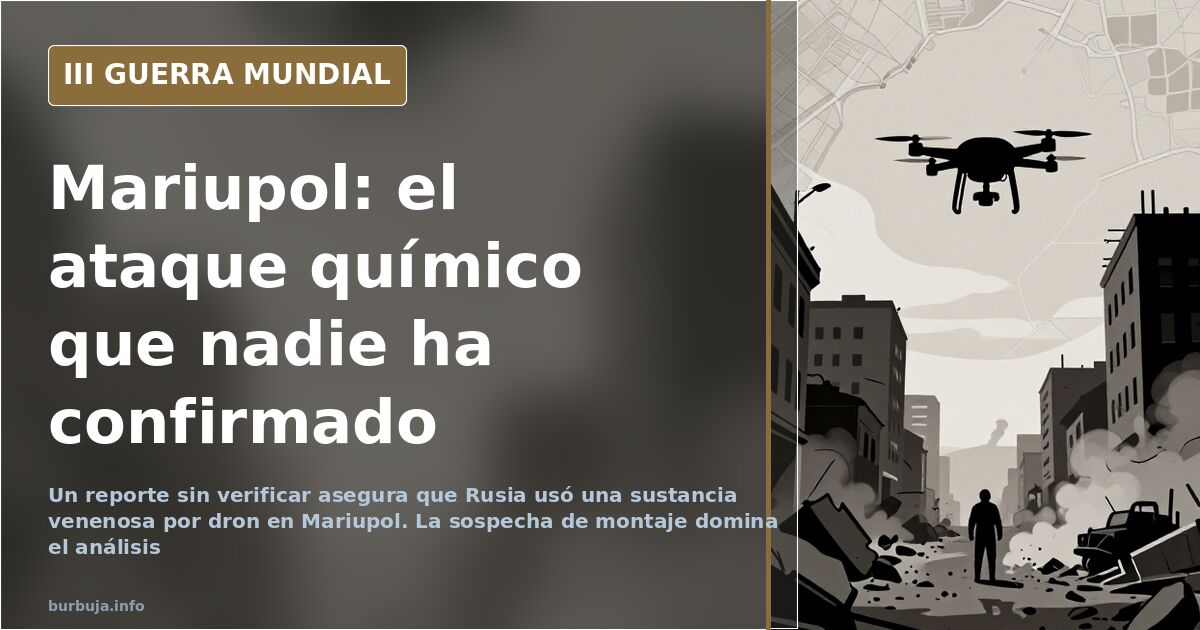
Mariupol: an unconfirmed chemical attack that smells like a staged operation
An urgent alert, two symptoms described with clinical precision, and a word Ukraine’s war has worn to the shreds: chemical. Russian forces allegedly employed “an unknown poisonous substance” against military and civilians in Mariupol, launched from a drone, according to a report that immediately circulated on social media. Victims, it said, presented respiratory failure and vestibulo-ataxic syndrome, the condition that translates into loss of balance and coordination. The crucial part came at the end of the same message: “Unconfirmed reports.” No images, no neutral observer, and no official confirmation from anyone.
From there, the alert was replicated ad nauseam, and the conversation split in two. One half sought proof; the other already had a verdict.
What is really known about the alleged chemical attack?
Very little, and everything arrives through the same transmission chain. The story of the drone and the symptoms is collected by a conflict-tracking account; the Azov Regiment, cited by Ukrainian media, repeats the same report: substance distributed by a drone, victims with dyspnea and vestibulocerebellar ataxia. Based on this, some source adds without proof that sarin gas was allegedly used, and another casually mentions a possible chlorine gas attack. All of this coexists with a phrase that summarizes the situation: it is unconfirmed.
What is striking is how poorly the scenario fits the phase of the battle. Mariupol was practically besieged. Defenders are holed up in underground fortifications in the Azovstal industrial zone, and urban combat is being fought there, which alone does not equate to a chemical attack. But there is one detail that is indeed audiovisual: a military representative of the self-styled DPR states in a video that it makes no sense to assault the basements and that a chemical weapon would be “more appropriate.” That clip does not prove the attack. It proves an intention expressed aloud, and that is different.
Why does one side suspect a staged operation?
Skepticism is not a corner of the debate; it is the dominant current. The central argument takes the form of a syllogism. Russia is on the verge of controlling the region; why would it gas those it has already won over? The comparison with Syria repeats as a refrain, recalling the sequence observed there: when the regime lost territory, chemical weapons did not appear; when it reconquered and had everything in view, they did. The same voices evoke Kuwait’s incubators and Iraqi weapons of mass destruction as textbook precedents for a false flag operation.
On the other side, a more instrumental reading holds that these announcements function as a market test. Crude disinformation is launched to measure what percentage of the public buys into it, thereby calibrating subsequent, more sophisticated manipulations. And a third position, minority but active, admits the episode may be false but warns nonetheless: the red line is already drawn, and any real use would serve as justification for intervention.
The NATO warning and the calculus of escalation
None of this was read in a vacuum. In parallel, it circulated that the US president requested Russia’s expulsion from the G-20 and warned that a chemical war in Ukraine “would provoke a response” from NATO. That phrase is the real reason the alert spread like wildfire: it mattered less whether it was true than who would use it first.
The context invites caution. Anyone who remembers how interventions in previous conflicts were cooked recognizes the pattern: first the accusation, then the red line, and only finally the proof, often never. Much of the analysis points to the fact that, even if confirmed, no one is going to lift a finger directly against Russia, because one thing is gesturing and another is crossing the threshold of open confrontation.
The point where the analysis gets stuck
With these threads, the conversation remains exactly where it started. An unverified report, two audiences that already know what to believe, and an institutional response promising intervention but not executing it. If images appear, they will be called a staged operation; if they do not appear, it will be said that it never peine. The clinical report—respiratory failure, ataxia—sounds like a medical report. But without a hospital, a forensic expert, and a neutral observer, it remains what it was: a text. And with a text, one cannot sustain a war crimes accusation, no matter how much the one repeating it already has the conclusion written.
An urgent alert, two symptoms described with clinical precision, and a word Ukraine’s war has worn to the shreds: chemical. Russian forces allegedly employed “an unknown poisonous substance” against military and civilians in Mariupol, launched from a drone, according to a report that immediately circulated on social media. Victims, it said, presented respiratory failure and vestibulo-ataxic syndrome, the condition that translates into loss of balance and coordination. The crucial part came at the end of the same message: “Unconfirmed reports.” No images, no neutral observer, and no official confirmation from anyone.
From there, the alert was replicated ad nauseam, and the conversation split in two. One half sought proof; the other already had a verdict.
What is really known about the alleged chemical attack?
Very little, and everything arrives through the same transmission chain. The story of the drone and the symptoms is collected by a conflict-tracking account; the Azov Regiment, cited by Ukrainian media, repeats the same report: substance distributed by a drone, victims with dyspnea and vestibulocerebellar ataxia. Based on this, some source adds without proof that sarin gas was allegedly used, and another casually mentions a possible chlorine gas attack. All of this coexists with a phrase that summarizes the situation: it is unconfirmed.
What is striking is how poorly the scenario fits the phase of the battle. Mariupol was practically besieged. Defenders are holed up in underground fortifications in the Azovstal industrial zone, and urban combat is being fought there, which alone does not equate to a chemical attack. But there is one detail that is indeed audiovisual: a military representative of the self-styled DPR states in a video that it makes no sense to assault the basements and that a chemical weapon would be “more appropriate.” That clip does not prove the attack. It proves an intention expressed aloud, and that is different.
Why does one side suspect a staged operation?
Skepticism is not a corner of the debate; it is the dominant current. The central argument takes the form of a syllogism. Russia is on the verge of controlling the region; why would it gas those it has already won over? The comparison with Syria repeats as a refrain, recalling the sequence observed there: when the regime lost territory, chemical weapons did not appear; when it reconquered and had everything in view, they did. The same voices evoke Kuwait’s incubators and Iraqi weapons of mass destruction as textbook precedents for a false flag operation.
On the other side, a more instrumental reading holds that these announcements function as a market test. Crude disinformation is launched to measure what percentage of the public buys into it, thereby calibrating subsequent, more sophisticated manipulations. And a third position, minority but active, admits the episode may be false but warns nonetheless: the red line is already drawn, and any real use would serve as justification for intervention.
The NATO warning and the calculus of escalation
None of this was read in a vacuum. In parallel, it circulated that the US president requested Russia’s expulsion from the G-20 and warned that a chemical war in Ukraine “would provoke a response” from NATO. That phrase is the real reason the alert spread like wildfire: it mattered less whether it was true than who would use it first.
The context invites caution. Anyone who remembers how interventions in previous conflicts were cooked recognizes the pattern: first the accusation, then the red line, and only finally the proof, often never. Much of the analysis points to the fact that, even if confirmed, no one is going to lift a finger directly against Russia, because one thing is gesturing and another is crossing the threshold of open confrontation.
The point where the analysis gets stuck
With these threads, the conversation remains exactly where it started. An unverified report, two audiences that already know what to believe, and an institutional response promising intervention but not executing it. If images appear, they will be called a staged operation; if they do not appear, it will be said that it never peine. The clinical report—respiratory failure, ataxia—sounds like a medical report. But without a hospital, a forensic expert, and a neutral observer, it remains what it was: a text. And with a text, one cannot sustain a war crimes accusation, no matter how much the one repeating it already has the conclusion written.
Also available in: Deutsch
Summary of a discussion on Burbuja.info - Foro de economía, actualidad y política., translated from Spanish and reviewed before publication. Read the full discussion (241 replies).
More summaries
-
NATO and Ukraine: The Narrative of Planned Nuclear War
Former Ukrainian PM claims NATO planned nuclear strikes on Russia in 2022
-
Russia cripples Ukraine’s energy grid in massive strike
A massive Russian strike cuts Ukraine’s nuclear capacity by up to 90%, marking a decisive phase in the ongoing energy and territorial siege.
-
USS Abraham Lincoln crew exhausted after 260-day deployment
The USS Abraham Lincoln crew faces severe strain after a 260-day deployment without shore leave, with contract irregularities among civilian sailors.
-
Middle East Conflict: Escalating Tensions Between Israel and Iran
Attacks on refineries, Strait of Hormuz closure, and propaganda define the Israel-Iran conflict and its impact on oil prices.
-
Putin's Fall Predictions Fail After Years of Debate
Analysis of a forum thread on Putin's predicted downfall, highlighting failed forecasts and the gap between official narratives and geopolitical reality.
-
Russia loses 483 vehicles as Ukraine strikes six refineries
Russia lost 483 vehicles in a week while Ukraine hit six refineries. The war of attrition shifts to fuel supplies and Moscow's skies.