
Ukrainian proposal: strike Transnistria to save Mariupol
A Ukrainian digital outlet proposes attacking Transnistria to save Mariupol: 2,000 Russian soldiers, a major arsenal and doubts about holding two fronts at once.
English · Original discussion in Spanish · Published
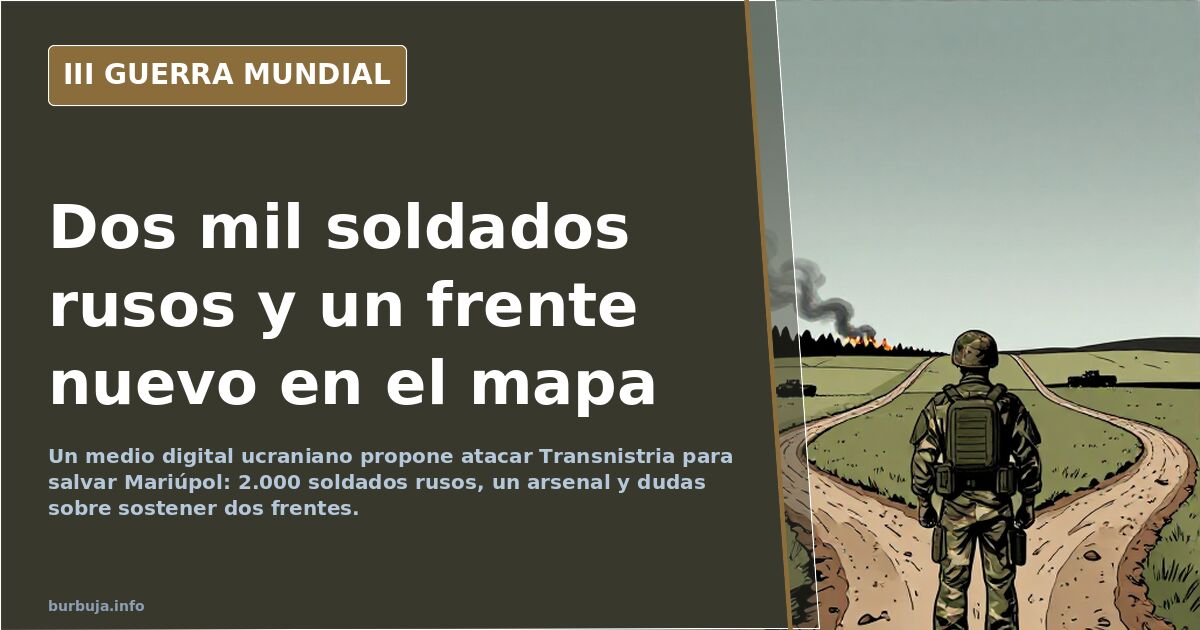
Transnistria, the second front Ukraine is weighing up
To save Mariupol, attack Transnistria. That is the thesis published by a Ukrainian digital outlet, and it comes with an uncomfortable figure attached: in that separatist strip of Moldova there are 2,000 Russian soldiers, an arsenal of the first order and, on paper, little capacity to withstand an offensive. The reasoning has its military logic. The problem is the usual one: what fits in an opinion piece does not always fit on the ground.
Around that time, the proposal was circulating as casually as the daily Donbas war report is discussed, and that alone says something about the moment. Because the article does not merely suggest a bombing: it sketches out a complete operation, with targets, spoils and legal justification, and hangs it all on a single idea — that without a strike in the southwest there is no way to rescue the Ukrainian prisoners of war.
What the Ukrainian article actually proposes
The argument is explicit: the only chance of saving the Mariupol prisoners would be «the demilitarization of occupied Transnistria». The text claims that Moldova has no strength to recover on its own what it considers a legitimate and integral part of its territory, and concludes that Ukraine would have the right to intervene on its own.
The list of reasons is the most concrete part of the document, and that is where the detail worth unpacking lies. It talks of capturing thousands of Russian prisoners for exchanges, of eliminating the threat of an advance that would link Russian troops with their base, of closing an alleged black hole of smuggling at the border, of seizing arsenals and of freeing two Ukrainian brigades currently tied down watching that flank. It also asserts that the territory is a source of international terrorism from which arms are trafficked. That last accusation, it should be said, comes with no evidence whatsoever.
The April 22 remarks that set it all off
The trigger has a name and a date. On April 22, the deputy commander of the Central Military District, Rustam Minnekayev, announced the goal of linking by land the Russian troops deployed in southern Ukraine with the military base in Transnistria, justifying it by citing «acts of oppression of the Russian-speaking population».
Read from Kyiv, that announcement is more than propaganda: it turns a frozen region into the enemy's rear guard. And from there the debate splits in two. Some see the window of opportunity the article describes; others, a fairly effective way of widening the conflict to a third country and handing Moscow the pretext it lacks.
Kolbasna, drones and gunfire: the escalation on the ground
While the theory is debated, things are happening on the ground. Transnistrian sources reported the presence of drones from Ukraine in the area of Kolbasna, home to a major weapons depot, and gunfire directed at that settlement. The region's authorities ruled out asking Russia for military help — they saw no reason, they said — though they acknowledged keeping permanent contact.
In parallel, Aleksei Arestovich, an adviser to President Zelensky, let slip that Ukraine could intervene militarily in Transnistria. Between the article, the drones and the statement, the southwestern flank stopped being a theoretical problem.
Two thousand soldiers do not invade a country
Here the analysis cools down. The Russian forces in Transnistria are peacekeepers deployed after the war between Moldova and the separatist region. Two thousand men do not occupy Moldova, and the question of why Russia would want to answers itself: it does not need to invade anything to sustain the narrative it has already built.
What that contingent does do is force Ukraine to keep troops looking west. That is the real cost, and also the reason why the temptation to remove it is so attractive on a map.
Can Ukraine sustain two fronts at once?
The most frequent objection is not legal, it is arithmetic. Opening a front in Transnistria means taking men away from the Donbas, and the numbers do not add up: it is pointed out that Kyiv barred military-age men from leaving the country, that casualties are high and that there have been surrenders by the hundreds in some places. None of that comes with verifiable figures, but the direction of the argument is clear.
Against that, another line of analysis holds that the number of soldiers matters less than intuition suggests. Firepower density — the power each combatant can deploy — today allows a front to be held with far fewer men than eighty years ago, and adding troops beyond a certain threshold barely improves the operation. The example cited is the fighting between Chinese and American forces in the Korean War, where huge concentrations of troops did not change the outcome of specific battles.
The key, in that reading, is not numbers but replacements and time. A division entering hard combat can lose two thirds of its personnel in two months, and the surviving third ends up surrendering like the whole unit. Those who arrive afterwards bear almost all the casualties. It is an industrial process, and that is why the pertinent question is not how many people Ukraine has, but how many it can replace.
The detail almost nobody looks at: who lives there
There is an objection that has nothing to do with maps or logistics. According to it, many of those in the Transnistrian armed groups are Ukrainians who there side with the Russians against the Moldovans, who are ethnically Romanian. If that is so, a Ukrainian intervention would kill more Ukrainians than anything else before touching a single Russian depot.
It is the kind of fact that dismantles a plan without needing to debate its legality. It is also the hardest one to fit into an article that starts out talking about saving lives.
With these pieces on the table — 2,000 soldiers, a coveted arsenal, two immobilized brigades and a neighborhood where flags do not separate anyone cleanly — the question is no longer whether Ukraine can take Transnistria. The question is how many Ukrainians fit into the price of opening a new front, and nobody has put that figure on the table yet.
Summary of a discussion on Burbuja.info - Foro de economía, actualidad y política., translated from Spanish and reviewed before publication. Read the full discussion (100 replies).
More summaries
-
Putin rejects peace and vows devastating strikes on Ukraine and NATO
Putin dismisses Kyiv's peace proposals and threatens devastating attacks against Ukraine and NATO. The Kremlin has opened Pandora's box.
-
Russia admits corridor to Crimea and route to Transnistria
Russian command says phase two aims to control southern Ukraine, open a land corridor to Crimea and reach Transnistria
-
Gisbert and Sivaya: Romance Amid Ukraine War Narratives
Analysis of media coverage for Rubén Gisbert and Liu Sivaya during the Ukraine war. Is this digital propaganda or reality?
-
Trump eases sanctions on Russian diesel as Ukraine hits Rostov
Trump eases sanctions on Russian diesel and Ukrainian drones set fire to the Rostov-on-Don terminal. A user says Zelensky responded that it only prolongs the war.
-
Ukraine on the brink of extinction, forum debate warns
Is Ukraine on the brink of extinction? We break down the debate over its demographic and military crisis and Yulia Mendel's controversial remarks.
-
The Europe Ukrainians are fighting for – and the irony of who they're fighting
Ukraine is fighting for a Europe that many of its own defenders question: is the EU a peace project or a US instrument? Historical ironies and divisions.