
Ukraine’s Robotino offensive: 80 days and 45,000 casualties for three ruined streets
Ukraine’s summer counteroffensive claims Robotino after nearly 80 days, costing 45,000 casualties, 21 tanks, and 10 armored vehicles to secure three streets in the Zaporizhia region.
English · Original discussion in Spanish · Published
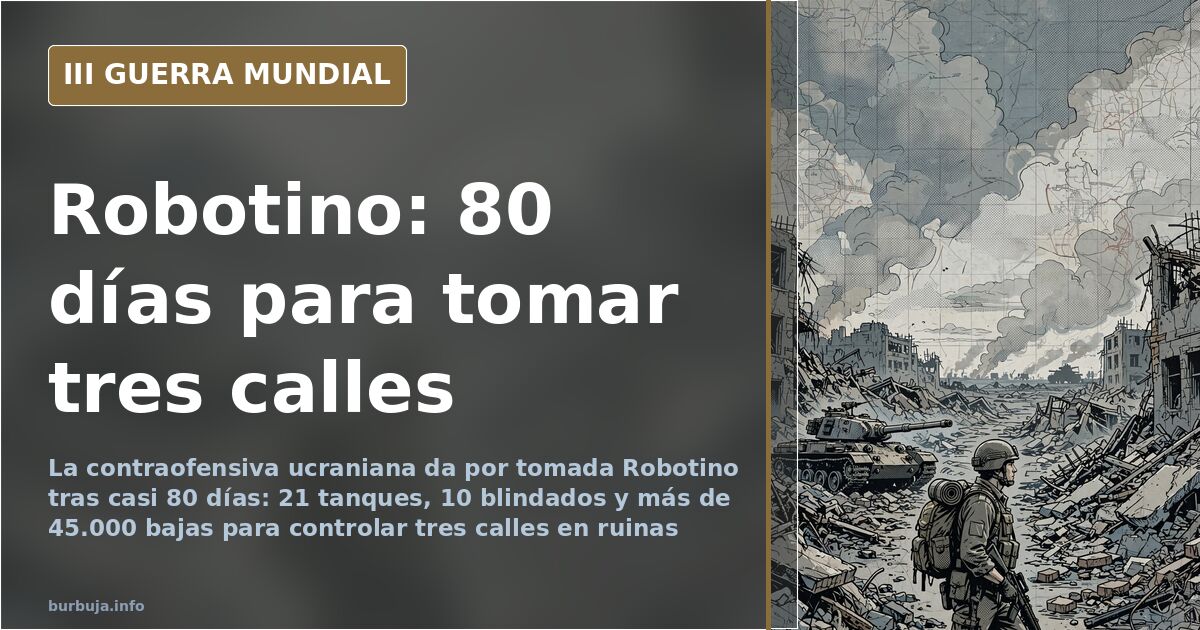
Robotino: Three months and 45,000 casualties for three ruined streets
After nearly 80 days of counteroffensive, the capture of Robotino has resulted in the control—total or partial, depending on the account—of three ruined streets and some standing buildings. The figure that best contextualizes the episode is the length of the settlement itself: between 250 and 300 meters from end to end, according to the analysis’s count. The average advance resulting from this calculation is three meters per day. And the cost in material and lives is the only aspect about which there is no longer any dispute.
What is Robotino and why is it compared to Bakhmut?
Robotino is not a city: it is a handful of streets in the south of the Zaporizhia front, with more destroyed houses than habitable ones. Any Spanish housing estate with chalets occupies several times more land beside it. Hence the comparison with Bakhmut, the other small settlement that became a symbol and a grinder.
The fundamental difference is proportion. In Bakhmut, talk was of a city; here, it is about two city blocks that, in the best-case scenario, have filled with rubble and casualties. The terrain gained is measured in sidewalk meters, not kilometers, and the distance separating this point from the coast or Crimea remains the same as on day one.
Lancet, artillery, and mines: defense without infantry
A very specific part of the analysis insists on the same point: in much of this front, you do not need to see a soldier to die. Mines, artillery, and drones do the work before armored columns reach rifle distance. The Lancet drones, Kamov helicopters with guided missiles, and glide bombs complete the repertoire.
Regarding the lethality of these devices, very heavy claims have been written: some maintain that the Lancet mounts a charge capable of piercing the upper armor of a turret and half a meter of concrete. The claim circulates without independent verification and should be read as what it is, forum propaganda favoring one side.
What is verifiable is the pattern: mechanized columns entering open fields, drones arriving before air support, and vehicles left stopped in the middle of nowhere.
Why does the Russian first line of defense start after Robotino?
Because the locality was not the defense: it was the path to it. South of the core, the analysis points to at least three more lines of staggered fortification, and this is the piece that gives sense to the entire struggle. The attacker must cross kilometers of open field; the defender retreats, holds, and lets the artillery work.
Some defend the opposite, arguing that the breach of the densest area of mines and bunkers has already occurred and that retaining twenty reserve brigades is a sign that the advance is real. The discussion is open and depends on where the line of the “main line” is placed.
The price: 21 tanks, 10 armored vehicles, and a trickle of casualties
The figures for a single day in this sector summarize the scale quite well: 21 tanks, ten infantry fighting vehicles, one recovery vehicle, and a group of soldiers, according to the count that has been circulated. Added to this, in other counts, are 45,000 cumulative casualties in the offensive and a trickle of about 300 dead daily on the front.
The breakdown by armored vehicle model—Leopard, T-64, T-72, Bradley, M-113, BMP—gives an idea of what is being consumed: Western and Soviet equipment, mixed, burning on the same stretch of asphalt. The full detail of this account, vehicle by vehicle, is one that invites opening the original source and checking how the damage is distributed.
The intact bridges and the 82nd Brigade: the last cartridge
One thesis that has taken shape is that leaving the bridges intact was, more than an error, a deliberate play: if there is no comfortable retreat, the attacker must cross and stay. The idea has no official confirmation, but it explains the logic of a front that does not move.
The other piece is the 82nd Brigade, thrown into the assault as an elite reserve. If this unit wears out without opening a breach, Ukraine’s offensive capability is left in the air. It is the exact point where the analysis stalls: no one knows what lies behind if the reserve is consumed.
The local anecdote was provided by the size comparison itself: some went to look for it on Google Maps and found few Spanish settlements as small to match it. And at that scale, with those losses, the question that remains unanswered is how many more times this maneuver can be repeated.
After nearly 80 days of counteroffensive, the capture of Robotino has resulted in the control—total or partial, depending on the account—of three ruined streets and some standing buildings. The figure that best contextualizes the episode is the length of the settlement itself: between 250 and 300 meters from end to end, according to the analysis’s count. The average advance resulting from this calculation is three meters per day. And the cost in material and lives is the only aspect about which there is no longer any dispute.
What is Robotino and why is it compared to Bakhmut?
Robotino is not a city: it is a handful of streets in the south of the Zaporizhia front, with more destroyed houses than habitable ones. Any Spanish housing estate with chalets occupies several times more land beside it. Hence the comparison with Bakhmut, the other small settlement that became a symbol and a grinder.
The fundamental difference is proportion. In Bakhmut, talk was of a city; here, it is about two city blocks that, in the best-case scenario, have filled with rubble and casualties. The terrain gained is measured in sidewalk meters, not kilometers, and the distance separating this point from the coast or Crimea remains the same as on day one.
Lancet, artillery, and mines: defense without infantry
A very specific part of the analysis insists on the same point: in much of this front, you do not need to see a soldier to die. Mines, artillery, and drones do the work before armored columns reach rifle distance. The Lancet drones, Kamov helicopters with guided missiles, and glide bombs complete the repertoire.
Regarding the lethality of these devices, very heavy claims have been written: some maintain that the Lancet mounts a charge capable of piercing the upper armor of a turret and half a meter of concrete. The claim circulates without independent verification and should be read as what it is, forum propaganda favoring one side.
What is verifiable is the pattern: mechanized columns entering open fields, drones arriving before air support, and vehicles left stopped in the middle of nowhere.
Why does the Russian first line of defense start after Robotino?
Because the locality was not the defense: it was the path to it. South of the core, the analysis points to at least three more lines of staggered fortification, and this is the piece that gives sense to the entire struggle. The attacker must cross kilometers of open field; the defender retreats, holds, and lets the artillery work.
Some defend the opposite, arguing that the breach of the densest area of mines and bunkers has already occurred and that retaining twenty reserve brigades is a sign that the advance is real. The discussion is open and depends on where the line of the “main line” is placed.
The price: 21 tanks, 10 armored vehicles, and a trickle of casualties
The figures for a single day in this sector summarize the scale quite well: 21 tanks, ten infantry fighting vehicles, one recovery vehicle, and a group of soldiers, according to the count that has been circulated. Added to this, in other counts, are 45,000 cumulative casualties in the offensive and a trickle of about 300 dead daily on the front.
The breakdown by armored vehicle model—Leopard, T-64, T-72, Bradley, M-113, BMP—gives an idea of what is being consumed: Western and Soviet equipment, mixed, burning on the same stretch of asphalt. The full detail of this account, vehicle by vehicle, is one that invites opening the original source and checking how the damage is distributed.
The intact bridges and the 82nd Brigade: the last cartridge
One thesis that has taken shape is that leaving the bridges intact was, more than an error, a deliberate play: if there is no comfortable retreat, the attacker must cross and stay. The idea has no official confirmation, but it explains the logic of a front that does not move.
The other piece is the 82nd Brigade, thrown into the assault as an elite reserve. If this unit wears out without opening a breach, Ukraine’s offensive capability is left in the air. It is the exact point where the analysis stalls: no one knows what lies behind if the reserve is consumed.
The local anecdote was provided by the size comparison itself: some went to look for it on Google Maps and found few Spanish settlements as small to match it. And at that scale, with those losses, the question that remains unanswered is how many more times this maneuver can be repeated.
Also available in: Deutsch
Summary of a discussion on Burbuja.info - Foro de economía, actualidad y política., translated from Spanish and reviewed before publication. Read the full discussion (213 replies).
More summaries
-
Severodonetsk: The Ukrainian Counteroffensive That Failed
Ukraine's June 2022 counteroffensive in Severodonetsk reclaimed parts of the city but led to a sealed encirclement within three weeks.
-
Ukraine's Unconfirmed 387,000 Casualty Count
A claim of 387,000 Ukrainian deaths relies on Kyiv's opacity regarding its own losses. Here are the figures circulating.
-
191,000 Ukrainian casualties: the unverified report in circulation
A document attributed to the Ukrainian General Staff puts the AFU’s dead and wounded alone at 191,000. No one has verified its authenticity.
-
Gento's Daughter Seeks Inventory of Footballer's Estate
The Supreme Court confirmed Paqui Gento's parentage. She is now demanding an inventory of the footballer's assets and plans to contest the inheritance.
-
Is the Russian military truly obsolete?
Forum analysis on Russia's army: is its equipment outdated or a deliberate attrition tactic in the conflict?
-
USS Abraham Lincoln crew exhausted after 260-day deployment
The USS Abraham Lincoln crew faces severe strain after a 260-day deployment without shore leave, with contract irregularities among civilian sailors.