
Ukraine warns Iran over missiles supplied to Russia
Ukraine threatens Iran with devastating consequences if Fath-300 missiles sent to Russia kill civilians, citing defense sources.
English · Original discussion in Spanish · Published
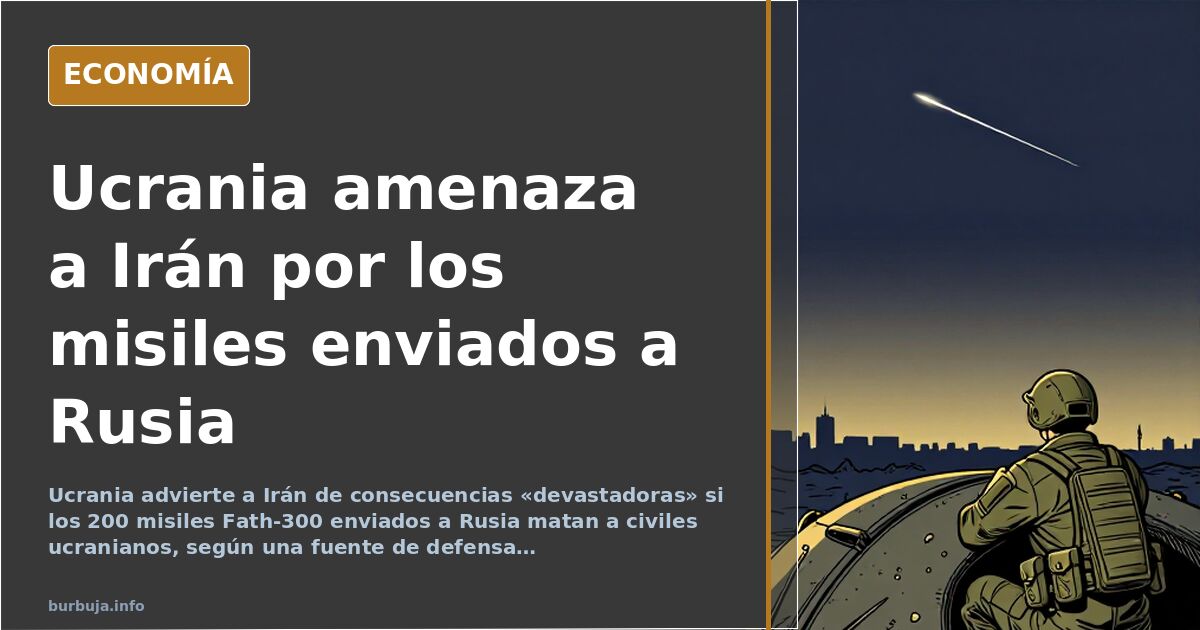
Ukraine threatens Iran over 200 ballistic missiles sent to Russia
Ukraine has warned Iran of "devastating" consequences if the 200 ballistic missiles Tehran transferred to Russia result in the deaths of Ukrainian civilians. The threat, circulated by a Ukrainian defense source via outlets like The Times, mentions a "double price" Iran would pay and promises a "severe" response. This announcement comes as Kyiv seeks to internationalize the conflict and open diplomatic fronts beyond the Donbas.
The news came as a shock to analytical circles. Not because the message was unexpected, but because Ukraine lacks demonstrated military capability to strike Iranian territory more than 2,000 kilometers from its borders. The lingering question is simple: how does Kyiv execute this threat? For now, there is no answer on the table.
What are the 200 Fath-300 missiles and why do they worry NATO?
According to data cited by analysts in Western media, the 200 missiles transferred by Iran to Russia are tactical Fath-300 ballistic missiles with an effective range of 30 to 120 kilometers and a 150-kilogram warhead. They are short-range weapons designed for targets near the front line.
NATO's real concern is less about the direct damage these missiles cause and more about the substitution effect. By using Iranian Fath-300s for tactical targets, Russia can reserve its Iskander missiles—which have greater range and precision—to strike distant targets. Among those distant targets could be military units that are officially not in Ukraine. That is the point causing unease in Brussels and Washington.
Some argue that the Iranian supply opens the door to something graver: the subsequent arrival of longer-range Iranian missiles capable of exceeding 500 kilometers. If that happens, the balance of forces on the air front would change significantly. In this context, the Ukrainian threat reads more as a preventive warning than as actual operational capability.
The logic of deterrence: does threatening without ability to act work?
In strategic analysis, a principle repeats itself: deterrence only works if the adversary believes the threat is credible. Here is where the Ukrainian warning loses force. Iran has lived under threats from the United States and Israel for decades, two powers with real military capacity to strike Tehran. If it hasn't bowed to those pressures, it is unlikely to be intimidated by a statement from Kyiv.
One part of the analysis suggests the Ukrainian threat is actually a message directed at the West: "If you don't arm us more, the conflict will spill over." Another reading points out that Kyiv simply seeks international visibility at a time when media attention on Ukraine is starting to fatigue. The war has already lasted more than two years, and information fatigue is a weighing factor.
A frequently cited historical precedent is the fatwa against Salman Rushdie. Ayatollah Khomeini issued the religious condemnation in 1989. The writer was not attacked until nearly three decades later, when a supporter of the Revolutionary Guard stabbed him at a public event in New York. Some analysts draw the lesson that Iranian revenge does not trinc the immediacy of Western culture. It may take years. Or decades.
The double standard critics point out
The consistency of the Ukrainian argument is also questioned. If the criterion is that whoever supplies weapons killing civilians must pay a price, then Russia would have the right to devastate Europe for the material NATO sends to Ukraine. This is the reasoning used by those who see the threat as an exercise in diplomatic cynicism.
The underlying problem is that Ukraine has no direct way to harm Iran. It could only do so indirectly, through European or American allies. And Iran is already accustomed to such pressure. It has endured sanctions, isolation, and threats for decades. One more warning from a country at war does not change its strategic calculation.
The discussion gets stuck exactly here: in the difference between what Ukraine wants to happen and what it can make happen. The threat has been launched. The capacity to execute it is, for now, unproven. Meanwhile, Tehran continues sending missiles.
Ukraine has warned Iran of "devastating" consequences if the 200 ballistic missiles Tehran transferred to Russia result in the deaths of Ukrainian civilians. The threat, circulated by a Ukrainian defense source via outlets like The Times, mentions a "double price" Iran would pay and promises a "severe" response. This announcement comes as Kyiv seeks to internationalize the conflict and open diplomatic fronts beyond the Donbas.
The news came as a shock to analytical circles. Not because the message was unexpected, but because Ukraine lacks demonstrated military capability to strike Iranian territory more than 2,000 kilometers from its borders. The lingering question is simple: how does Kyiv execute this threat? For now, there is no answer on the table.
What are the 200 Fath-300 missiles and why do they worry NATO?
According to data cited by analysts in Western media, the 200 missiles transferred by Iran to Russia are tactical Fath-300 ballistic missiles with an effective range of 30 to 120 kilometers and a 150-kilogram warhead. They are short-range weapons designed for targets near the front line.
NATO's real concern is less about the direct damage these missiles cause and more about the substitution effect. By using Iranian Fath-300s for tactical targets, Russia can reserve its Iskander missiles—which have greater range and precision—to strike distant targets. Among those distant targets could be military units that are officially not in Ukraine. That is the point causing unease in Brussels and Washington.
Some argue that the Iranian supply opens the door to something graver: the subsequent arrival of longer-range Iranian missiles capable of exceeding 500 kilometers. If that happens, the balance of forces on the air front would change significantly. In this context, the Ukrainian threat reads more as a preventive warning than as actual operational capability.
The logic of deterrence: does threatening without ability to act work?
In strategic analysis, a principle repeats itself: deterrence only works if the adversary believes the threat is credible. Here is where the Ukrainian warning loses force. Iran has lived under threats from the United States and Israel for decades, two powers with real military capacity to strike Tehran. If it hasn't bowed to those pressures, it is unlikely to be intimidated by a statement from Kyiv.
One part of the analysis suggests the Ukrainian threat is actually a message directed at the West: "If you don't arm us more, the conflict will spill over." Another reading points out that Kyiv simply seeks international visibility at a time when media attention on Ukraine is starting to fatigue. The war has already lasted more than two years, and information fatigue is a weighing factor.
A frequently cited historical precedent is the fatwa against Salman Rushdie. Ayatollah Khomeini issued the religious condemnation in 1989. The writer was not attacked until nearly three decades later, when a supporter of the Revolutionary Guard stabbed him at a public event in New York. Some analysts draw the lesson that Iranian revenge does not trinc the immediacy of Western culture. It may take years. Or decades.
The double standard critics point out
The consistency of the Ukrainian argument is also questioned. If the criterion is that whoever supplies weapons killing civilians must pay a price, then Russia would have the right to devastate Europe for the material NATO sends to Ukraine. This is the reasoning used by those who see the threat as an exercise in diplomatic cynicism.
The underlying problem is that Ukraine has no direct way to harm Iran. It could only do so indirectly, through European or American allies. And Iran is already accustomed to such pressure. It has endured sanctions, isolation, and threats for decades. One more warning from a country at war does not change its strategic calculation.
The discussion gets stuck exactly here: in the difference between what Ukraine wants to happen and what it can make happen. The threat has been launched. The capacity to execute it is, for now, unproven. Meanwhile, Tehran continues sending missiles.
Also available in: Deutsch
Summary of a discussion on Burbuja.info - Foro de economía, actualidad y política., translated from Spanish and reviewed before publication. Read the full discussion (118 replies).
More summaries
-
Vladi Orlov’s Donbas War: 57% of Ukrainians Seek Peace Talks
Hispanic-Ukrainian basketball player Vladi Orlov discusses 8 years of war in Donbass, revealing that 57% of Ukrainians now favor negotiations with Russia.
-
Spain's IMV to top €1,600 in 2027: how it compares to working
Spain's IMV to top €1,600 for the first time in 2027, reaching over 893,000 households: how it compares to a job
-
Spanish Army Faces Recruitment Crisis Amid Low Pay
Recent Spanish army recruitment drives left positions unfilled. Soldier salaries lag behind civilian jobs, hindering enlistment.
-
Viral brawl: Two women knocked down, kick to head
Video shows a slap knocking two women down and a kick to an unconscious victim. Interpretations of the viral fight diverge sharply.
-
Male testosterone drops 17% in three decades, cause unknown
Men aged 65 in 2002 had 17% less testosterone than those born earlier. Three studies confirm the decline, but the cause remains elusive.
-
Spain's 2023 World Cup Parade: Official Crowd Claims vs Empty Sidewalks
A convertible bus traveled Madrid's Gran Vía while radio reported massive crowds, but onboard footage revealed deserted sidewalks.