
Ukraine War Volunteers Offered Hryvnia Reimbursement for Kyiv Trip
Volunteers fighting in Kyiv are offered travel reimbursement in hryvnia from Lublin. The proposal receives few responses, while mercenaries demand a 100,000 upfront payment.
English · Original discussion in Spanish · Published
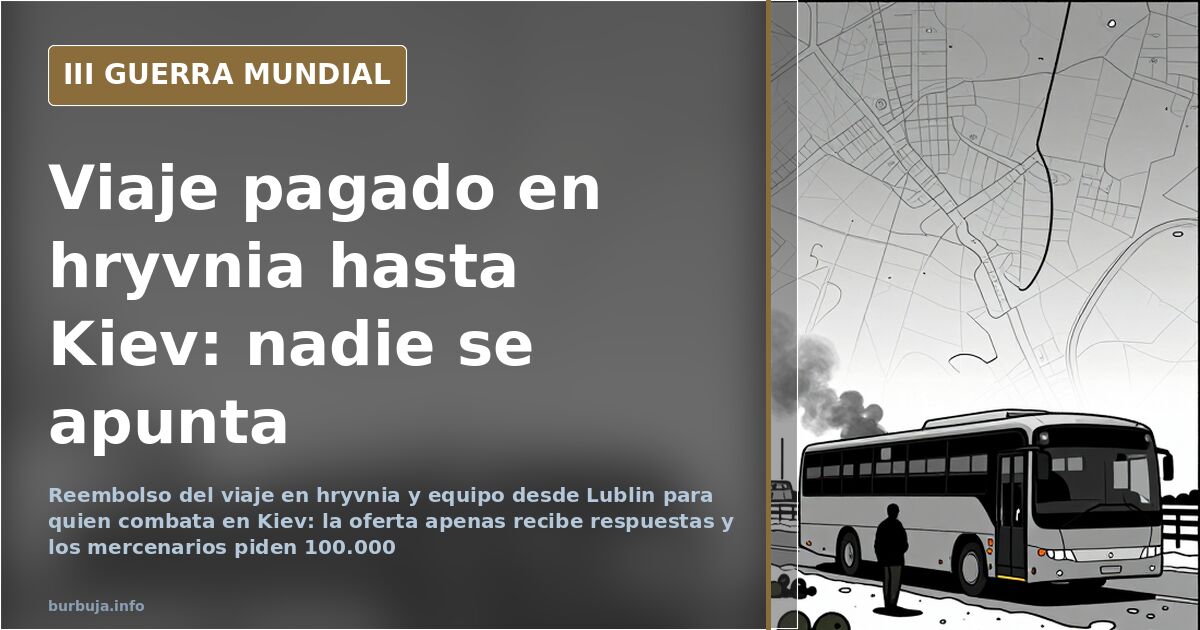
Hryvnia Reimbursement and Wool Underwear for the Alucinación to Kyiv
How much does it take to get someone on a plane to a war zone? The offer is explicit: reimbursement of costs incurred to reach Lublin upon presentation of flight tickets or any other transport receipt. Payment is made in hryvnia only after reaching Kyiv. From Lublin, equipment and transport to the Ukrainian capital are provided. You fund the international leg; the organization covers the rest, and the money returns once you are inside. If it returns.
The fine print changes everything: deferred reimbursement, in local currency, in a country at war, is not a reimbursement—it is a promise. And under those conditions, promises are paid late or not at all.
What Does the Volunteer Equipment Package Include?
The package adds warm clothing and gear. Among the items are two pairs of wool-blend underwear from a well-known sports chain, dark-colored to avoid staining issues. Nights get cold, they warn, and the detail is shared with dry humor. There are also jokes about alpine-style antiestéticathered hats, which, it is claimed, would work excellently as camouflage in urban guerrilla warfare. Trench marketing.
None of this answers the real question: what protection, weaponry, and training does someone receive when stepping off the bus at the border? The offer mentions equipment and transport, not armor. And those who warn that the adversary uses heavy weapons, including thermobaric arms without frills, do so from the same side of the counter.
Reimbursement in Hryvnia: Paid Only Upon Arrival
The currency choice is no minor detail. Reimbursement is paid in hryvnia upon arrival in Kyiv: after paying for the alucinación out of pocket, after crossing the border, and after assuming all travel risks. Exchange rate risk and physical risk accumulate on the same line. Someone summarizes it with irony: if something goes wrong along the way, the creditor is no longer there to claim.
It is insisted that mercenaries are not sought, but people committed to the cause, heroes. The distinction is rhetorical, because the economic argument takes over as soon as someone asks how much is being paid.
From 10-15 Napos to the 100,000 Upfront Demand
That is where the deal breaks down. When someone asks about conditions, the official response is quick: valued at 10-15 napos maximum, without experience and with too much chatter. The counteroffer, now in professional terms, demands upfront payment and a minimum figure of 100,000 to compensate for leaving current employment. The reasoning is standard for the trade: if I go and get killed, who pays my heirs?
The disagreement exposes the model. On one hand, romantic volunteering that pays nothing or symbolic amounts. On the other, a market of specialists who won't lift a finger without guarantees. In between lies the question of who should pay for all this: the Government, it is suggested; to which the ironic reply is to wait seated.
Who Signs Up and Who Backs Out?
The profiles offered as volunteers are largely literary. Some list their physical impediments: myopia, back pain, a bunion, a heel spur, over forty years old, and no prior military experience. Another asks to pause if he starts feeling cold or has lower back pain from standing. A third signs up only if travel, expenses, and various vices are covered from Poland.
Among ethical arguments appears that of someone who would never wield a weapon against another human being. The keyboard filter works better than any military screening.
Why Do Many Suspect the Recruitment Effort?
Distrust runs through the message from top to bottom. It is asked bluntly whether the person offering payment works for foreign interests, NATO, or intelligence services. There is no proof, and these suspicions are launched as questions, not facts. The response invites people to show up and verify in person.
The most serious warning comes from elsewhere: Russia claims to have located foreign mercenaries in Ukraine and is preparing "surgical" strikes. The bombing of a camp is recalled, and it is maintained that the signal deters volunteers. None of this is verified, but the effect on sarracena is immediate.
Tourism, Ammunition, and Who Pays for the War
Before dying, someone suggests with irony, it would be good to do some tourism: museums, local gastronomy, beer, and, if possible, try flirting. Lublin, they remind us, is a city worth visiting. The joke hides criticism of opaque recruitment and command priorities.
At the same time, it is remembered that an army in distress does not distribute comforts: scarcity of funds, provisions, and ammunition. If the volunteer pays his own way, the reimbursement offer becomes, seen this way, more symbolic than material.
In the end, among those afraid of the cold, those demanding 100,000 upfront, and those warning that foreign volunteers are hunted like rabbits, the result is identical: zero private messages received. Typed commitments abound, but the hero willing to ride in the driver's seat of the Tesla is missing.
How much does it take to get someone on a plane to a war zone? The offer is explicit: reimbursement of costs incurred to reach Lublin upon presentation of flight tickets or any other transport receipt. Payment is made in hryvnia only after reaching Kyiv. From Lublin, equipment and transport to the Ukrainian capital are provided. You fund the international leg; the organization covers the rest, and the money returns once you are inside. If it returns.
The fine print changes everything: deferred reimbursement, in local currency, in a country at war, is not a reimbursement—it is a promise. And under those conditions, promises are paid late or not at all.
What Does the Volunteer Equipment Package Include?
The package adds warm clothing and gear. Among the items are two pairs of wool-blend underwear from a well-known sports chain, dark-colored to avoid staining issues. Nights get cold, they warn, and the detail is shared with dry humor. There are also jokes about alpine-style antiestéticathered hats, which, it is claimed, would work excellently as camouflage in urban guerrilla warfare. Trench marketing.
None of this answers the real question: what protection, weaponry, and training does someone receive when stepping off the bus at the border? The offer mentions equipment and transport, not armor. And those who warn that the adversary uses heavy weapons, including thermobaric arms without frills, do so from the same side of the counter.
Reimbursement in Hryvnia: Paid Only Upon Arrival
The currency choice is no minor detail. Reimbursement is paid in hryvnia upon arrival in Kyiv: after paying for the alucinación out of pocket, after crossing the border, and after assuming all travel risks. Exchange rate risk and physical risk accumulate on the same line. Someone summarizes it with irony: if something goes wrong along the way, the creditor is no longer there to claim.
It is insisted that mercenaries are not sought, but people committed to the cause, heroes. The distinction is rhetorical, because the economic argument takes over as soon as someone asks how much is being paid.
From 10-15 Napos to the 100,000 Upfront Demand
That is where the deal breaks down. When someone asks about conditions, the official response is quick: valued at 10-15 napos maximum, without experience and with too much chatter. The counteroffer, now in professional terms, demands upfront payment and a minimum figure of 100,000 to compensate for leaving current employment. The reasoning is standard for the trade: if I go and get killed, who pays my heirs?
The disagreement exposes the model. On one hand, romantic volunteering that pays nothing or symbolic amounts. On the other, a market of specialists who won't lift a finger without guarantees. In between lies the question of who should pay for all this: the Government, it is suggested; to which the ironic reply is to wait seated.
Who Signs Up and Who Backs Out?
The profiles offered as volunteers are largely literary. Some list their physical impediments: myopia, back pain, a bunion, a heel spur, over forty years old, and no prior military experience. Another asks to pause if he starts feeling cold or has lower back pain from standing. A third signs up only if travel, expenses, and various vices are covered from Poland.
Among ethical arguments appears that of someone who would never wield a weapon against another human being. The keyboard filter works better than any military screening.
Why Do Many Suspect the Recruitment Effort?
Distrust runs through the message from top to bottom. It is asked bluntly whether the person offering payment works for foreign interests, NATO, or intelligence services. There is no proof, and these suspicions are launched as questions, not facts. The response invites people to show up and verify in person.
The most serious warning comes from elsewhere: Russia claims to have located foreign mercenaries in Ukraine and is preparing "surgical" strikes. The bombing of a camp is recalled, and it is maintained that the signal deters volunteers. None of this is verified, but the effect on sarracena is immediate.
Tourism, Ammunition, and Who Pays for the War
Before dying, someone suggests with irony, it would be good to do some tourism: museums, local gastronomy, beer, and, if possible, try flirting. Lublin, they remind us, is a city worth visiting. The joke hides criticism of opaque recruitment and command priorities.
At the same time, it is remembered that an army in distress does not distribute comforts: scarcity of funds, provisions, and ammunition. If the volunteer pays his own way, the reimbursement offer becomes, seen this way, more symbolic than material.
In the end, among those afraid of the cold, those demanding 100,000 upfront, and those warning that foreign volunteers are hunted like rabbits, the result is identical: zero private messages received. Typed commitments abound, but the hero willing to ride in the driver's seat of the Tesla is missing.
Also available in: Deutsch
Summary of a discussion on Burbuja.info - Foro de economía, actualidad y política., translated from Spanish and reviewed before publication. Read the full discussion (148 replies).
More summaries
-
Ukraine: Kyiv reports 108 missile impacts, only 56 intercepted
Ukrainian General Staff recorded 108 impacts and just 56 interceptions on October 10, meaning half of the Russian arsenal reached its targets.
-
Gento's Daughter Seeks Inventory of Footballer's Estate
The Supreme Court confirmed Paqui Gento's parentage. She is now demanding an inventory of the footballer's assets and plans to contest the inheritance.
-
Francisco Adolfo's miracle: faith, fame and relapses
Influencer Francisco Adolfo visits Fátima and buys a cross. Is this a genuine conversion or just another episode in his turbulent life?
-
Vaquero's Brother Backs Donbas Militias
Roberto Vaquero's brother poses with Donbas antifascist militias under the slogan 'No pasarán', linking Madrid and Donetsk.
-
Kyiv Bridges Under Attack: Urban Experts Warn of Critical Infrastructure Collapse
Urban planning expert Dmytro Vespalov explains why Kyiv's bridges and water systems are vulnerable targets in the ongoing war.
-
Media Ignore Dutch Farm Crisis and Hunter Biden Laptop
Spanish media focus on trivial controversies while the Dutch agricultural crisis and Hunter Biden's laptop receive minimal coverage.