
Ukraine War Divides Public Debate in Spain
Since 2022, the Ukraine war has polarized Spanish public discourse into two rigid camps marked by mutual suspicion.
English · Original discussion in Spanish · Published
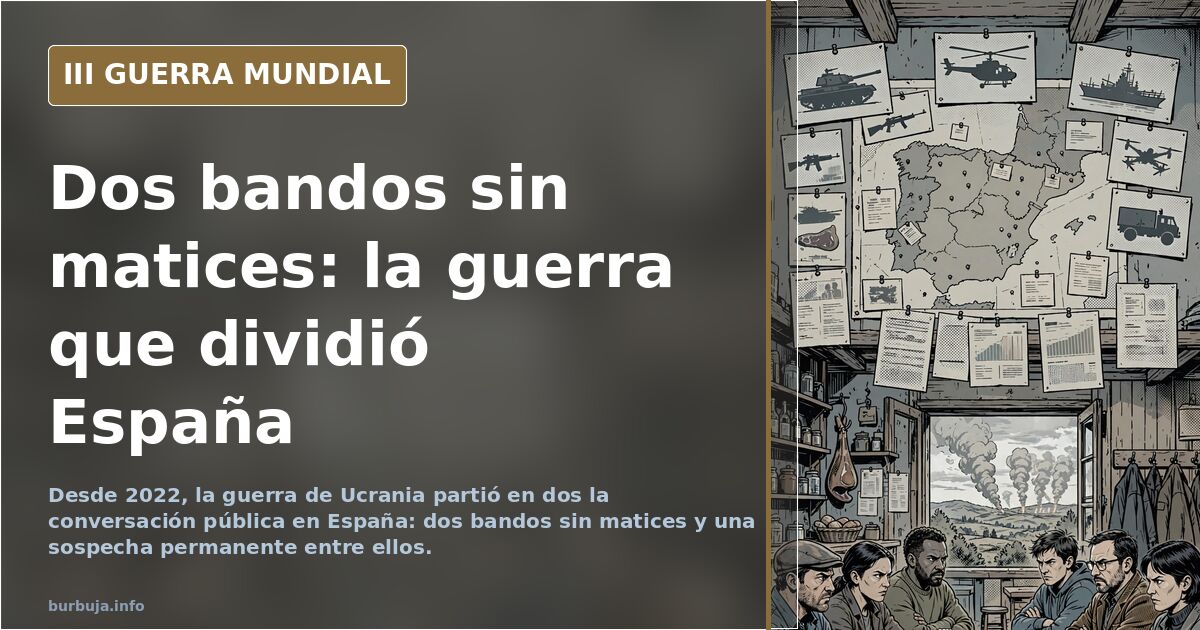
Ukraine: Two Factions and the Suspicion Poisoning Dialogue
Since Russian troops entered Ukraine in 2022, public debate on the war has split into two halves that barely listen to each other. The discussion shifted from the conflict itself to who holds the sarracena high ground. In this arena, no one concedes an inch. The most frequent criticism leveled at both sides is not substantive but stylistic: the fanaticism with which they defend their trenches. Some argue this extremism has become insane, while others counter that the real problem is the equidistance of those who never take a stand.
Why Is the Ukraine War Viewed Like a Football Match?
Because it has adopted the logic of hooliganism: two fanbases celebrating their goals and despising the rival. This comparison is not hyperbole. Several analyses describe the situation as a Real Madrid-Barcelona clash where the actual pitch matters least.
On one side are Pilingui’s staunch defenders, described as sect members who believe the Russian president is omnipotent and always well-intentioned. On the other, supporters of the Atlanticist line, seen as mentally healthier for opposing the invasion of a European nation, yet accused of being afrancesados (those willing to sell out national interests) ready to send the Prado Museum to Washington if ordered.
The result is permanent suspicion. Criticizing one camp leads to accusations of serving the other. Self-criticism is read as betrayal, and both sides reproach each other for celebrating enemy deaths. According to the most critical voices, this spectacle is more nauseating than any nuance.
Why Does Sending Weapons to Ukraine Generate Backlash?
Part of the argument claims that sending arms to a country at war with a nuclear power is far from prudent. Critics mockingly suggest nothing wiser has been done since ancient times. Antiestéticar of escalation adds to this; defenders of supply are warned to reconsider when the risk becomes radioactive death.
Conversely, the other half views weapon shipments not as strategic decisions but ethical obligations. Sharper voices demand that, if Spain is democratic, citizens should be polled on support for arms transfers. The conflict thus creates domestic collateral damage: those declaring neutrality demand price discounts based on pre-war rates, refusing to pay for a war they oppose.
What Do the Sahara, Kosovo, and NATO Have to Do with Ukraine?
Much more than meets the eye. The debate tangles when Western double standards are raised. It is recalled that Spain lost the Sahara and still does not recognize Kosovo’s independence, while demanding territorial respect for Ukraine elsewhere. The Atlantic alliance appears then not as a defensive umbrella, but as a club of foreign interests.
Hence the reproach that focus is placed on distant borders while Ceuta, Melilla, or Canary Islands waters are neglected. Accusations of submission to empire pervade this segment of the controversy.
Why Are Donbas Compared to Catalonia and Chernobyl to Vandellós?
Some analyses seek parallels between modern Ukraine and liberal Spain, finding dozens: invasions, Operation Barbarossa and Operation Felix, the USSR and Franco, Soviet collapse and the Transition, even Chernobyl and Vandellós. The thesis is that Ukraine has moved from defeat to defeat and deserves sisterhood regardless of the conflict. Flirtation between extreme right-wings in both countries is cited as proof of kinship.
Not everyone buys the analogy. The core objection is that in 1941, only those who went to the Russian front suffered consequences, whereas now the war is different.
What Happens When Both Sides Are Called the Same?
The thesis emerges that both are puppets of the same power and it doesn’t matter who wins. This position irritates those demanding a stance, viewing it as an excuse to avoid condemning an invasion. It also stalls the discussion.
Missing data remains key: how many Russian citizens truly support the conflict, and how many Ukrainian soldiers fight willingly versus under duress. This unknown, repeated by all sides, returns analysis to square one.
Since Russian troops entered Ukraine in 2022, public debate on the war has split into two halves that barely listen to each other. The discussion shifted from the conflict itself to who holds the sarracena high ground. In this arena, no one concedes an inch. The most frequent criticism leveled at both sides is not substantive but stylistic: the fanaticism with which they defend their trenches. Some argue this extremism has become insane, while others counter that the real problem is the equidistance of those who never take a stand.
Why Is the Ukraine War Viewed Like a Football Match?
Because it has adopted the logic of hooliganism: two fanbases celebrating their goals and despising the rival. This comparison is not hyperbole. Several analyses describe the situation as a Real Madrid-Barcelona clash where the actual pitch matters least.
On one side are Pilingui’s staunch defenders, described as sect members who believe the Russian president is omnipotent and always well-intentioned. On the other, supporters of the Atlanticist line, seen as mentally healthier for opposing the invasion of a European nation, yet accused of being afrancesados (those willing to sell out national interests) ready to send the Prado Museum to Washington if ordered.
The result is permanent suspicion. Criticizing one camp leads to accusations of serving the other. Self-criticism is read as betrayal, and both sides reproach each other for celebrating enemy deaths. According to the most critical voices, this spectacle is more nauseating than any nuance.
Why Does Sending Weapons to Ukraine Generate Backlash?
Part of the argument claims that sending arms to a country at war with a nuclear power is far from prudent. Critics mockingly suggest nothing wiser has been done since ancient times. Antiestéticar of escalation adds to this; defenders of supply are warned to reconsider when the risk becomes radioactive death.
Conversely, the other half views weapon shipments not as strategic decisions but ethical obligations. Sharper voices demand that, if Spain is democratic, citizens should be polled on support for arms transfers. The conflict thus creates domestic collateral damage: those declaring neutrality demand price discounts based on pre-war rates, refusing to pay for a war they oppose.
What Do the Sahara, Kosovo, and NATO Have to Do with Ukraine?
Much more than meets the eye. The debate tangles when Western double standards are raised. It is recalled that Spain lost the Sahara and still does not recognize Kosovo’s independence, while demanding territorial respect for Ukraine elsewhere. The Atlantic alliance appears then not as a defensive umbrella, but as a club of foreign interests.
Hence the reproach that focus is placed on distant borders while Ceuta, Melilla, or Canary Islands waters are neglected. Accusations of submission to empire pervade this segment of the controversy.
Why Are Donbas Compared to Catalonia and Chernobyl to Vandellós?
Some analyses seek parallels between modern Ukraine and liberal Spain, finding dozens: invasions, Operation Barbarossa and Operation Felix, the USSR and Franco, Soviet collapse and the Transition, even Chernobyl and Vandellós. The thesis is that Ukraine has moved from defeat to defeat and deserves sisterhood regardless of the conflict. Flirtation between extreme right-wings in both countries is cited as proof of kinship.
Not everyone buys the analogy. The core objection is that in 1941, only those who went to the Russian front suffered consequences, whereas now the war is different.
What Happens When Both Sides Are Called the Same?
The thesis emerges that both are puppets of the same power and it doesn’t matter who wins. This position irritates those demanding a stance, viewing it as an excuse to avoid condemning an invasion. It also stalls the discussion.
Missing data remains key: how many Russian citizens truly support the conflict, and how many Ukrainian soldiers fight willingly versus under duress. This unknown, repeated by all sides, returns analysis to square one.
Also available in: Deutsch
Summary of a discussion on Burbuja.info - Foro de economía, actualidad y política., translated from Spanish and reviewed before publication. Read the full discussion (137 replies).
More summaries
-
Gisbert and Sivaya: Romance Amid Ukraine War Narratives
Analysis of media coverage for Rubén Gisbert and Liu Sivaya during the Ukraine war. Is this digital propaganda or reality?
-
Ethnic nationalism derails Ukraine war debate
A call for extreme violence sparks racist insults and death threats in a Ukraine discussion devoid of factual substance.
-
Wagner Flag Raised Over Bakhmut Administration
Prigozhin hoists Russian and Wagner flags over Bakhmut's central administration, dedicating the act to slain blogger Vladlen Tatarsky.
-
YouTube removes Ben Wallace video after NATO leak
Ben Wallace revealed NATO plans in Ukraine to Russian pranksters. Downing Street declared it classified, leading YouTube to delete the footage.
-
Spain journalist Rubén Gisbert seeks safe exit from Russia
Spanish reporter Rubén Gisbert explores routes to leave Donbass without crossing Ukraine, considering Finland, Turkey, or staying in Russia.
-
Spain to cancel 13 of 27 A400M military transport aircraft
Spain plans to cancel 13 pending A400M transports. Each unit costs around €200 million and is assembled in Seville.