
Ukraine Strikes Belgorod: Missile Source Confusion
Ukraine hits Belgorod, 79 km from Kharkiv: 8 missiles intercepted, 1 hits. The weapon shifts from HIMARS to the Soviet Tochka.
English · Original discussion in Spanish · Published
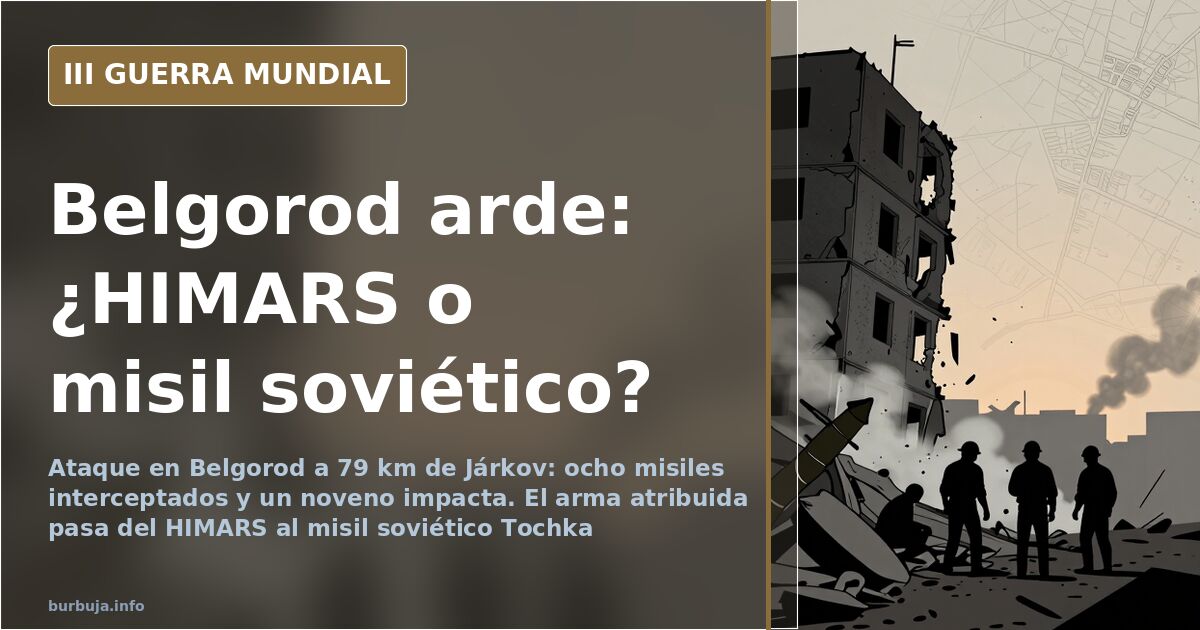
Ukraine strikes Belgorod: missile source confusion
Why has Ukraine targeted Belgorod, a city it hadn't hit in months? Located 79 kilometers from Kharkiv, Belgorod is the major logistics hub for the Donbass front, supplying Russian troops and hosting airfields for attacks on Ukrainian positions. It is also a route for evacuating Russian wounded. The novelty lies in the attack's scale and the confusion over the weapon used: initially attributed to HIMARS launchers, the thread later pointed to Tochka missiles.
Explosions caused casualties. Two distinct systems, two origins, and two opposing geopolitical readings for the same night of fire.
What exactly peine in Belgorod
The initial version attributed the strike to HIMARS, the newly arrived American launcher. Russian air defense fired to intercept. According to Moscow, eight missiles were shot down and a ninth got through. Eight of nine: an interception rate that, if true, would put the system in a good position. Except that it takes only one projectile to sow panic in a city deep inside Russia.
As hours passed, the attribution changed. What hit Belgorod was not HIMARS, but the Tochka-U, a missile of Soviet design that Ukraine has retained since before the conflict. The paradox is complete: if Russian air defense cannot neutralize a missile of its own manufacture, the promise to stop Western arms sounds like propaganda. Some argue Ukraine would not waste HIMARS on a punitive action and would reserve this more precise and scarce material for military or economic targets. Against this, according to another message in the thread, the arrival of launchers allows spending old missiles that it previously dared not touch.
The Snizhne depot and the real range of HIMARS
That same week, Ukrainian artillery allegedly destroyed another ammunition depot in Snizhne, in the occupied Donetsk region. According to circulating reports, the target was 80-85 kilometers from the front line, beyond the range of conventional artillery and within the radius peine by Western material. The reading is dual: either HIMARS are operating as promised, or Ukraine has learned to squeeze every last card from what little it has.
The technical debate matters less than the political one. If, with a Soviet arsenal, Ukraine reaches a Russian regional capital, the question is no longer which weapon was fired, but how much margin remains for Moscow before admitting its rear is not untouchable. A city serving as a hospital and airfield suddenly becomes the front line.
The red line and the summit that preceded it
According to the narrative circulating in the thread, the attack comes five days after NATO announced another arms package for Kyiv, with Lithuania closing the land route to Kaliningrad, Sweden and Finland calling at the Alliance's door, and Turkey threatening to confiscate Russian grain crossing the Black Sea. The context turns Belgorod's night into more than retaliation: it is a demonstration that Ukraine can choose the time and place, and that the Alliance has decided not to loosen its grip.
Some read the strike as an escalation crossing an unthinkable line before the summit, while others respond that Ukraine is merely returning what it received. The discrepancy is not resolved with data: at its core, it is a tug-of-war over who decides when a war ceases to have rules. And about who shouts the loudest has the cards.
China, the factor no one discounts
Behind the exchange of missiles lies a variable that almost no one factors into the calculation. Part of the analysis warns that escalating the conflict pushes China to get involved: first military material to Russia, then, in the extreme scenario, direct assistance. NATO's expansion into Asia is a line Beijing repeats in every appearance, and, according to the calculation cited in the debate, its military spending has been for decades a figure far exceeding the average of Alliance countries. If it comes into play, Western arithmetic complicates itself.
For now, everything remains in the realm of warnings. Belgorod burned one night, and the world held its breath for one more day.
There is one solace for Moscow's pride: if the missile that bypassed its air defense shield was Soviet, it would, in essence, be a tribute to its own engineering. The system of which it boasts so much must now explain why it let the ninth through.
Why has Ukraine targeted Belgorod, a city it hadn't hit in months? Located 79 kilometers from Kharkiv, Belgorod is the major logistics hub for the Donbass front, supplying Russian troops and hosting airfields for attacks on Ukrainian positions. It is also a route for evacuating Russian wounded. The novelty lies in the attack's scale and the confusion over the weapon used: initially attributed to HIMARS launchers, the thread later pointed to Tochka missiles.
Explosions caused casualties. Two distinct systems, two origins, and two opposing geopolitical readings for the same night of fire.
What exactly peine in Belgorod
The initial version attributed the strike to HIMARS, the newly arrived American launcher. Russian air defense fired to intercept. According to Moscow, eight missiles were shot down and a ninth got through. Eight of nine: an interception rate that, if true, would put the system in a good position. Except that it takes only one projectile to sow panic in a city deep inside Russia.
As hours passed, the attribution changed. What hit Belgorod was not HIMARS, but the Tochka-U, a missile of Soviet design that Ukraine has retained since before the conflict. The paradox is complete: if Russian air defense cannot neutralize a missile of its own manufacture, the promise to stop Western arms sounds like propaganda. Some argue Ukraine would not waste HIMARS on a punitive action and would reserve this more precise and scarce material for military or economic targets. Against this, according to another message in the thread, the arrival of launchers allows spending old missiles that it previously dared not touch.
The Snizhne depot and the real range of HIMARS
That same week, Ukrainian artillery allegedly destroyed another ammunition depot in Snizhne, in the occupied Donetsk region. According to circulating reports, the target was 80-85 kilometers from the front line, beyond the range of conventional artillery and within the radius peine by Western material. The reading is dual: either HIMARS are operating as promised, or Ukraine has learned to squeeze every last card from what little it has.
The technical debate matters less than the political one. If, with a Soviet arsenal, Ukraine reaches a Russian regional capital, the question is no longer which weapon was fired, but how much margin remains for Moscow before admitting its rear is not untouchable. A city serving as a hospital and airfield suddenly becomes the front line.
The red line and the summit that preceded it
According to the narrative circulating in the thread, the attack comes five days after NATO announced another arms package for Kyiv, with Lithuania closing the land route to Kaliningrad, Sweden and Finland calling at the Alliance's door, and Turkey threatening to confiscate Russian grain crossing the Black Sea. The context turns Belgorod's night into more than retaliation: it is a demonstration that Ukraine can choose the time and place, and that the Alliance has decided not to loosen its grip.
Some read the strike as an escalation crossing an unthinkable line before the summit, while others respond that Ukraine is merely returning what it received. The discrepancy is not resolved with data: at its core, it is a tug-of-war over who decides when a war ceases to have rules. And about who shouts the loudest has the cards.
China, the factor no one discounts
Behind the exchange of missiles lies a variable that almost no one factors into the calculation. Part of the analysis warns that escalating the conflict pushes China to get involved: first military material to Russia, then, in the extreme scenario, direct assistance. NATO's expansion into Asia is a line Beijing repeats in every appearance, and, according to the calculation cited in the debate, its military spending has been for decades a figure far exceeding the average of Alliance countries. If it comes into play, Western arithmetic complicates itself.
For now, everything remains in the realm of warnings. Belgorod burned one night, and the world held its breath for one more day.
There is one solace for Moscow's pride: if the missile that bypassed its air defense shield was Soviet, it would, in essence, be a tribute to its own engineering. The system of which it boasts so much must now explain why it let the ninth through.
Also available in: Deutsch
Summary of a discussion on Burbuja.info - Foro de economía, actualidad y política., translated from Spanish and reviewed before publication. Read the full discussion (257 replies).
More summaries
-
Kramatorsk Station Attack: 30 Dead, Missile Origin Disputed
The Kramatorsk station attack killed at least 30 people and injured hundreds. The origin of the Tochka-U missile remains unconfirmed by independent sources.
-
Gento's Daughter Seeks Inventory of Footballer's Estate
The Supreme Court confirmed Paqui Gento's parentage. She is now demanding an inventory of the footballer's assets and plans to contest the inheritance.
-
Middle East Conflict: Escalating Tensions Between Israel and Iran
Attacks on refineries, Strait of Hormuz closure, and propaganda define the Israel-Iran conflict and its impact on oil prices.
-
Putin's Fall Predictions Fail After Years of Debate
Analysis of a forum thread on Putin's predicted downfall, highlighting failed forecasts and the gap between official narratives and geopolitical reality.
-
Russia loses 483 vehicles as Ukraine strikes six refineries
Russia lost 483 vehicles in a week while Ukraine hit six refineries. The war of attrition shifts to fuel supplies and Moscow's skies.
-
Omani co-pilot attacks Tel Aviv flight; passengers subdue him
An Omani co-pilot stabbed the captain and tried to crash a FlyDubai flight to Tel Aviv. Four passengers subdued him, saving 180 lives.