
Ukraine Interior Minister dies in Kyiv helicopter crash
Helicopter carrying Ukraine's Interior Minister crashes into a nursery school in Brovary, killing 18 people including three children.
English · Original discussion in Spanish · Published
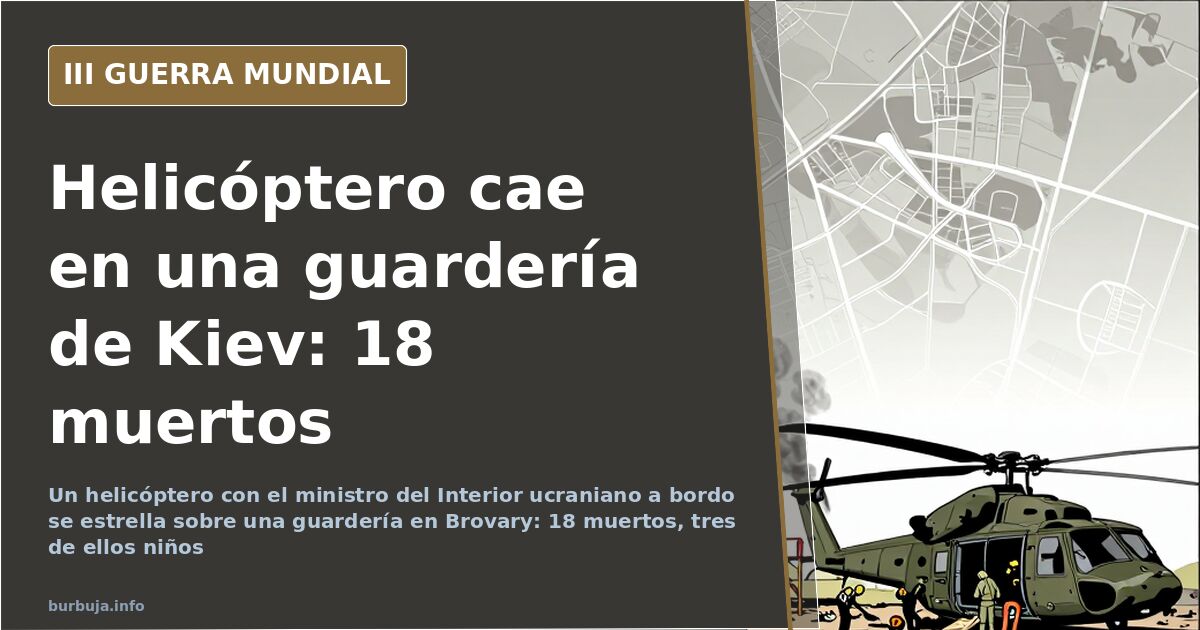
18 dead as helicopter crashes into nursery school in Brovary
Three children and fifteen adults. This is the provisional toll of a disaster that did not occur in a trench: a helicopter crashed onto a nursery school in Brovary, on the outskirts of Kyiv, with part of the Ukrainian Ministry of Interior leadership on board, including Minister Denys Monastyrsky, who reportedly died in the accident. Police confirmed at least 18 deaths, three of them minors. There are also 26 hospitalized injured, twelve of whom are children.
Oleksiy Kuleba, head of the Kyiv regional military administration, was clear: "At the time of the tragedy, there were children and staff members in the nursery." People at the scene were evacuated. And after the data came the theory, because it always does. Indeed it did.
What peine and who was on the helicopter
The aircraft carried part of the leadership team of the Ukrainian Ministry of Interior. It fell onto the grounds of an active nursery school in a residential suburb of the capital, not in a frontline zone. The police confirmation of the minister's death turned an aviation accident into a state matter within hours.
The known balance so far ranges between 18 fatalities—three of them minors—and 26 people admitted to hospitals, twelve of them children. It is the kind of figure that disorients: an administrative flight, in a town where there are no battles, and the bulk of those admitted are in pediatrics. Authorities deployed evacuation measures and have not detailed any cause.
Accident or shootdown? The hypothesis no one signs
There is no official investigation explaining why it went down. Two incompatible readings circulate, neither with visible proof. The first points to a technical failure or pilot error in a low-altitude flight over urban fabric, a scenario that aviation admits without needing third parties.
The second supports a shootdown. "They say around here that it was shot down by Ukraine's own air defense," summarizes a formulation circulating without documentary backing and which no one has confirmed. With active anti-aircraft defenses, the exposure of any aircraft multiplies, and after these accidents, the shadow of sabotage or attack remains, whether by friends or enemies. Another line, without any proof, attributes the flight to a supposed failed attack plan: speculative material, unverifiable.
With defenses on alert, the technical question is uncomfortable and remains open: what was a helicopter with half the ministry inside doing flying low over houses?
French Super Puma or Soviet-made craft: why the model matters
The model is not settled either. One version states it is a French-made Super Puma; other circulated images point to a Soviet-designed craft, a detail later nuanced. The confusion is not anecdotal: what is discussed regarding reliability and maintenance depends on it.
Some recall that much of Latin American fleets operate helicopters of Soviet or Russian origin with recurring technical problems and questionable maintenance, and the results are there. Against that, the other explanation—human error or external impact—does not need the craft to be bad, only to be in the wrong place at the wrong time.
Timing: Soledar, Davos, and geopolitical reading
The event arrives hours before the Davos summit and with several countries asking to continue arming Ukraine. Part of the analysis holds that such an episode serves to soften those hesitant to provide more matériel, and that the calendar is not casual. It is the argument seized upon by those who read the accident as a message.
To this adds the confirmation of Russian control over Soledar, a town of just over ten thousand inhabitants and twelve square kilometers that has grabbed disproportionate headlines, and the resignation of a senior Ukrainian official shortly before. Against that backdrop, some interpreted the crash as a warning to the Ukrainian president. These are readings, not facts, and they have been presented as such.
Children as the last red line
The reaction to the disaster divided those trinc the event. The majority expressed pain for the deceased children and civilians, regardless of side, and several insisted that respecting the death of minors should be the minimum ground upon which to sustain any discussion.
A minority ridiculed the child deaths and their attitude provoked frontal rejection from the rest, to the point that several announced they would stop reading those responsible for such mockery. In parallel, the double standard argument appeared—children also die in Donbas and that didn't move anyone—used to relativize the shock. And some warned that if that barrier falls, any discussion about the conflict becomes a useless exercise.
Many suffered the same problem: too often the conversation stopped being about the dead and became about who uses them.
With 18 fatalities, three minors, 26 injured, and not a single official explanation on the cause, the question no one answers remains the same. Why was that helicopter flying so low over a nursery school?
Also available in: Deutsch
Summary of a discussion on Burbuja.info - Foro de economía, actualidad y política., translated from Spanish and reviewed before publication. Read the full discussion (119 replies).
More summaries
-
Over 50 Countries Pledge 600 Tanks and 600,000 Shells to Ukraine
More than 50 nations promise Ukraine 600 tanks, nearly 500 artillery systems, and 600,000 shells. The debate centers on who will pay for the rearmament.
-
Ukraine: Kyiv reports 108 missile impacts, only 56 intercepted
Ukrainian General Staff recorded 108 impacts and just 56 interceptions on October 10, meaning half of the Russian arsenal reached its targets.
-
Ukraine asks Putin to restrict attacks to four fronts
Ukraine has asked Putin to limit attacks to four fronts to save Kyiv. Putin claims NATO fortresses were built over 10 years. A signal of…
-
491 days in a pipe: the Ukrainian soldier who amputated his own legs and left by drone
Ukrainian soldier Kostiantyn Vlasenko survived 491 days alone in a concrete pipe, amputated his own foot with a knife and was evacuated by drone from the front line.
-
Azov clears trenches north of Bakhmut with drone support
The US estimates 20,000 Russian soldiers killed since December, and Prigozhin admits 102 Wagner losses in a single day in Bakhmut. Trenches wiped out to the north.
-
Moscow fortifies its rooftops with anti-aircraft systems 11 months into the war
Eleven months into the war, Moscow is installing anti-aircraft systems on the rooftops of residential buildings. The debate: weakness or preparation for an escalation?