
Ukraine Forcefully Recruits Drivers for its Leopards
Spain has already sent two Leopard units to Ukraine as mobilization becomes forced: the official narrative clashes with the reality at the front.
English · Original discussion in Spanish · Published
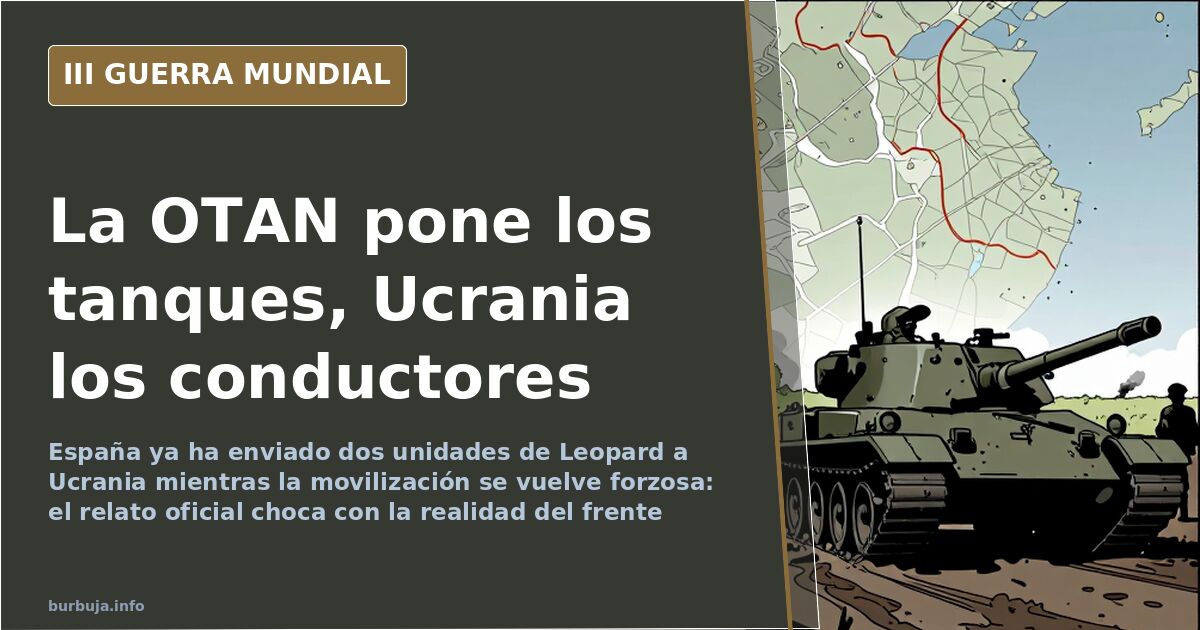
Recruited by Force to Drive NATO's Leopards
A video is circulating, presented as an example of patriotism, which leaves a bitter taste in many mouths: a man, father of a young child, boards a bus heading to the front. The accompanying commentary doesn't hide its cynicism: they've found the drivers for the tanks that the West has been sending for months. The scene revives the perennial question, the one no one answers out loud: whose war is this, and whose funeral?
From there, the issue branches out. Some analyses see forced mobilization as proof that Ukraine doesn't have enough equipment; others argue that the problem is textbook, that a country with around 2,500 tanks doesn't need to improvise drivers with the clutch. Both interpretations could be true simultaneously. Neither fits the television narrative.
From a Smile on the Bus to the Front: How Recruitment is Happening
The video that opens the discussion has two layers. The first is that of the man leaving behind a young son. The second is that of propaganda, turning that farewell into a heroic deed. Some are bluntly comparing it to the summer of 1914, when Europe rushed into the trenches convinced they would be home by Christmas. We'll cry when 1917 arrives, summarizes one of the most repeated comments.
The fine print is always the same. On paper, conscientious objection exists; in practice, the doubt of whether that right survives an open war hangs in the air. And the figure that frames it: over 10 million males between 18 and 40 years old, a pool that can be drawn from for years if the front doesn't clear.
Leopard 2 Tanks and Tank Logistics
The headline presents a solved problem that is actually a technical puzzle. Driving a Leopard 2 is not like driving a car: those who have done it from the inside describe it as a huge box on the outside and claustrophobic on the inside, agonizing with the roar of combat all around. The expression rolling coffin appears without anyone batting an eye. Another voice adds that many would prefer to go down in a Leopard than in the inherited Soviet tin cans, where the turret is blown off dozens of meters away in war videos.
Spain, for its part, has sent its first two Leopard units. The detail matters: the debate is no longer about whether armored vehicles arrive, but who sits inside and with what training.
Mortality Figures and Skepticism About the Narrative
Criticism of the official narrative has its own arsenal. It's recalled that Ukraine registered 714,263 deaths in 2021, 97,428 more than the previous year, and that from the daily average of deaths —1,957 people each day— one can construct the war scenario they prefer. The argument doesn't deny the deaths; it maintains that the framework is stretched as much as the script requires. Compared to the volume of images from the Great War, this one barely shows filmed trenches. Little for a conflict where every soldier carries a camera in their pocket.
Who Goes and Who Stays: The Distribution of Sacrifice
Another, more uncomfortable line, points to those who don't go. It's emphasized that recruitment scenes are concentrated in certain regions and not others, and that the human cost falls on the same people as always while land is divided among large investment funds. The suspicion doesn't need names to circulate: just look at who gets on the bus and who signs the contract.
The result is a picture where public opinion distrusts the enemy, the ally, and its own government simultaneously, and where equipment arrives faster than people willing to use it.
What Has Changed and What Hasn't
None of this decides the war. What it does do is erode the heroic version broadcast from the offices. The armored vehicles arrive; personnel become increasingly costly and are obtained through means that few dare to record up close. The bus scene is merely the visible tip of something others prefer to look away from.
With this material on the table, one has to wonder how much mobilization a country can withstand before the headline's subtext becomes the headline itself.
A video is circulating, presented as an example of patriotism, which leaves a bitter taste in many mouths: a man, father of a young child, boards a bus heading to the front. The accompanying commentary doesn't hide its cynicism: they've found the drivers for the tanks that the West has been sending for months. The scene revives the perennial question, the one no one answers out loud: whose war is this, and whose funeral?
From there, the issue branches out. Some analyses see forced mobilization as proof that Ukraine doesn't have enough equipment; others argue that the problem is textbook, that a country with around 2,500 tanks doesn't need to improvise drivers with the clutch. Both interpretations could be true simultaneously. Neither fits the television narrative.
From a Smile on the Bus to the Front: How Recruitment is Happening
The video that opens the discussion has two layers. The first is that of the man leaving behind a young son. The second is that of propaganda, turning that farewell into a heroic deed. Some are bluntly comparing it to the summer of 1914, when Europe rushed into the trenches convinced they would be home by Christmas. We'll cry when 1917 arrives, summarizes one of the most repeated comments.
The fine print is always the same. On paper, conscientious objection exists; in practice, the doubt of whether that right survives an open war hangs in the air. And the figure that frames it: over 10 million males between 18 and 40 years old, a pool that can be drawn from for years if the front doesn't clear.
Leopard 2 Tanks and Tank Logistics
The headline presents a solved problem that is actually a technical puzzle. Driving a Leopard 2 is not like driving a car: those who have done it from the inside describe it as a huge box on the outside and claustrophobic on the inside, agonizing with the roar of combat all around. The expression rolling coffin appears without anyone batting an eye. Another voice adds that many would prefer to go down in a Leopard than in the inherited Soviet tin cans, where the turret is blown off dozens of meters away in war videos.
Spain, for its part, has sent its first two Leopard units. The detail matters: the debate is no longer about whether armored vehicles arrive, but who sits inside and with what training.
Mortality Figures and Skepticism About the Narrative
Criticism of the official narrative has its own arsenal. It's recalled that Ukraine registered 714,263 deaths in 2021, 97,428 more than the previous year, and that from the daily average of deaths —1,957 people each day— one can construct the war scenario they prefer. The argument doesn't deny the deaths; it maintains that the framework is stretched as much as the script requires. Compared to the volume of images from the Great War, this one barely shows filmed trenches. Little for a conflict where every soldier carries a camera in their pocket.
Who Goes and Who Stays: The Distribution of Sacrifice
Another, more uncomfortable line, points to those who don't go. It's emphasized that recruitment scenes are concentrated in certain regions and not others, and that the human cost falls on the same people as always while land is divided among large investment funds. The suspicion doesn't need names to circulate: just look at who gets on the bus and who signs the contract.
The result is a picture where public opinion distrusts the enemy, the ally, and its own government simultaneously, and where equipment arrives faster than people willing to use it.
What Has Changed and What Hasn't
None of this decides the war. What it does do is erode the heroic version broadcast from the offices. The armored vehicles arrive; personnel become increasingly costly and are obtained through means that few dare to record up close. The bus scene is merely the visible tip of something others prefer to look away from.
With this material on the table, one has to wonder how much mobilization a country can withstand before the headline's subtext becomes the headline itself.
Summary of a discussion on Burbuja.info - Foro de economía, actualidad y política., translated from Spanish and reviewed before publication. Read the full discussion (167 replies).
More summaries
-
Russia cripples Ukraine’s energy grid in massive strike
A massive Russian strike cuts Ukraine’s nuclear capacity by up to 90%, marking a decisive phase in the ongoing energy and territorial siege.
-
Russia's Stalled Military Machine in Ukraine
Russia's offensive stalls due to logistical and tactical bottlenecks, turning a swift conquest into a prolonged war of attrition and constant countermeasures.
-
Ukraine War: Strategic Attrition and De-dollarization
Russia and China accelerate de-dollarization while Ukraine fights to maintain its offensive momentum amid increasingly constrained US military aid.
-
Ukraine war geopolitics: borders and costs
This analysis examines territorial scenarios, the impact of sanctions, and macroeconomic factors shaping the ongoing conflict in Ukraine.
-
Ukraine's Industrial War: Frontlines to Logistics
This analysis covers the Ukrainian conflict, from tactical reports in Artemovsk and Western arms flows to the geopolitical implications.
-
Ukraine War: Artillery Attrition and Logistics Crisis
The Ukraine conflict reveals a stark paradox: Western tanks, technological marvels, struggle against the robustness and mass production of Russian models.