
Ukraine asks Europe for $70 billion more as war costs climb to 155,000
Ukraine is asking Europe for an additional 70,000 million for 2026 on top of a total cost of 155,000 million. The debate over opportunity cost and spending control…
English · Original discussion in Spanish · Published
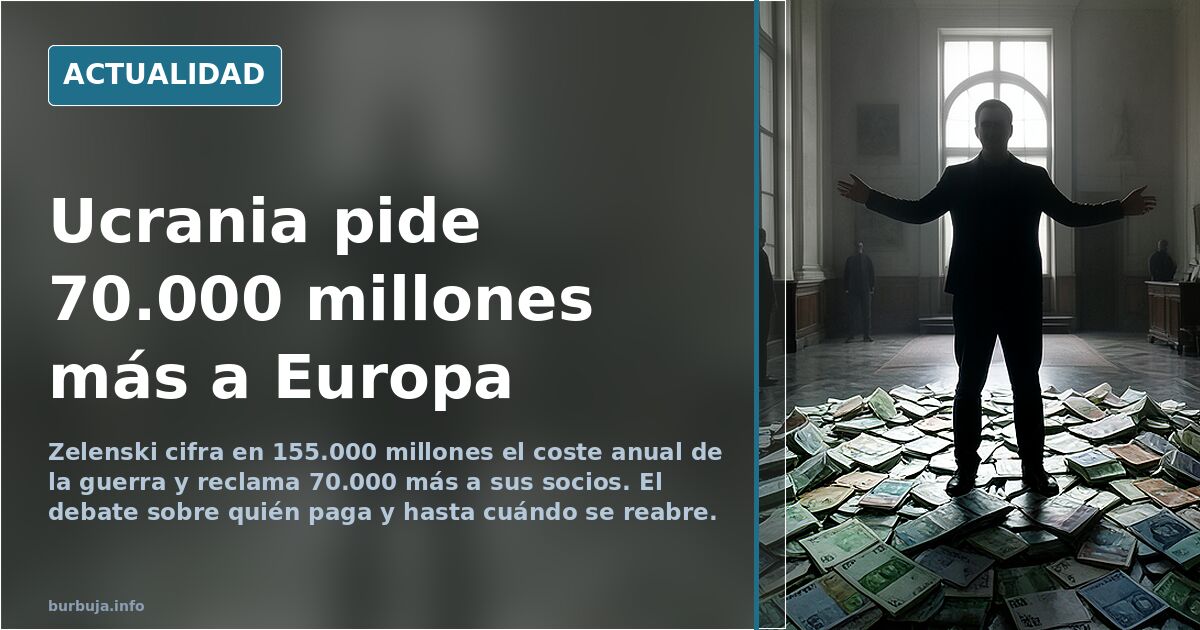
Ukraine asks Europe for 70,000 million more for 2026
Ukraine needs 155,000 million euros to sustain the war next year and is asking its European allies for at least 70,000 million more. The figure, put forward by Volodymyr Zelensky, has peine the debate over how far the EU's financial effort should go in a conflict that is not its own. The request comes at a time when national budgets are already stretched and a growing share of public opinion is starting to ask what it gets in return.
There are two ways to read the issue. The first is strategic: stopping Russia in Ukraine avoids having to do so closer to home. The second is arithmetic: 70,000 million is, for example, close to a million social housing units, according to widely circulated estimates. And that is where the political problem begins.
What the 70,000 million would fund
The money is not a one-off donation. It is spread across defence, weapons and what has come to be called resilience: keeping the Ukrainian state standing while the war continues. The total figure, 155,000 million, is equivalent to more than 10% of Spain's GDP, to give readers a sense of scale. The detail of how that spending is actually executed is what nobody has fully audited.
Some argue that part of these funds is lost to corruption. It is not a new accusation: outlets such as The Economist have published warnings about the spread of corruption in Ukraine, something Zelensky himself has acknowledged at various points. The suspicion does not make the aid useless, but it does feed the distrust of those who pay for it.
The European security argument
The official thesis is simple: if Ukraine falls, Russia will keep advancing and Europe will have to defend itself on its own soil, at a far higher cost. Seen through that lens, the 70,000 million is a cheap investment. The problem is that this logic requires an enemy willing to invade the EU, something not everyone accepts.
Part of the analysis holds that Russia has been unable to subdue Ukraine after years of war and could hardly pose a conventional threat to NATO. Another camp responds that the threat is not only military: it is one of influence, energy and political destabilisation. The disagreement is no small matter, because on it depends whether the spending is seen as insurance or as a money pit.
The opportunity cost: housing, healthcare, wages
With 70,000 million, nearly a million social housing units could be built, a figure that appears repeatedly in European public debate. It also equals several years of healthcare investment or a sizeable tax cut for middle incomes. The question is not whether Ukraine deserves aid, but whether the European taxpayer can sustain it indefinitely without anything in return.
In Spain, with a strained rental market and rising tax pressure, the opportunity-cost argument has traction. Funelling funds to a country at war is not the same as funding policies voters see as their own. Foreign policy is paid for with money that is not spent on something else.
Who decides, and with what oversight
The money comes from national budgets and European funds, but there is no clear accountability mechanism before the European Parliament. Some propose an international oversight commission; others consider any such control to be worthless paper in a war economy. Opacity is the breeding ground for hoaxes and suspicion.
Zelensky has presented the figure as a necessity, not as a negotiation. That stance strengthens his hand, but it also erodes the patience of those who foot the bill. In politics, asking for a lot while explaining little usually ends badly.
The most reasonable prediction is that Europe will end up providing a substantial share of what has been requested, though in instalments and with conditions. What is unclear is how long it can keep up that pace before public opinion in the contributing countries starts to exact a price at the ballot box.
Also available in: Deutsch
Summary of a discussion on Burbuja.info - Foro de economía, actualidad y política., translated from Spanish and reviewed before publication. Read the full discussion (51 replies).
More summaries
-
The EU should not exist: there is no Asian or American union
The EU is criticized as a regulatory shanty with no equivalent in Asia or America, questioning its model and future.
-
Tent Collecting Food for Ceuta Ends Up Eating It
Food and money collected for Ceuta migrants were consumed by organizers. The destination of the funds remains unknown.
-
Olona backs officer who pushed a teacher: "Orders must be obeyed"
Macarena Olona defends the police officer who pushed a teacher during a protest: "orders must be obeyed." The incident reopens the debate on the use of force at demonstrations.
-
Stoicism: ancient philosophy, modern paradox
Zeno's Stoicism in three periods and the paradox of calling yourself a Stoic. Philosophy or fad? Historical facts and an open debate.
-
RISC-V tops 25% market share, drawing NVIDIA, Qualcomm and ex-Intel engineers
RISC-V reaches 25% market penetration in 2025. NVIDIA backs CUDA, Qualcomm buys Ventana and ex-Intel engineers found AheadComputing. An analysis of the open-source ecosystem.
-
Spain's Interior Ministry alerts 25,000 victims about repeat abusers
Spain's Interior Ministry has alerted more than 25,000 victims that their abuser is a repeat offender. The measure, launched in 2023, has sparked debate over privacy and effectiveness.