
UK: Middle class unable to afford living alone
UK grocery costs rose 25% in two years, forcing many into caravans as single incomes no longer sustain households.
English · Original discussion in Spanish · Published
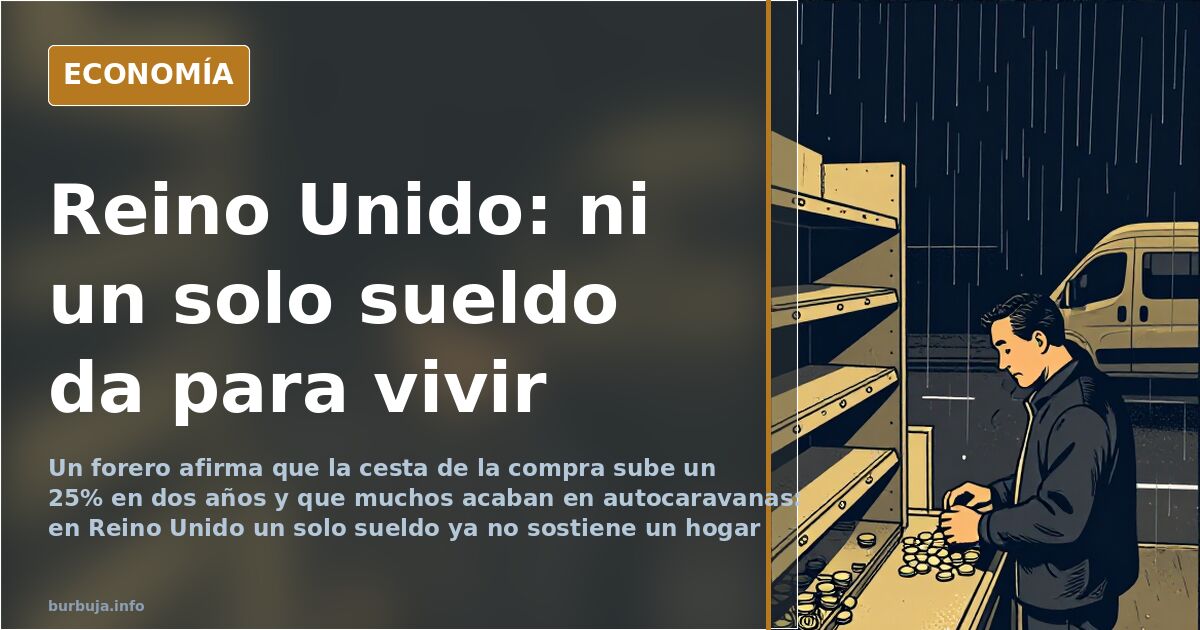
UK: The middle class that can no longer live alone
In the UK, people are leaving their homes to live in motorhomes. They are not digital nomads or retirees with free time; they are divorced individuals, people in their fifties, and workers who cannot make ends meet. The image debated on Spanish economic forums is not of a war-torn country, but of a society where a single salary no longer supports a household. And the uncomfortable question hovering over everything is: when will it happen to us?
The starting point is a video about British urban decay. From there, the analysis branches out: food inflation, unaffordable housing, stagnant wages, and a sense of decline that many place beyond Brexit.
Food prices rise 25% in two years
The most repeated data point is the shopping basket. A 25% increase in two years, according to the conversation. For a country where food spending weighs less in the family budget than in Spain, this percentage implies a direct hit to the middle class. Some compare: "We would have been happy with just 25% inflation since 2022." The irony hurts because it is true.
Housing is the other front. Prices are sky-high and rent eats up any wage increases. The result is a forced return to shared housing: nobody knows anyone who lives alone. Those who can afford independence do so in a caravan or camper van. It is a silent legion that does not appear in unemployment statistics but does appear in suburban parking lots.
Why has the British economy stagnated?
The economic diagnosis points to a fundamental problem: stagnation since the first decade of the century. The UK has failed to keep pace with Germany, the Netherlands, Scandinavia, or Ireland in innovation and productivity. Brexit, far from solving anything, has worsened the situation. Cited economic reports speak of lost competitiveness and a middle class already struggling to heat their homes or buy basics.
Immigration appears as a central theme in the British debate. The Conservative government reportedly broke records for legal entries, with intense flows especially from India. The regularization of 500,000 irregular migrants in Spain is mentioned as a factor tying Spanish residents in the UK to stay there: at least there the issue is discussed openly.
The collapse of liberal democracies
The conversation drifts toward politics. Some argue that what happens in the UK is a symptom of something broader: the exhaustion of a model. There is talk of "the collapse of Anglo-Saxon liberal democracies" and a process affecting all of the West. The thesis of decline since 1945 appears several times: the last gasps of a civilization that ceased to be an empire two centuries ago and has still not accepted it.
Against this, another current points to more earthly factors: financial economies that create no wealth, only tax imports and chain commissions. At first everyone seems to win. Then inflation arrives, purchasing power is lost, and the middle class disappears. It is a mechanism repeating in the US and half of Europe.
Oxford, the street where a homeless person dies
The most concrete anecdote comes from someone who lived in Oxford for years: recently, a homeless person died on the city's most central street. Causes unknown. This is not a newspaper headline, it is an everyday scene. In Spain, where sun and healthy food remain accessible, poverty seems less perversos than in the UK. The difference is not just economic: it is one of expectations.
The comparison with Spain appears at various points. Here we are poor, but we have been poor for longer. There, they are not yet aware they stopped being an empire. The reality check, when it comes, will be hard. And the initial question —when will it reach us?— remains unanswered.
The disorienting fact is not inflation or Brexit. It is that in the country that invented the industrial middle class, nobody in your circle lives alone.
In the UK, people are leaving their homes to live in motorhomes. They are not digital nomads or retirees with free time; they are divorced individuals, people in their fifties, and workers who cannot make ends meet. The image debated on Spanish economic forums is not of a war-torn country, but of a society where a single salary no longer supports a household. And the uncomfortable question hovering over everything is: when will it happen to us?
The starting point is a video about British urban decay. From there, the analysis branches out: food inflation, unaffordable housing, stagnant wages, and a sense of decline that many place beyond Brexit.
Food prices rise 25% in two years
The most repeated data point is the shopping basket. A 25% increase in two years, according to the conversation. For a country where food spending weighs less in the family budget than in Spain, this percentage implies a direct hit to the middle class. Some compare: "We would have been happy with just 25% inflation since 2022." The irony hurts because it is true.
Housing is the other front. Prices are sky-high and rent eats up any wage increases. The result is a forced return to shared housing: nobody knows anyone who lives alone. Those who can afford independence do so in a caravan or camper van. It is a silent legion that does not appear in unemployment statistics but does appear in suburban parking lots.
Why has the British economy stagnated?
The economic diagnosis points to a fundamental problem: stagnation since the first decade of the century. The UK has failed to keep pace with Germany, the Netherlands, Scandinavia, or Ireland in innovation and productivity. Brexit, far from solving anything, has worsened the situation. Cited economic reports speak of lost competitiveness and a middle class already struggling to heat their homes or buy basics.
Immigration appears as a central theme in the British debate. The Conservative government reportedly broke records for legal entries, with intense flows especially from India. The regularization of 500,000 irregular migrants in Spain is mentioned as a factor tying Spanish residents in the UK to stay there: at least there the issue is discussed openly.
The collapse of liberal democracies
The conversation drifts toward politics. Some argue that what happens in the UK is a symptom of something broader: the exhaustion of a model. There is talk of "the collapse of Anglo-Saxon liberal democracies" and a process affecting all of the West. The thesis of decline since 1945 appears several times: the last gasps of a civilization that ceased to be an empire two centuries ago and has still not accepted it.
Against this, another current points to more earthly factors: financial economies that create no wealth, only tax imports and chain commissions. At first everyone seems to win. Then inflation arrives, purchasing power is lost, and the middle class disappears. It is a mechanism repeating in the US and half of Europe.
Oxford, the street where a homeless person dies
The most concrete anecdote comes from someone who lived in Oxford for years: recently, a homeless person died on the city's most central street. Causes unknown. This is not a newspaper headline, it is an everyday scene. In Spain, where sun and healthy food remain accessible, poverty seems less perversos than in the UK. The difference is not just economic: it is one of expectations.
The comparison with Spain appears at various points. Here we are poor, but we have been poor for longer. There, they are not yet aware they stopped being an empire. The reality check, when it comes, will be hard. And the initial question —when will it reach us?— remains unanswered.
The disorienting fact is not inflation or Brexit. It is that in the country that invented the industrial middle class, nobody in your circle lives alone.
Also available in: Deutsch
Summary of a discussion on Burbuja.info - Foro de economía, actualidad y política., translated from Spanish and reviewed before publication. Read the full discussion (113 replies).
More summaries
-
UK's Labour Party Open to Rejoining EU, Ten Years After Brexit
Andy Burnham hints at EU re-entry in Labour's next manifesto, while Tony Blair urges abandoning Brexit's red lines.
-
Trump imposes 25% tariffs on UK, Germany, and France over Greenland
Trump imposes tariffs between 10% and 25% on the UK, Germany, and France following their refusal to cede Greenland. Analysis of economic impact and Eurozone reactions.
-
YouTube's Cuqui Family: Profiting from Junk Food and Plastics
Burbuja.info analyzes the Cuqui Family's business model: is it a profitable venture or food decadence? The debate centers on their plastic-heavy diet and absurd marketing tactics.
-
Burger King Drops Xokas Menu as McDonald's Shares Surge
McDonald's shares rose 60% after Burger King removed the controversial menu of Spanish streamer Xokas, highlighting the financial impact of influencer cancellations.
-
Spain's Transport Minister threatens Feijóo, sparking electoral fraud accusations
Óscar Puente's threat to Alberto Núñez Feijóo fuels claims of vote rigging via INDRA and the 'grandchildren law', targeting 2.5 million new voters.
-
Spain's Andalusia attracts IMEC chip hub and Pilatus aircraft plant
Andalusia secures an IMEC microchip center in Malaga and a Pilatus factory in Carmona, signaling a shift from tourism to high-tech industry.