
UK Mandatory Digital ID for Work Announced by Starmer
Starmer links work rights to a mandatory digital ID in the UK. Over 1.6 million signatures oppose it amid fears of mass surveillance.
English · Original discussion in Spanish · Published
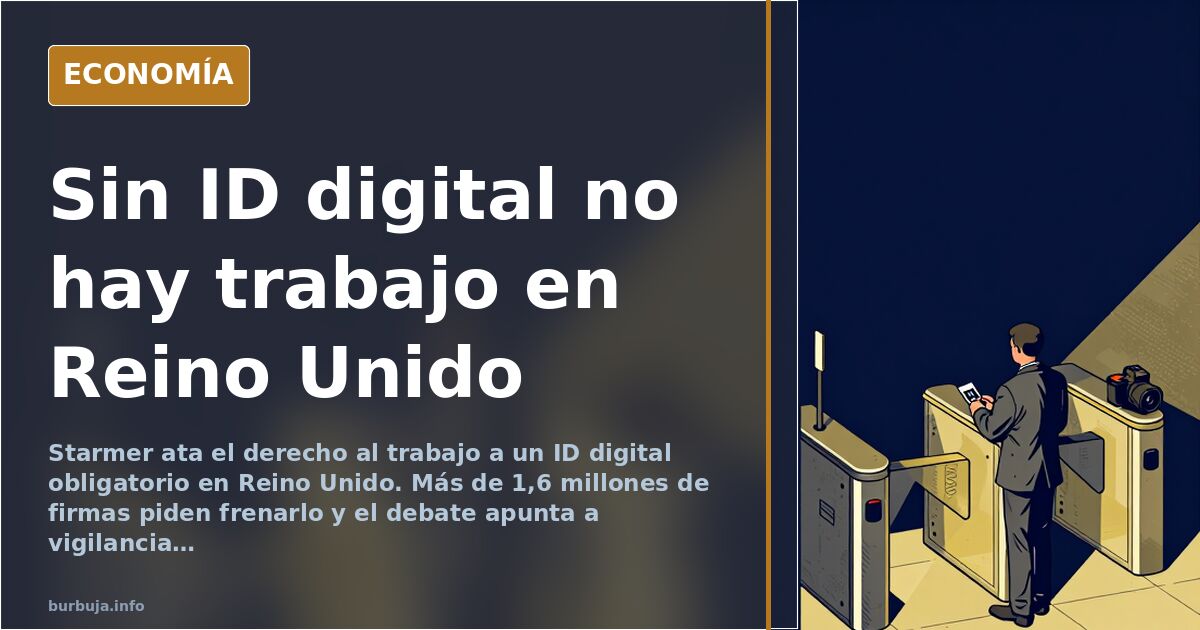
Starmer ties right to work to mandatory digital ID in UK
British Prime Minister Keir Starmer has announced the implementation of a mandatory digital identification system in the United Kingdom with an unambiguous statement: without it, you cannot work. Simple and stark. Presented as a tool against illegal immigration, the measure has triggered political turmoil in a country that has never had a standard national identity document and is accustomed to using passports, National Insurance numbers, or tax identifiers. A petition against it has already gathered over 1.6 million signatures, according to debate data, describing it as a step toward mass surveillance and digital control.
What the digital ID really implies compared to traditional IDs
The difference is not cosmetic. A magnetic stripe card fits in your wallet; this requires a personal smartphone, a paid monthly plan, sufficient memory, passwords, PINs, and multiple keys to memorize or safeguard. Losing or breaking your phone ceases to be an anecdote and becomes an administrative hurdle. The digital ID also has infinite memory and connects with everything: medical history, fiscal and financial data, online and physical purchases, social media opinions, geolocation, and facial recognition from public street cameras. The next step, technically existing but not yet legal, points to biological signals: heartbeats, body energy signature, neural activity.
Why Britons see it as an outrage
The UK lacks a tradition of a single citizenship document. There is no language academy, no single constitutional text, but a dispersed set of norms. Formalizing things is not their style. Therefore, resistance is not only technological but cultural: the idea of a state identifier conditioning employment clashes with how they understand the relationship with the State. Added to this is the context: the measure arrives during discussions on the Online Safety Act and internet content control. The suspicion that the ID will link identity and network activity — goodbye anonymity — is the most prevalent argument in analysis.
The Chinese model, CBDCs, and social credit
The underlying question is how far this will go. If the identifier is linked to a digital portfolio of administrative services and a central bank digital currency — expirable, traceable, and restrictable — the result is a social credit system granted through monitoring real and digital life. The European Central Bank has declared interest in CBDCs, and the Chinese model is the uncomfortable reference. The UK, outside the EU, can do it its way. The EU, if decided, will do it its own way. The complete calculation of what such integration would imply, item by item, is the material most circulated among those closely trinc the issue.
Gaza as a test: phone localization and SMS threats
The cited precedent is not hypothetical. In Gaza, it has been demonstrated that a phone is a locator and a loudspeaker. The Israeli army announced control over residents' terminals and live broadcasting of the prime minister's speech via this method. There was localization using data analysis tools, speakers on drones pursuing the population, and text message threats throughout the day. The lingering question is simple: how far are they willing to go? They say Gaza is the trial run.
Spain already has DNI and the debate is different
Here we are three-quarters of a century ahead, some joke: the Spanish DNI has existed since the 1950s. Without identification you cannot work, true, but the Spanish document is physical and does not depend on a smartphone. The real discussion is not whether identification is needed, but whether the digital support adds control. And here Pedro Sánchez enters: the suspicion that he will eventually apply an equivalent model, with or without prior announcement, is established. The technique of the PSOE — pretending to act — is well known. Meanwhile, millions of undocumented people still do not need to identify themselves at all.
The official argument is fighting illegal immigration. The problem, skeptics point out, is that someone crossing a border without papers is unlikely to register in a state app. The mandatory digital ID will force compliance on those who already trinc the rules. How many people are willing to resist when work depends on a code on their phone?
British Prime Minister Keir Starmer has announced the implementation of a mandatory digital identification system in the United Kingdom with an unambiguous statement: without it, you cannot work. Simple and stark. Presented as a tool against illegal immigration, the measure has triggered political turmoil in a country that has never had a standard national identity document and is accustomed to using passports, National Insurance numbers, or tax identifiers. A petition against it has already gathered over 1.6 million signatures, according to debate data, describing it as a step toward mass surveillance and digital control.
What the digital ID really implies compared to traditional IDs
The difference is not cosmetic. A magnetic stripe card fits in your wallet; this requires a personal smartphone, a paid monthly plan, sufficient memory, passwords, PINs, and multiple keys to memorize or safeguard. Losing or breaking your phone ceases to be an anecdote and becomes an administrative hurdle. The digital ID also has infinite memory and connects with everything: medical history, fiscal and financial data, online and physical purchases, social media opinions, geolocation, and facial recognition from public street cameras. The next step, technically existing but not yet legal, points to biological signals: heartbeats, body energy signature, neural activity.
Why Britons see it as an outrage
The UK lacks a tradition of a single citizenship document. There is no language academy, no single constitutional text, but a dispersed set of norms. Formalizing things is not their style. Therefore, resistance is not only technological but cultural: the idea of a state identifier conditioning employment clashes with how they understand the relationship with the State. Added to this is the context: the measure arrives during discussions on the Online Safety Act and internet content control. The suspicion that the ID will link identity and network activity — goodbye anonymity — is the most prevalent argument in analysis.
The Chinese model, CBDCs, and social credit
The underlying question is how far this will go. If the identifier is linked to a digital portfolio of administrative services and a central bank digital currency — expirable, traceable, and restrictable — the result is a social credit system granted through monitoring real and digital life. The European Central Bank has declared interest in CBDCs, and the Chinese model is the uncomfortable reference. The UK, outside the EU, can do it its way. The EU, if decided, will do it its own way. The complete calculation of what such integration would imply, item by item, is the material most circulated among those closely trinc the issue.
Gaza as a test: phone localization and SMS threats
The cited precedent is not hypothetical. In Gaza, it has been demonstrated that a phone is a locator and a loudspeaker. The Israeli army announced control over residents' terminals and live broadcasting of the prime minister's speech via this method. There was localization using data analysis tools, speakers on drones pursuing the population, and text message threats throughout the day. The lingering question is simple: how far are they willing to go? They say Gaza is the trial run.
Spain already has DNI and the debate is different
Here we are three-quarters of a century ahead, some joke: the Spanish DNI has existed since the 1950s. Without identification you cannot work, true, but the Spanish document is physical and does not depend on a smartphone. The real discussion is not whether identification is needed, but whether the digital support adds control. And here Pedro Sánchez enters: the suspicion that he will eventually apply an equivalent model, with or without prior announcement, is established. The technique of the PSOE — pretending to act — is well known. Meanwhile, millions of undocumented people still do not need to identify themselves at all.
The official argument is fighting illegal immigration. The problem, skeptics point out, is that someone crossing a border without papers is unlikely to register in a state app. The mandatory digital ID will force compliance on those who already trinc the rules. How many people are willing to resist when work depends on a code on their phone?
Also available in: Deutsch
Summary of a discussion on Burbuja.info - Foro de economía, actualidad y política., translated from Spanish and reviewed before publication. Read the full discussion (125 replies).
More summaries
-
UK's Labour Party Open to Rejoining EU, Ten Years After Brexit
Andy Burnham hints at EU re-entry in Labour's next manifesto, while Tony Blair urges abandoning Brexit's red lines.
-
Miss UK: Who Decides What Beauty Is in a Pageant
Miss UK: the crowning of its winner reignites the debate over representation, beauty, and who really funds the contests
-
Spain to mint €1.50 Mortadelo and Filemón coins in late 2026
Controversy over €1.50 Mortadelo and Filemón coins. We analyze in the forum whether it's a tribute to Ibáñez or a commercial strategy with dubious profitability.
-
Canary Islands Schools Closed Due to Extreme Heat
Schools in Spain's Canary Islands are closed on October 11 and 13 due to extreme heat. No official high-temperature protocol exists yet.
-
Spanish Royal Scandal Reignites Debate on the Crown
A photo of Queen Letizia with film director Rodrigo Cortés fuels speculation about the Spanish monarchy, highlighting institutional silence.
-
Micro-racism: Self-protection labeled as discrimination
SOS Racismo defines everyday self-protection gestures as micro-racism. The backlash reignites debate on statistics, safety, and media narratives.